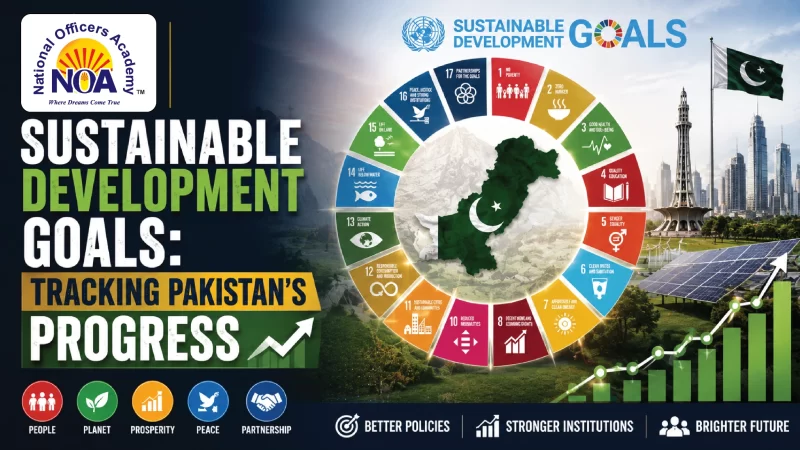
Sustainable Development Goals: Tracking Pakistan’s Progress
In 2015, all United Nations Member States collectively embraced the 2030 Agenda for Sustainable Development, establishing a universal roadmap aimed at fostering global harmony and well-being for humanity and the planet. Central to this agenda are the 17 Sustainable Development Goals (SDGs), which call upon nations to collaborate in addressing critical social, economic, and environmental challenges.
The SDGs recognize that eradicating poverty and other forms of deprivation must go hand in hand with improving healthcare and education, reducing inequality, promoting economic growth, combating climate change, and protecting oceans, forests, and ecosystems.
The implementation of the SDGs commenced worldwide in 2016 through a process often referred to as “Localizing the SDGs.” The goals cover a broad spectrum of development priorities, ranging from poverty eradication, food security, health, education, and gender equality to clean water, affordable energy, decent employment, sustainable cities, climate action, environmental protection, peace, justice, and international partnerships.
Each year, the UN Secretary-General presents a report on global SDG progress, developed in collaboration with the UN system and based on a global indicator framework, national statistical systems, and regional data.
By placing sustainability at their core, the SDGs emphasize the interconnected nature of environmental, social, and economic development. Global oversight is provided through the United Nations High-Level Political Forum on Sustainable Development (HLPF), convened with the support of the United Nations Economic and Social Council.
Pakistan’s Advancement on SDGs
Aligned with its Vision 2025, Pakistan formulated strategies corresponding with the United Nations Sustainable Development Goals to support its ambition of becoming an upper-middle-income country. However, progress on the ground has remained challenging.
Pakistan’s position in several global development indicators reflects these difficulties. The country ranked 145th out of 146 states in the 2022 Global Gender Gap Report. Its Human Development Index performance also declined, with Pakistan falling to 161st position out of 192 countries in 2022, compared with 153rd in 2021 and 154th in 2020. In 2020, approximately 38% of the population faced multidimensional poverty.
Rapid population growth represents another major obstacle to Pakistan’s sustainable development trajectory. Political instability, recurring natural disasters, weak law and order, limited public awareness, social intolerance, and entrenched cultural barriers have further constrained progress.
Although Pakistan has developed multiple frameworks and policies for achieving the SDGs, implementation has frequently fallen short of expectations. The Government of Pakistan has pursued SDG-related initiatives through the Ministry of Planning, Development and Special Initiatives, yet substantial implementation gaps continue to keep many targets distant from realization.
Pakistan’s Performance on the SDG Index
According to the 2022 Sustainable Development Goal Index, Pakistan achieved a score of 59.3 and ranked 125th, improving from 129th position previously. In the 2021 SDG Index, Pakistan ranked 129th among 165 countries with an overall score of 57.7%. Progress in climate action contributed significantly to this improvement.
Within the UN SDGs dashboard framework, Pakistan’s performance varies considerably across the 17 goals. Positive progress has been recorded in SDG 10 — Reduced Inequalities, SDG 12 — Responsible Consumption and Production, and SDG 13 — Climate Action.
Pakistan has also made progress, although below the optimal trajectory, towards SDG 6 — Clean Water and Sanitation, SDG 8 — Decent Work and Economic Growth, SDG 14 — Life Below Water, and SDG 16 — Peace, Justice and Strong Institutions.
However, progress remains stagnant across several crucial areas, including SDG 1 — No Poverty, SDG 2 — Zero Hunger, SDG 3 — Good Health and Well-being, SDG 4 — Quality Education, SDG 5 — Gender Equality, SDG 7 — Affordable and Clean Energy, SDG 11 — Sustainable Cities and Communities, SDG 15 — Life on Land, and SDG 17 — Partnerships for the Goals.
This indicates that Pakistan’s pace of advancement in many development areas remains insufficient to achieve the required targets within the intended timeframe.
Sustainable Development Goals: Shaping Pakistan’s Path Ahead
The 2030 Agenda for Sustainable Development provides countries with an integrated framework for building a more prosperous and sustainable future. Its strength lies in recognizing that progress in one development area can generate positive outcomes across several others.
Pakistan emerged as an early adopter by integrating the SDGs into its national development agenda in February 2016. This commitment represented an important institutional step towards translating the global development framework into national policy.
However, progress towards the goals suffered a major setback during the COVID-19 pandemic. The crisis disrupted livelihoods, reduced incomes, intensified inflationary pressures, and pushed vulnerable populations towards poverty. Despite these challenges, Pakistan introduced measures to manage the socioeconomic consequences of the pandemic.
Institutionalizing the SDGs
SDG units were established at both federal and provincial levels to facilitate implementation and coordination. A national framework for achieving the SDGs was also approved by the National Economic Council, the country’s apex economic decision-making forum chaired by the Prime Minister.
Since 2016, numerous policies and initiatives have been developed with particular attention to SDG 4 — Quality Education, SDG 8 — Decent Work and Economic Growth, and SDG 16 — Peace, Justice and Strong Institutions.
Pakistan’s journey towards the 2030 targets nevertheless requires sustained political commitment, stronger implementation mechanisms, institutional coordination, and continuity of development policies. The SDGs provide Pakistan with a comprehensive framework through which economic advancement can be connected with social inclusion and environmental sustainability.
Conclusion
Pakistan’s progress towards the Sustainable Development Goals presents a mixed picture. Institutional frameworks and policy commitments have been established, and progress has been recorded in selected areas such as climate action, responsible consumption, and reduced inequalities. However, poverty, hunger, education, gender inequality, population growth, governance constraints, and implementation gaps continue to impede broader advancement.
Achieving the 2030 Agenda will therefore depend not merely on adopting policies but on translating commitments into measurable outcomes. Stronger institutions, policy continuity, effective implementation, and coordinated action across federal and provincial levels will be essential if Pakistan is to transform the SDGs from an ambitious international framework into a sustainable national development pathway.