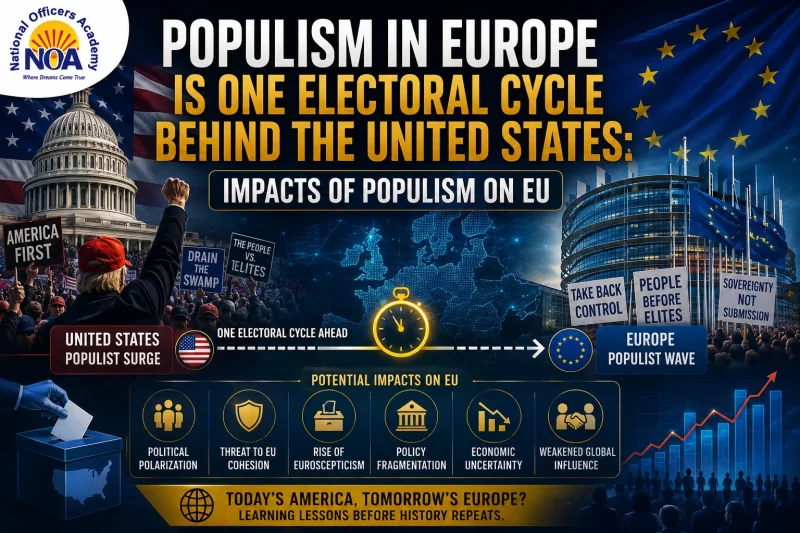
Populism in Europe is One Electoral Cycle Behind the United
States: Impacts of Populism on EU
Written By: Saad Nawaz
“The crisis consists precisely in the fact that the old is dying and the new cannot be born; in this interregnum a great variety of morbid symptoms appear.” Antonio Gramsci
Populism is reshaping the continental Europe as it actively turns the trajectory of politics away from liberal internationalism to nationalist isolationism. This populism is not entirely indigenous as it is a phenomenon being strengthened by a foreign blueprint. Thus, it is best understood as a strong, two-stage mechanism. Trump 2.0 serves as an inspiration to the anti-elite consensus in Europe. The idea is to transform post-Cold War Europe—based on neoliberalism—into a sovereignty first project—based on nationalism and anti-integration. As nationalists in European countries cement their popularity, it ensures that populism is not seen as a threat rather a legitimate position within the governance of European Union.
The 2016 U.S. presidential election proved that populist politics could win. This event acted as a clear sign for Europe. The continent then experienced similar, strong results about one election cycle later. This was seen with the final steps of Brexit and the growing power of far-right parties in nations like Italy and France around 2019. These European political shifts directly mirrored the anger about globalisation and immigration that fuelled American voters. This timing confirms a clear pattern: major political trends often move from the United States to Europe, showing that the one-cycle lag is a useful way to track the spread of populism.
The political structure of Europe changes how fast populism spreads. The U.S. operates as one large political body, so a populist wave hits the nation at once. Europe, in contrast, is a union of twenty-seven sovereign states. A populist movement must first capture power in a capital city like Paris, London or Budapest. The trend then spreads unevenly, nation by nation. Because of this fragmentation, the trend is broken up across different political systems before it can truly challenge the central authority in Brussels. This complex path means the European delay is less of a simple lag and more of a slow, complicated process.
Despite the differences in speed and structure, both the U.S. and European populist movements share the same root causes. Economically, large groups of people in both places feel left behind by globalisation. They worry about job losses and falling wages. Culturally, there is a strong pushback against rapid social change and increased immigration. These twin anxieties—economic worry and cultural fear—create a single fuel for populism on both sides of the Atlantic. Therefore, the European lag is not a different phenomenon; it is the same powerful force acting on a slower system.
Digital media platforms quickly move populist arguments from the U.S. to Europe. While voting results show a time lag, the sharing of political ideas happens almost instantly. European populist parties now copy U.S. campaign tactics and rhetoric without delay. This means the time lag exists only in election timing, not in the spread of ideas. The internet turns the physical distance between continents into a shared political space, making these international movements feel strongly connected.
The one-cycle lag offers European leaders a unique benefit: they can study the negative consequences of U.S. populism before those trends fully reach Europe. This allows them to prepare their own defenses and counter-strategies. For example, they can see how a populist government manages trade or international alliances. This warning system helps European media and political parties prepare their voters for the coming challenges. While they cannot stop the underlying social trends, this time advantage allows the mainstream parties to better frame the debate and adjust their own policies accordingly.
European populist parties directly challenge the most fundamental legal and financial structures of the EU. Unlike U.S. populism, which largely works within a single national system, European populism attacks the idea of shared laws. For example, governments in Poland and Hungary have openly fought with the European Commission over the independence of their courts. This conflict is a fight over whether EU law is supreme over national law. These actions seriously damage the EU’s ability to act as a unified legal entity and control its budget across all member states.
While populist governments challenge the EU, the Union’s deep administrative system acts as a powerful defense against immediate failure. The EU is not governed by a single, simple act; it runs on thousands of complex treaties, directives, and rules. This heavy bureaucracy makes quick, radical change nearly impossible, even if a major country’s government is populist. The process for changing treaties or removing EU power is so slow and requires so much agreement that it prevents a single national political wave from instantly destroying the EU’s structure. The complexity of the system provides a structural inertia that protects it from short-term political shock.
The structural defence of the EU does not mean it is unharmed by the populist attack. Instead, the result is a slow and constant erosion of authority. When member states ignore EU law, they weaken the entire system over time. This continuous pressure harms the EU’s global image and its ability to act decisively in crises. For instance, repeated blocking of joint foreign policy statements by one member state prevents the EU from being a strong, unified global player. The outcome is not sudden death, but rather a slow, continuous loss of trust and operational effectiveness.
Populism strongly focuses on the fight between a nation’s right to rule itself and the central authority of the EU in Brussels. Populist leaders argue that Brussels takes away local power and forces countries to follow rules they did not agree to. This narrative is effective because many citizens feel distant from the
EU’s decision-making. This argument is not just theoretical; it drives major policy clashes, especially over migration policy, where populist governments refuse to accept the quotas or rules set by the EU Commission. This makes the power struggle the central theme of populist politics in Europe.
The most extreme form of nationalist protest was Brexit, where the United Kingdom chose to leave the EU entirely. However, most current European populist movements have a different goal. They no longer focus on leaving, or “exit”, but on changing the EU from within. Leaders want to keep the economic benefits of the single market while getting back more political control. This strategy creates a new, complex challenge for the EU: it must now deal with members who are trying to weaken the union through cooperation rather than by simply walking away. This internal weakening is harder to fight than an external threat.
Following U.S. political debates, European populism is now moving away from just immigration and economic arguments. New populist movements are focused on social and cultural themes, often relating to climate change and environmental policies. For example, some farmer protests across Europe have quickly gained support by framing environmental rules as attacks on their national way of life and sovereignty. This new front of the culture war challenges the EU’s core agenda, which prioritises the Green Deal. These shifts show the populist trend is constantly adapting, not stopping.
To prevent losing all support, mainstream European parties are adapting to the populist challenge. They are taking on some of the popular themes that populists champion. This is clear in the area of migration, where center-right governments across Europe have moved toward stricter border controls and tougher asylum rules. This strategy aims to bring back voters who might otherwise choose a far-right party. While this helps the mainstream parties survive elections, it ultimately means the EU’s overall policy direction is pulled further right, fulfilling populist goals through established political actors.
The most damaging long-term effect of the populist cycle is not the collapse of the EU, but the slow loss of its core liberal values. The EU was founded on principles like open borders, deepening free trade, and the supremacy of human rights. When mainstream parties adopt stricter policies to counter populist threats, they move the Union away from these founding principles. This change means the EU will survive structurally, but its identity will change. It becomes a more closed, more cautious entity, prioritising security and national control over the original ideals of deep integration and openness.
The internal turmoil caused by populism paradoxically forces the EU to become stronger and more unified on the global stage. Facing challenges from both the U.S. and rising powers like China, the EU is pushed to be more independent. This pressure accelerates cooperation on crucial issues like defense policy and technology regulation. For example, the EU’s response to geopolitical instability has led to unprecedented joint military funding. The existential threat from within makes the EU realise it must be a self-reliant global power to survive.
The European Union will likely survive the current wave of populism, but its future will be defined by constant compromise. The EU has proven structurally resilient, capable of absorbing shocks and adapting to the one-cycle lag. However, the continuous internal fighting means it operates based on the lowest common denominator, not on shared goals. The resulting entity is structurally stable but ideologically weakened. It maintains economic unity and increased global autonomy, but it sacrifices its original, ambitious liberal vision. The EU becomes a transactional union, focused more on managing differences than achieving true political integration.
European populism follows the U.S. trend by one electoral cycle, which offers the European Union a clear, though limited, window for necessary reforms. However, the EU’s decentralised structure prevents it from quickly using this advantage due to constant internal disagreements. The Union’s large bureaucracy successfully protects it from sudden collapse, yet the constant populist pressure forces mainstream parties to adopt more nationalist policies. This results in the EU’s survival as a structurally stable entity, but one that is ideologically weakened, sacrificing its core liberal values for the sake of political agreement. The EU emerges as a strong global player in areas like defense, but operates as a transactional union built on managing differences rather than integrating deeply. What remains to be seen is that will a union formed on shared principles of liberalism, liberty, and economic freedom give up on its foundational values to ensure its survival. If yes, then will such a union be equipped for long-term management of possible future predicaments including existential ones.
“The only thing necessary for the triumph of evil
is for good men to do nothing.” Edmund Burke