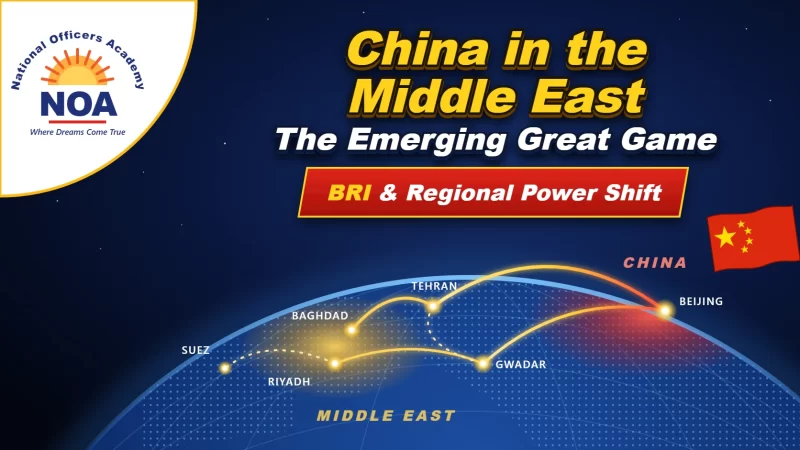
Emerging Great Game in the Middle East
China Flexing Her Economic Muscle
The Middle East has remained trapped in prolonged geopolitical rivalry, proxy conflicts and ideological confrontation.
Although these rivalries are frequently presented through the lens of religious and sectarian divisions, political influence, economic interests and strategic competition remain central drivers.
The region has repeatedly witnessed conflicts whose effects extend far beyond national borders.
Its politics are therefore highly interconnected: a crisis in one country can quickly generate consequences across the wider Middle East.
The Arab Spring demonstrated this interconnectedness when unrest originating in Tunisia spread across much of the region.
A new dimension has now emerged in this strategic environment: China’s expanding economic and diplomatic presence.
As the United States seeks to reduce some of its direct involvement in the Middle East after decades of military engagement, Beijing is steadily expanding relationships with both American allies and rivals.
The source highlights visits by senior officials from major Arab states to China to explore cooperation in:
- Energy
- Infrastructure
- Trade
- Investment
Iran has similarly looked towards Beijing for large-scale investment, while Türkiye has explored deeper economic cooperation.
The result is an emerging strategic game involving regional rivals such as Saudi Arabia and Iran alongside major external actors including the United States and China. :chatgpt-content-reference{index=”1″}
The Middle East Conundrum – What Went Wrong?
The Middle East possesses some of the world’s largest hydrocarbon resources, but it is also characterised by intense geopolitical rivalry.
One of the most important regional competitions is between:
- Saudi Arabia
- Iran
Their rivalry is frequently framed through the Sunni-Shia divide, but the source argues that the underlying contest is fundamentally political and strategic.
Both states seek greater regional influence.
Proxy Warfare as the Centre of Gravity
Proxy politics has become one of the defining features of Middle Eastern rivalry.
Iran has developed relationships with allied groups and political actors in:
- Iraq
- Syria
- Lebanon
- Yemen
Saudi Arabia has also supported partners and governments that align with its strategic interests.
These competing networks have transformed local conflicts into broader regional struggles.
Yemen – A Major Saudi-Iranian Flashpoint
Yemen represents one of the clearest manifestations of the regional rivalry.
The Houthis have fought against the internationally recognised Yemeni government.
The source presents Iran as supporting the Houthis politically, economically and militarily, while Saudi Arabia supports the government.
The conflict has therefore become a major theatre of Saudi-Iranian competition.
Both sides have also exploited sectarian narratives to advance broader political objectives.
The result has been devastating for civilians.
Yemen has suffered from:
- War
- Displacement
- Food insecurity
- Shortages of medicine
- Political instability
The source describes the struggle as a geopolitical contest whose humanitarian consequences have been severe. :chatgpt-content-reference{index=”2″}
Everyone Wants a Share in the Pie – Why the Middle East Matters
The Middle East remains one of the most strategically important regions in the world.
The Persian Gulf contains an enormous share of global hydrocarbon reserves.
This gives the region exceptional importance for:
- Global oil markets
- Natural-gas supplies
- Energy security
- International trade
The region also contains several globally significant maritime chokepoints.
Strait of Hormuz
The Strait of Hormuz is one of the world’s most strategically important energy routes.
Its geographical proximity to Iran provides Tehran with an important strategic advantage.
Any serious confrontation in the Persian Gulf can threaten:
- Oil shipments
- Global energy prices
- Maritime trade
- Relations among Iran, Saudi Arabia and the United States
Suez Canal and Global Trade
The Middle East is important not only because of oil and gas.
Major international trade routes also pass through the region.
The source refers to the blockage of the Suez Canal as an example of how disruption at a single strategic chokepoint can affect global trade.
This demonstrates the wider strategic importance of Middle Eastern geography. :chatgpt-content-reference{index=”3″}
Militias and Weak State Structures
The Middle East is also characterised by a strong presence of armed non-state actors.
Weak institutions in several states provide opportunities for regional and external powers to compete through:
- Proxy groups
- Armed militias
- Political factions
- Economic influence
This environment creates strategic opportunities for outside powers seeking influence.
As the US Pulls Back, China Leans In
China has significantly expanded its economic relationships across the Middle East.
Its involvement includes:
- Infrastructure investment
- Energy cooperation
- Technology partnerships
- Trade
- Security cooperation
The Middle East has always been important to Beijing because China requires large and reliable energy supplies to sustain its economic growth.
The source notes that a substantial share of Chinese petroleum imports comes from Arab states, with Saudi Arabia being particularly important.
China’s Growing Energy Dependence
As China’s economy expands, its requirement for imported hydrocarbons also increases.
This makes stable relationships with Middle Eastern energy producers strategically important.
China therefore seeks long-term relations with states capable of supplying:
- Oil
- Natural gas
- Petrochemical products
Middle Eastern States Looking Beyond Washington
The source argues that some Middle Eastern states increasingly view China not simply as an energy customer but also as a potential partner in:
- Infrastructure
- Technology
- Investment
- Security cooperation
This trend may intensify if regional governments perceive the United States as becoming less engaged.
The American military withdrawal from Afghanistan and formal conclusion of its combat mission in Iraq contributed to concerns among some regional partners regarding Washington’s long-term priorities.
At the same time, US strategic focus has increasingly shifted towards competition with China.
China’s Diplomatic Model in the Middle East
Beijing generally presents itself as a partner focused on:
- Economic cooperation
- Trade
- Infrastructure
- Non-interference
The source contrasts this approach with the political and military interventions historically associated with Western powers.
China also develops relations with governments that face criticism or sanctions from the United States.
This provides Beijing with access to partners that may seek alternatives to Western financial and diplomatic pressure. :chatgpt-content-reference{index=”4″}
BRI Comes to the Middle East
The Middle East has become increasingly important to China’s Belt and Road Initiative.
Chinese state-owned enterprises have pursued or supported infrastructure projects in several strategically important locations.
The source mentions Chinese involvement or interest in:
- Chabahar in Iran
- Duqm Port in Oman
- Container facilities in Abu Dhabi
- Ports in Israel
These investments reflect Beijing’s view of the Middle East as an important bridge connecting Asian, African and European markets.
The “String of Pearls” Logic
The source describes China’s expansion in terms of a growing network of strategic and commercial nodes extending from China towards the Indian Ocean and wider Middle East.
Through the Belt and Road Initiative, Beijing seeks to connect:
- Ports
- Markets
- Supply chains
- Energy routes
- Transport corridors
This infrastructure increases China’s economic reach and provides greater security for trade and energy supplies.
China’s Middle East Strategy
The source identifies three major objectives behind China’s growing engagement in the region.
1. Expand Political Influence
China seeks to increase its diplomatic influence and challenge the predominance traditionally enjoyed by the United States.
2. Secure Continuous Energy Supplies
Stable access to Middle Eastern energy is essential to maintaining Chinese economic growth.
3. Expand the Belt and Road Initiative
Middle Eastern participation is important for transforming BRI into a genuinely global connectivity network. :chatgpt-content-reference{index=”5″}
Economic Engagement Brings Political Benefits
Although China’s principal objectives in the Middle East are economic, deeper economic ties also generate political advantages.
States that depend heavily on Chinese:
- Investment
- Trade
- Energy purchases
- Infrastructure finance
may become more reluctant to confront Beijing on politically sensitive issues.
The source points to the limited criticism from many Middle Eastern governments concerning:
- Hong Kong
- Taiwan
- Xinjiang
as evidence of the political benefits generated by strong economic relationships.
Impacts of China’s Expanding Role
China’s deeper involvement could significantly alter the strategic balance of the Middle East.
The region is already highly vulnerable because of:
- Weak state structures
- Powerful non-state actors
- Sectarian polarisation
- External interventions
- Political transitions
These conditions have repeatedly contributed to conflict and instability.
Chinese Economic Engagement as an Opportunity
The source presents China’s economic approach as potentially beneficial because it focuses heavily on development and infrastructure.
Middle Eastern states can benefit from:
- Long-term Chinese demand for oil and gas
- Infrastructure investment
- Trade integration
- Industrial development
- BRI connectivity
China also maintains relationships with governments that remain isolated from the United States.
Syria, for example, joined the Belt and Road Initiative despite remaining under Western sanctions.
Iran has similarly become increasingly dependent on China after the re-imposition of US sanctions following Washington’s withdrawal from the nuclear agreement.
China’s Policy of Non-Intervention
The source highlights China’s stated preference for non-interference in the domestic politics of partner countries.
This makes Beijing attractive to governments that prefer economic cooperation without demands concerning:
- Political reform
- Governance
- Human rights
However, deeper economic involvement may ultimately make complete political neutrality difficult.
As Chinese assets and citizens increase across the region, Beijing may eventually face greater pressure to become involved in regional security and political disputes. :chatgpt-content-reference{index=”6″}
Can China Remain Neutral Forever?
The source argues that China cannot remain entirely detached from regional security issues if it intends to become a truly global power.
Large investments create strategic interests that eventually require protection.
China may therefore gradually move from:
- Geo-economics
towards a combination of:
- Geo-economics
- Diplomatic influence
- Security engagement
- Geostrategy
This could transform Beijing from a primarily economic actor into a much more influential political stakeholder.
How Is Pakistan Involved?
Pakistan occupies an important position in China’s wider Central and South Asian strategy.
Its significance arises largely from geography.
Pakistan can provide China with a gateway towards the energy-rich Persian Gulf and the Middle East.
This role is reinforced by the China-Pakistan Economic Corridor.
Pakistan as China’s Gateway to the Middle East
Through Pakistan, China can strengthen connectivity between:
- Western China
- Arabian Sea
- Persian Gulf
- Middle Eastern markets
Pakistan therefore has the potential to support China’s transition from primarily economic influence towards broader strategic engagement in the region.
Gwadar and Chabahar
The source highlights the strategic significance of both:
- Gwadar
- Chabahar
Greater economic cooperation could potentially allow these ports to complement rather than simply compete with one another.
Improved connectivity could also support wider regional trade and energy cooperation.
Iran-Pakistan Energy Cooperation
The source also suggests that deeper regional economic integration could improve prospects for projects such as the Iran-Pakistan gas pipeline.
Such cooperation could strengthen Pakistan’s energy security while connecting the country more deeply with regional economic networks.
Pakistan’s Sectarian Vulnerability
Pakistan must approach Middle Eastern rivalries with extreme caution.
Its own population includes large Sunni and Shia communities.
A strong alignment with either Saudi Arabia or Iran could therefore create serious internal consequences.
The source warns that involvement in the Saudi-Iranian rivalry could bring sectarian tensions into Pakistan.
Potential consequences include:
- Polarisation
- Religious extremism
- Violence
- Domestic instability
Pakistan as a Mediator
Pakistan has frequently attempted to maintain balanced relations with both Saudi Arabia and Iran.
Rather than entering the regional rivalry directly, Islamabad has sought opportunities to promote dialogue and mediation.
This approach protects Pakistan from becoming trapped in Middle Eastern sectarian competition.
China Creates a Geo-Economic Opportunity for Pakistan
China’s growing engagement with the Middle East creates opportunities for Pakistan to expand economic relations with the region.
Pakistan can potentially benefit through:
- CPEC
- Regional trade
- Energy cooperation
- Port connectivity
- Infrastructure
This could allow Islamabad to pursue a more geo-economic role without becoming directly involved in the strategic rivalry between Riyadh and Tehran. :chatgpt-content-reference{index=”7″}
The Emerging Great Game
The strategic contest in the Middle East is no longer limited to regional actors.
It increasingly includes:
- Saudi Arabia
- Iran
- United States
- China
- Russia
Each actor possesses different instruments of power.
Saudi Arabia and Iran rely heavily on regional partnerships and proxy influence.
The United States retains enormous military and diplomatic capability.
Russia has expanded its security role in conflicts such as Syria.
China, by contrast, has relied primarily on economic power.
China’s Economic Muscle as Strategic Power
China’s most important advantage lies in its ability to offer:
- Investment
- Infrastructure
- Trade
- Long-term energy demand
- Diplomatic cooperation
This allows Beijing to build influence without initially relying on large-scale military intervention.
The model therefore differs significantly from traditional great-power involvement in the region.
Possible Consequences for the United States
China’s expanding presence creates a strategic challenge for Washington.
The United States has historically been the most influential external power in the Middle East.
If regional states deepen their economic dependence on China, American political leverage may gradually weaken.
However, Chinese economic influence still remains different in scale and character from the extensive US military and security presence.
Risks of Great-Power Competition
The involvement of additional major powers can create new opportunities but also new risks.
1. Greater Polarisation
Regional states may face pressure to balance relations among China, Russia and the United States.
2. Strategic Competition
Infrastructure and energy projects could increasingly become part of wider geopolitical rivalry.
3. Security Entanglement
China may eventually become more deeply involved in security disputes as its economic interests expand.
4. Regional Arms and Alliance Politics
External competition can reinforce existing rivalries among Middle Eastern states.
Opportunities for the Middle East
China’s economic expansion can also create opportunities.
Infrastructure Development
BRI projects can support ports, logistics, industrial zones and transport infrastructure.
Energy Market Stability
China provides Middle Eastern exporters with a large and growing market for hydrocarbons.
Economic Diversification
Chinese investment can support sectors beyond traditional energy exports.
Multiple Foreign Partnerships
Middle Eastern states can diversify international partnerships instead of depending exclusively on Western powers.
Way Forward for Pakistan
1. Maintain Neutrality in Saudi-Iran Rivalry
Pakistan should avoid becoming part of sectarian or proxy competition.
2. Continue Mediation
Islamabad should use its relations with Riyadh and Tehran to promote dialogue.
3. Expand Geo-Economic Cooperation
Pakistan should connect CPEC with wider Middle Eastern trade and investment networks.
4. Improve Energy Connectivity
Regional energy projects should be pursued where politically and economically feasible.
5. Strengthen Gwadar
Gwadar can become an important node linking China, Pakistan and Middle Eastern markets.
6. Avoid Sectarian Spillover
Foreign policy should remain sensitive to Pakistan’s internal social and religious diversity.
Conclusion
The Middle East is entering a new phase of geopolitical competition.
Traditional rivalries between Saudi Arabia and Iran remain central, but the growing involvement of external powers is changing the strategic environment.
The United States continues to possess enormous security influence, while Russia remains important in selected conflicts and China is rapidly expanding its economic footprint.
Beijing’s strategy differs from traditional military intervention.
It emphasises infrastructure, energy trade, investment, ports and Belt and Road connectivity.
These relationships are already generating political benefits and could eventually push China towards a more direct diplomatic and security role.
For Middle Eastern states, China offers a large energy market and an additional source of investment.
For Pakistan, the shift creates opportunities to act as a gateway connecting China with the Persian Gulf while expanding regional trade and energy cooperation.
However, Islamabad must avoid becoming entangled in the Saudi-Iran rivalry because sectarian spillover could have serious domestic consequences.
The emerging Great Game in the Middle East is therefore increasingly being fought not only through military alliances and proxy wars, but also through ports, pipelines, investment, trade and infrastructure. China’s economic muscle is becoming a major new instrument of power in a region long dominated by conventional geopolitics.