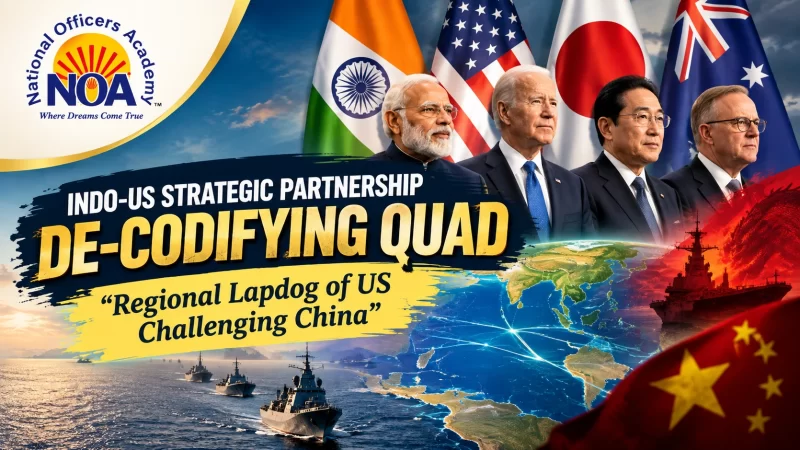
Indo-US Strategic Partnership: De-Codifying QUAD
The Indo-US strategic partnership has emerged as an important feature of the changing strategic landscape of the Indo-Pacific. One of its major multilateral dimensions is the Quadrilateral Security Dialogue, or QUAD, comprising India, the United States, Japan and Australia. The grouping presents itself as supporting a free, open, prosperous and resilient Indo-Pacific, while its agenda now extends beyond traditional security into areas such as emerging technologies, infrastructure, cybersecurity, climate and maritime awareness. Current official Indian material similarly describes the Quad as a four-country grouping with a practical agenda covering health security, climate change, critical technologies, infrastructure, cybersecurity and maritime-domain awareness.
At the same time, the deepening India-US relationship has acquired particular strategic significance because of China’s growing economic and military influence in the Indo-Pacific. Defence cooperation, military interoperability and technology-sharing have therefore become prominent components of bilateral ties.
Indo-US Strategic Partnership: Beyond QUAD
The roots of contemporary Indo-US strategic cooperation can be traced to the gradual improvement in bilateral relations beginning in the late 1990s and early 2000s. The partnership gained further momentum with the 2005 civil nuclear initiative and subsequent expansion of defence and technology cooperation.
Several agreements and institutional mechanisms have strengthened defence relations between India and the United States.
Major Defence Partner Status
In 2016, the United States designated India as a Major Defense Partner, providing a framework for deeper defence cooperation and access to advanced technologies. India was later elevated to Strategic Trade Authorization Tier 1 status in 2018.
Logistics Exchange Memorandum of Agreement
The Logistics Exchange Memorandum of Agreement (LEMOA), signed in 2016, facilitated reciprocal logistics support between the armed forces of India and the United States.
COMCASA
The Communications Compatibility and Security Agreement (COMCASA) was signed in 2018. It facilitates secure communications and access to certain advanced defence systems and technologies.
BECA
The Basic Exchange and Cooperation Agreement (BECA) further expanded bilateral information-sharing, including geospatial cooperation relevant to military planning and navigation. The agreement was formally signed during the third India-US 2+2 Ministerial Dialogue in 2020.
These agreements have contributed to closer interoperability between the two militaries and form part of a broader defence relationship encompassing exercises, intelligence-sharing, technology and maritime cooperation.
QUAD and the Rise of Indo-US Security Cooperation
The QUAD has increasingly become an important platform for cooperation among India, the United States, Japan and Australia. The grouping was revived at the officials’ level in 2017 and was elevated to the leaders’ level in 2021.
Security cooperation among the four countries is visible in their participation in military exercises, particularly the Malabar naval exercises. Originally a bilateral India-US exercise, Malabar later included Japan and subsequently Australia. The exercises have contributed to greater familiarity and interoperability among participating forces.
The four countries also participate in a variety of bilateral and multilateral exercises, including:
Malabar naval exercises
India-Australia AUSINDEX exercises
Japan-India JIMEX exercises
Rim of the Pacific, or RIMPAC, exercises
The cooperation has also expanded into newer areas such as cyber defence, space, maritime-domain awareness and defence technology.
I2U2: A New Regional Arrangement
Alongside the Quad, another grouping involving India and the United States emerged in West Asia: I2U2, comprising India, Israel, the United Arab Emirates and the United States.
The grouping focuses primarily on economic cooperation, infrastructure, technology, transportation, food security and related areas. The source article presents I2U2 as another example of India’s increasing participation in smaller multilateral arrangements supported by Washington.
Such arrangements demonstrate how India-US cooperation increasingly extends beyond South Asia and the Indo-Pacific into wider regional frameworks.
QUAD in the Context of US-China Strategic Competition
The rise of China has become an important element of strategic debate surrounding the Quad. The article places the grouping within the wider framework of Sino-US strategic competition, arguing that Washington has developed closer partnerships with states around China’s maritime periphery.
Relations between China and individual Quad members have also experienced periods of tension. These include:
China-India border disputes
China-Japan maritime disputes
Australia-China political and economic tensions
Intensifying US-China strategic competition
The extent to which the Quad should be characterized primarily as a China-balancing mechanism remains contested. Quad governments officially describe the grouping in broader terms, emphasizing regional public goods, resilience, maritime cooperation, critical technologies and a free and open Indo-Pacific.
QUAD Summit 2022: Major Areas of Discussion
The fourth Quad Leaders’ Summit was held in Tokyo on 24 May 2022. According to the source article, discussions included developments in the Indo-Pacific, maritime security, the East and South China Seas, the Korean Peninsula, Myanmar, Afghanistan, climate change and post-pandemic challenges.
The summit reflected the expanding scope of the grouping from traditional strategic concerns to wider political, economic and transnational challenges.
QUAD and the Regional Political Dilemma
Each Quad member participates in the grouping according to its own strategic and national interests. At the same time, concerns about China’s regional influence remain a significant part of debates surrounding the grouping.
The source article argues that closer coordination among the four members could intensify regional strategic competition and generate reactions from China.
For this reason, the Quad is often discussed through two competing lenses: one portraying it as a practical mechanism for regional cooperation, and another viewing it as part of the strategic balancing taking place amid US-China rivalry.
Implications of QUAD for Pakistan
The expansion of Indo-US defence cooperation and India’s participation in the Quad have important implications for Pakistan, particularly because of the existing strategic rivalry between India and Pakistan.
Growing Indian Role in the Indian Ocean
The article identifies India’s expanding influence in the Indian Ocean Region as a central Pakistani concern. Pakistan depends heavily on maritime trade and therefore places considerable importance on secure sea lines of communication and access to its ports.
Strategic Balance in South Asia
Advanced defence technology, intelligence-sharing and military interoperability between India and the United States could affect perceptions of the regional balance of power. The source article argues that such developments may increase Pakistani concerns regarding India’s military capabilities.
Pakistan-China Strategic Cooperation
The changing regional environment may also reinforce Pakistan’s strategic relationship with China. The China-Pakistan Economic Corridor, wider Belt and Road Initiative, defence cooperation and diplomatic engagement are important components of this relationship.
Relations with the United States
Pakistan simultaneously has an interest in maintaining functional relations with Washington while managing the consequences of increasingly close US-India ties. This creates a complex diplomatic environment in which Islamabad must engage major powers without reducing its foreign policy exclusively to bloc politics.
What Policy Options Does Pakistan Have?
The source article proposes that Pakistan should strengthen its ability to respond to changing maritime and strategic conditions while maintaining relations with different regional and global actors.
Possible areas of focus include:
Strengthening maritime security and naval capacity
Protecting Pakistan’s Exclusive Economic Zone
Ensuring the security of sea lines of communication
Developing the country’s blue-economy potential
Maintaining bilateral engagement with Quad member states
Deepening cooperation with regional organizations
Managing relations with both the United States and China
Avoiding unnecessary dependence on any single strategic bloc
Conclusion
The Indo-US strategic partnership has developed into a broad relationship encompassing defence, technology, trade, maritime security and regional diplomacy. Defence-enabling agreements such as LEMOA, COMCASA and BECA have strengthened bilateral military cooperation, while the Quad provides an additional multilateral platform linking India and the United States with Japan and Australia.
For Pakistan, these developments raise questions concerning the balance of power in South Asia, maritime security and the growing strategic role of India in the Indian Ocean. At the same time, the Quad’s publicly stated agenda extends considerably beyond military cooperation into technology, infrastructure, climate, health and maritime awareness.
Pakistan’s policy challenge is therefore to protect its strategic and economic interests while maintaining productive relations with major powers and strengthening its own economic, maritime and diplomatic capabilities.