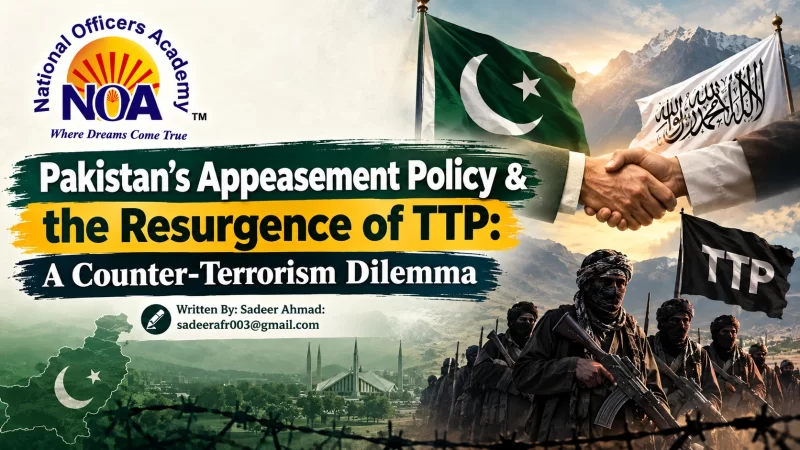
Pakistan’s Appeasement Policy & the Resurgence of TTP
A Counter-Terrorism Dilemma
Written By: Sadeer Ahmad
The appeasement policy of the Pakistani government towards the militant group Tehrik-i-Taliban Pakistan (TTP) has been widely debated in the country’s counter-terrorism discourse.
Introduction
Since August 2021, Pakistan has experienced a significant increase in militant violence associated with the TTP.
The Pakistani state pursued several measures, including:
- Negotiations with the TTP
- Ceasefire arrangements
- Release of some prisoners
- Efforts towards reconciliation
- Possible amnesty for militants accepting the Constitution
The TTP and Its Resurgence
Tehrik-i-Taliban Pakistan formally emerged in December 2007 as an umbrella organisation comprising several militant factions.
Afghan Taliban Takeover and TTP Revival
The return of the Afghan Taliban to power in August 2021 significantly altered the regional security environment.
Pakistan’s Appeasement Policy
Appeasement broadly refers to resolving disputes through negotiation, compromise and concessions instead of armed confrontation.
Major Negotiation Attempts
- 2014 peace talks
- 2021 ceasefire
- 2022 negotiations through tribal representatives
Consequences for Pakistan’s Counter-Terrorism Strategy
1. Giving the TTP Space to Regroup
Critics argued that ceasefires and negotiations provided the organisation with opportunities to reorganise and strengthen its presence.
2. Increasing Militant Activity
The breakdown of ceasefire arrangements was followed by renewed militant attacks.
3. Weakening Public Confidence
Repeated negotiations created concerns regarding the state’s ability to enforce its writ.
Way Forward
Strengthen Intelligence-Based Operations
Pakistan should prioritise targeted and intelligence-driven operations instead of relying exclusively on large-scale military campaigns.
Modernise Law-Enforcement Capabilities
- Modern surveillance systems
- Improved intelligence-sharing
- Better protective equipment
- Specialised counter-terrorism training
- Strong forensic capabilities
Address the Root Causes of Extremism
- Poverty
- Unemployment
- Weak governance
- Educational deprivation
- Radicalisation
- Political exclusion
Conclusion
Pakistan’s experience with the TTP demonstrates that counter-terrorism cannot rely on either negotiations or military force alone.
A sustainable strategy requires security operations, political consensus, diplomacy, institutional capacity, governance reforms and socioeconomic development working together.