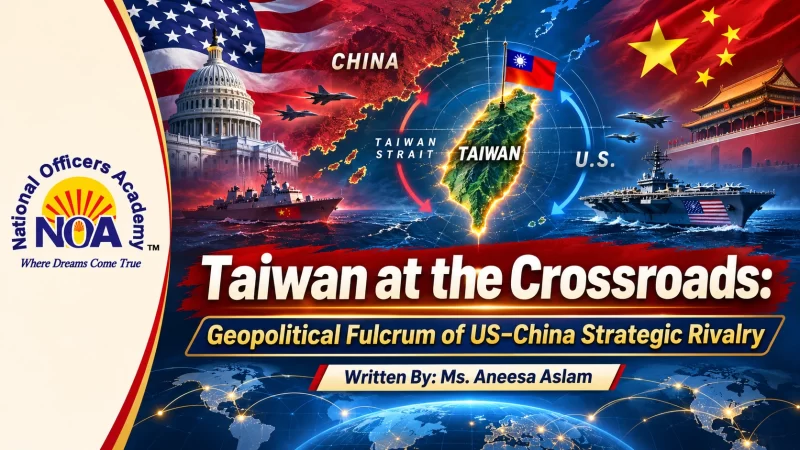
Taiwan at the Crossroads
Geopolitical Fulcrum of US–China Strategic Rivalry
Written By: Ms. Aneesa Aslam
“Out of fear and acquisitive self-defense arises the idea of ‘my country’ with its boundaries and tariff walls… The desire to gain and to hold creates the spirit of nationalism, and nationalism breeds war.” — Jiddu Krishnamurti
Jiddu Krishnamurti’s observation highlights how fear, resource competition and nationalism can transform political disagreements into geopolitical conflict.
The Taiwan issue offers a powerful contemporary manifestation of this dynamic.
Competing nationalisms between the People’s Republic of China and the Republic of China in Taiwan have transformed the Taiwan Strait into one of the most dangerous flashpoints in the wider strategic rivalry between China and the United States.
Silicon Shield and Strategic Fault Line
Taiwan is an island in East Asia located approximately 160 kilometres from mainland China in the western Pacific Ocean.
Despite its relatively small geographical size, its:
- Geopolitical location
- Strategic importance
- Economic strength
- Technological dominance
have made it one of the defining pivots of twenty-first-century great-power competition.
Geopolitical Importance
Taiwan occupies an important position in the First Island Chain, making it strategically significant to both China and the United States.
For Washington, Taiwan serves as an important element of offshore balancing in the western Pacific and helps preserve a regional balance of power.
Its location also places it close to vital maritime routes connecting East Asia with the wider Indo-Pacific.
For Beijing, Taiwan’s reunification with mainland China represents a long-standing territorial objective and an important element of national integration.
China regards Taiwan as a breakaway province whose eventual reunification is tied to the broader project of Chinese national rejuvenation.
Taiwan’s Economic and Technological Importance
Taiwan is not strategically important only because of geography.
Its economic and technological importance dramatically raises the stakes of any conflict.
The source describes Taiwan as one of the world’s major economies and trading states.
More importantly, it occupies a dominant position in the global semiconductor supply chain.
The article states that Taiwan:
- Produces around 92 percent of the world’s advanced chips
- Fabricates a large share of cutting-edge semiconductors
- Supplies crucial components for vehicles, laptops, smartphones and other advanced technologies
China itself remains heavily dependent on imported or foreign-manufactured semiconductors, with Taiwan serving as a critical supply source.
This technological dependence gives Taiwan what is frequently described as a “Silicon Shield.”
The Emerging “Silicon Curtain”
The strategic importance of semiconductors has transformed technology into a major field of geopolitical rivalry.
The article invokes Yuval Noah Harari’s idea that a new “Silicon Curtain” is emerging in the international system.
Just as ideological divisions shaped the Cold War, technological competition may increasingly divide the contemporary world.
Semiconductors sit at the centre of this competition because they are essential for:
- Artificial intelligence
- Advanced weapons
- Consumer electronics
- Industrial systems
- Telecommunications
- Modern computing
Taiwan therefore occupies a central position in both economic globalization and strategic competition.
Taiwan Unveiled: Historical Evolution
Taiwan’s contemporary political status can only be understood through its complicated history.
The island was formerly a Dutch colony and later came under the control of China’s Qing dynasty from 1683 until 1895.
Following the Sino-Japanese War, the Qing dynasty ceded Taiwan to Japan.
After the Second World War, control returned to China.
However, the Chinese Civil War between the:
- Chinese Communist Party led by Mao Zedong
- Kuomintang led by Chiang Kai-shek
fundamentally altered Taiwan’s political trajectory.
In 1949, the Communist Party won the civil war and established the People’s Republic of China on the mainland.
Chiang Kai-shek and the Kuomintang retreated to Taiwan and continued operating under the name Republic of China.
Since then, Beijing has regarded Taiwan as a breakaway region whose ultimate destiny is reunification with the mainland.
Key Events in Cross-Strait Relations
1949 – Establishment of the PRC
Mao Zedong established the People’s Republic of China, while Chiang Kai-shek and the Kuomintang retreated to Taiwan.
1950 – Korean War and US Intervention
The outbreak of the Korean War prompted deployment of the US Seventh Fleet to prevent an invasion across the Taiwan Strait.
1954–1958 – First and Second Taiwan Strait Crises
China shelled offshore islands controlled by Taiwan, while the United States strengthened its defence relationship with Taipei.
1972 – Nixon’s Visit to China
The Shanghai Communiqué marked the beginning of a major US rapprochement with Beijing.
1979 – US Recognition of the PRC
Washington formally recognised the People’s Republic of China and ended official diplomatic relations with the Republic of China.
However, the US Congress passed the Taiwan Relations Act to preserve unofficial relations and support Taiwan’s defence.
1987 – Democratic Transition
Taiwan lifted martial law and began transitioning from authoritarian Kuomintang rule towards a multi-party democratic system.
1995–1996 – Third Taiwan Strait Crisis
China conducted missile exercises near Taiwan ahead of its first direct presidential election.
2000 – Rise of the Democratic Progressive Party
The Democratic Progressive Party emerged as an important political force with a stronger Taiwan-centred identity.
2016 – Cross-Strait Communications Freeze
Beijing froze official communication after the DPP government refused to accept the 1992 Consensus.
2022 – Nancy Pelosi Visit
China responded to the visit of US House Speaker Nancy Pelosi with large-scale military exercises around Taiwan.
2024 – Lai Ching-te Election
The Democratic Progressive Party won a third consecutive presidential term.
China subsequently launched the Joint Sword-2024A and Joint Sword-2024B military exercises.
2025 – Justice Mission Plan
The source identifies further Chinese military signalling under what it describes as the Justice Mission Plan 2025.
The “One China” Framework
The One China issue lies at the heart of China-Taiwan relations.
Early Kinetic Compulsion
In the early years of the People’s Republic of China, Mao Zedong adopted what the article describes as a policy of kinetic compulsion.
This approach contributed to military confrontation during the Taiwan Strait crises of the 1950s.
Strategic Isolation
As Beijing gained wider diplomatic recognition, particularly after normalization with the United States, its policy increasingly shifted from direct coercion towards diplomatic isolation of Taiwan.
The 1992 Consensus
In 1992, representatives from the PRC and Taiwan reached what became known as the 1992 Consensus.
Both sides accepted the existence of “One China,” although they interpreted the concept differently.
Beijing maintains the One China Principle, under which Taiwan is an inseparable part of China.
The Kuomintang interpretation allowed both the PRC and ROC to claim their own understanding of what “China” represented.
Rise of the DPP and Xi Jinping
The rise of the Democratic Progressive Party in Taiwan and Xi Jinping in China intensified cross-Strait tensions.
The DPP is more sceptical of political integration with mainland China and has resisted Beijing’s preferred framework.
Xi Jinping, meanwhile, has promoted the idea of One Country, Two Systems.
China’s 2022 White Paper presents reunification as an important element of national rejuvenation and a historic mission of the Chinese Communist Party.
China’s Military Modernisation Around Taiwan
China has increasingly strengthened its military capabilities to support its political objectives.
The source highlights developments in:
- Long-range precision strike
- Space capabilities
- Counter-space systems
- Cyber warfare
- Artificial intelligence
- Quantum computing
- Intelligentized warfare
China has also increased military activity around Taiwan.
Aircraft frequently enter Taiwan’s Air Defence Identification Zone, while naval exercises demonstrate Beijing’s growing capability to impose Anti-Access/Area-Denial pressure.
These operations are designed not only to prepare the military but also to signal political resolve.
The United States’ Taiwan Policy
The United States has maintained a complicated relationship with Taiwan since 1949.
Washington initially recognised the Republic of China as the legitimate government of China and maintained a formal defence relationship with Taiwan.
In 1979, however, the United States formally recognised the People’s Republic of China.
Despite this diplomatic shift, Washington preserved substantial relations with Taiwan through the Taiwan Relations Act.
One China Policy versus One China Principle
The distinction between the American One China Policy and Beijing’s One China Principle is essential.
China’s One China Principle maintains that Taiwan is an inseparable part of Chinese territory.
The United States acknowledges Beijing’s position but does not fully accept China’s sovereignty claim over Taiwan.
Washington opposes unilateral attempts to alter the status quo through force.
At the same time, it maintains:
- Economic relations with Taiwan
- Cultural ties
- Unofficial diplomatic relations
- Arms sales
- Support for Taiwan’s self-defence
Relations are managed primarily through the American Institute in Taiwan.
Strategic Ambiguity
For decades, US policy towards Taiwan rested on strategic ambiguity.
Washington deliberately avoided clearly stating whether it would militarily intervene if China attacked Taiwan.
The purpose of this ambiguity was twofold.
It sought to deter:
- A Chinese invasion
- A unilateral Taiwanese declaration of independence
The policy therefore attempted to preserve the status quo by keeping both Beijing and Taipei uncertain about the precise American response.
From Strategic Ambiguity to Strategic Clarity?
The source argues that American policy has increasingly moved towards greater strategic clarity.
During the Trump administration, Washington expanded arms sales and diplomatic engagement with Taiwan.
The article states that more than $18 billion in arms sales were approved during this period.
Restrictions on diplomatic engagement with Taiwanese officials were also reduced.
Under President Biden, statements indicating that the United States would defend Taiwan were interpreted as movement towards strategic clarity.
Military support also continued through:
- Weapons sales
- Military assistance
- F-16-related systems
- Munitions
- Technical support
This stronger commitment increases deterrence but also raises the risk of direct US-China confrontation.
Chips at the Core of US–China Power Rivalry
“Since the development of the semiconductor, no other item has played a more decisive role in military development, economics, and international politics.” — Chris Miller, Chip War
Semiconductors sit at the heart of modern technological power.
They are essential for:
- Microprocessors
- Memory chips
- Graphics processing units
- Artificial intelligence
- Military technology
- Modern communications
The source also invokes Yuval Noah Harari’s warning that states unable to master advanced technology risk becoming increasingly irrelevant in the international system.
Artificial Intelligence and the Chip Race
The growing importance of artificial intelligence has intensified demand for advanced semiconductors.
The article highlights major investments by technology companies including:
- Nvidia
- Amazon
This demonstrates why semiconductor manufacturing has become a matter of national security rather than simply commercial competition.
TSMC and Taiwan’s Semiconductor Dominance
Taiwan hosts a vast semiconductor manufacturing ecosystem.
The article states that the island has approximately 77 semiconductor fabrication plants.
At the centre of this ecosystem is the Taiwan Semiconductor Manufacturing Company.
TSMC has established global leadership through advanced manufacturing technology.
According to the source, Taiwan and TSMC account for an extraordinary share of global semiconductor production, including most of the world’s most advanced chips.
These chips are used in:
- Smartphones
- Industrial equipment
- Advanced computing
- Military systems
Chris Miller’s description of chips as the “new oil” captures Taiwan’s strategic importance.
Taiwan’s semiconductor industry therefore acts simultaneously as an economic asset and geopolitical shield.
Taiwan and China’s Great Rejuvenation
For Beijing, Taiwan possesses historical, ideological and strategic importance.
Reunification forms part of China’s broader vision of national rejuvenation.
China has consequently accelerated military modernization with the long-term objective of developing what it considers a first-class military by 2049.
Its strategy combines:
- Political pressure
- Diplomatic isolation
- Military modernisation
- Economic leverage
- Coercive signalling
The source argues that Beijing remains prepared to use force if it concludes that peaceful reunification has become impossible.
Great-Power Collision and the Thucydides Trap
Taiwan increasingly places China and the United States within what the source describes as a Thucydides Trap.
A rising China seeks greater regional influence while the United States seeks to preserve an existing strategic balance.
Taiwan has become the point where these competing ambitions most dangerously intersect.
The risk of conflict is intensified by:
- Chinese military exercises
- PLA modernisation
- US arms sales
- American defence commitments
- Taiwanese identity politics
- Growing strategic mistrust
China’s “Wait and See” Approach
The source portrays China as pursuing a cautious approach while continuously improving its military options.
Beijing has not abandoned peaceful reunification, but it has also repeatedly warned that a formal Taiwanese declaration of independence could trigger military action.
China’s growing capabilities may gradually change the military balance across the Strait.
Why a Taiwan War Would Be Globally Catastrophic
A conflict over Taiwan would extend far beyond East Asia.
The global economy is deeply connected with Taiwan through semiconductor supply chains.
A military conflict could therefore disrupt:
- Global electronics production
- Vehicle manufacturing
- Artificial intelligence industries
- Military supply chains
- International shipping
- Financial markets
The source cites warnings that the loss or disruption of TSMC could impose enormous economic costs on the global economy.
This makes Taiwan fundamentally different from many traditional territorial disputes.
The island is not only strategically contested—it is deeply embedded in the technological infrastructure of the world economy.
Strategic Implications of a Taiwan Conflict
1. US-China Military Confrontation
A Chinese attack on Taiwan could directly test American security commitments and risk conflict between two nuclear-armed great powers.
2. Collapse of Semiconductor Supply Chains
Advanced-chip production could be severely disrupted.
3. Shock to the Global Economy
Manufacturing, technology and financial markets would experience severe instability.
4. Indo-Pacific Military Realignment
Countries including Japan, Australia and other US partners could become drawn into the crisis.
5. Maritime Trade Disruption
Conflict in the Taiwan Strait could affect some of the world’s most important shipping routes.
6. Acceleration of Global Bloc Politics
The world could become more sharply divided between competing US- and China-centred strategic systems.
Way Forward
1. Restore Strategic Ambiguity
The source argues that the United States should revitalise strategic ambiguity rather than making unconditional defence commitments.
This could deter both Chinese military adventurism and unilateral Taiwanese independence moves.
2. Exercise Chinese Strategic Restraint
China should avoid coercive measures that increase the likelihood of accidental escalation.
3. Preserve the Cross-Strait Status Quo
Neither side should unilaterally alter the existing political arrangement through force.
4. Strengthen Crisis-Management Channels
Washington and Beijing require reliable military and diplomatic communication mechanisms.
5. Reduce Miscalculation
Military exercises and deployments should be managed carefully to prevent accidents from escalating into war.
6. Maintain Economic Interdependence
Commercial ties can raise the economic costs of conflict and strengthen incentives for restraint.
7. Protect Semiconductor Supply Chains
Global semiconductor diversification can reduce economic vulnerability without eliminating Taiwan’s technological importance.
Conclusion
In the contemporary era of polycrisis, Taiwan represents one of the most dangerous tests of great-power rivalry.
Its strategic location, democratic political system, historical relationship with China and dominance in semiconductor manufacturing make it a uniquely consequential geopolitical flashpoint.
For Beijing, reunification is closely linked with national rejuvenation and territorial integrity.
For Washington, Taiwan remains an important component of Indo-Pacific balancing and the credibility of American regional commitments.
The semiconductor industry further raises the stakes by connecting Taiwan’s security directly with the functioning of the global economy.
China’s military modernisation and increasingly assertive exercises, combined with expanding US defence assistance to Taiwan, are pushing the Taiwan Strait closer to the logic of the Thucydides Trap.
Yet the costs of war would be catastrophic for all sides.
The United States is already strategically engaged across multiple global theatres, while China would risk devastating economic and military consequences from a full-scale confrontation.
The preservation of peace therefore depends on a delicate equilibrium: Washington must avoid abandoning strategic ambiguity entirely, Beijing must exercise strategic restraint, and both powers must recognise that the cost of collision vastly exceeds the price of coexistence. In an increasingly multipolar world, effective crisis management remains the only rational path forward.