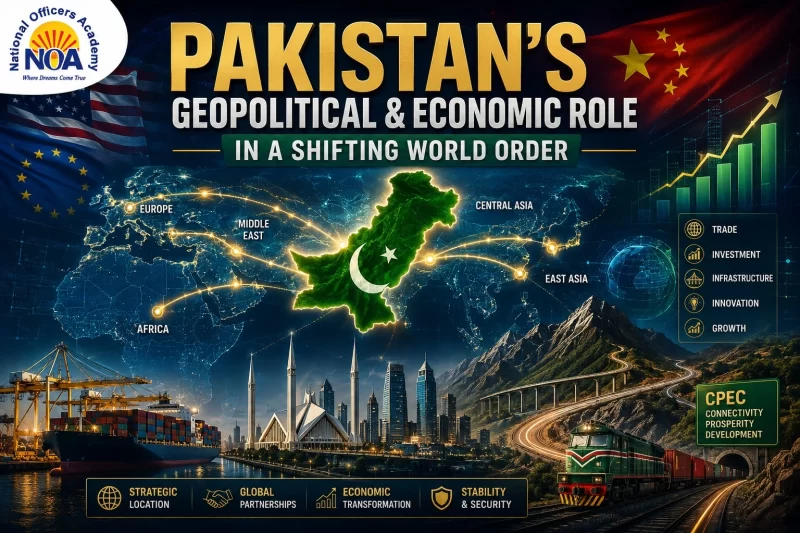
In an era defined by great-power rivalry, Pakistan finds itself navigating a delicate balance between its all-weather ally China and its historically complex but strategically important relationship with the United States of America. The May 2025 conflict with India underscored Islamabad’s reliance on Beijing for defence while simultaneously opening space for renewed engagement with Washington in counter terrorism and economic cooperation. Pakistan’s challenge is to leverage both partnerships without undermining either, ensuring security against India while seeking stability and growth through diversified external ties.
➢ Pakistan’s Security Concerns and the China Factor
Pakistan’s foremost security concern remains India. In the May 2025 conflict, Pakistan relied on Chinese platforms such as the J-10C fighter jets and PL-15 missiles, which proved decisive against India’s Rafale aircraft. Reports suggested that Pakistan’s use of these systems marked their first-ever combat deployment, providing both military analysts and the PLA a rare opportunity to assess their operational effectiveness. The success of Chinese platforms against Western counterparts reflected China’s rapid modernization in defence technology and reaffirmed Beijing’s reputation as a credible arms exporter.
China remains Pakistan’s primary defence partner, supplying more than 80% of its weapons, from fighter aircraft to naval assets. Over half of Beijing’s global arms exports are directed to Pakistan, underlining the depth of this strategic bond. For Islamabad, the May 2025 conflict reinforced the indispensability of Chinese defence support in balancing India’s expanding capabilities.
➢ The Future Trajectory of Pak-China Multi domain Cooperation
Modern conflicts increasingly demand multi-domain operations across land, air, sea, space, and cyberspace. Pakistan has made important advances in this regard, demonstrated during the May 2025 confrontation. Yet, the evolving nature of warfare and India’s accelerated procurements post-conflict demand further re-calibration. Pakistan is now reconsidering its stance on strategic missile defence, which it previously viewed as escalatory. India’s offensive missile use without crossing the nuclear threshold highlighted the need for long-range systems capable of intercepting BrahMos-class supersonic missiles and low-orbit satellites. The Chinese HQ-19 system, alongside existing HQ-9 batteries, is viewed as a potential solution.
Directed Energy Weapons (DEWs) also represent the future of South Asia’s defence environment. Offering speed, precision, and cost-effectiveness, they provide protection against drones, loitering munitions, and projectiles—all of which featured in the 2025 standoff. While India has initiated indigenous programmes in this domain, China has also made significant progress, making cooperation with Beijing essential for Pakistan.
Doctrinal reassessment and continued R&D collaboration with China can help Islamabad maintain an edge in multi domain warfare while ensuring credible deterrence against Indian escalation.
➢ Can Pakistan–US Defence Relations Revive?
The 2025 crisis also opened space for Pakistan–US defence dialogue. Washington’s mediation efforts to de-escalate the conflict reflected a shift in how the US views Islamabad’s role in regional stability.
Pakistan’s successful conduct during the four-day standoff and its restraint before retaliation convinced the US of Pakistan’s capacity to influence the regional balance of power. Counter-terrorism remains the most practical domain for renewed defence ties. The joint March 2025 operation that captured ISK leader Sharifullah alias Jafar, a mastermind of the Kabul airport attack, was widely recognised as a turning point. It reaffirmed Pakistan’s willingness to cooperate and the US interest in re-engaging Islamabad as a partner in counter-terrorism frameworks. Such cooperation not only enhances Pakistan’s strategic relevance but also indirectly supports Chinese interests by securing CPEC related projects against militant threats.
➢ Resetting the Arc: The Strategic Reawakening of Pak-US Relations in 2025
The year 2025 marked a significant shift in Pakistan–US ties. Moving beyond transactionalism, relations broadened to include diplomatic, security, and economic dimensions. High-level visits, including those of Pakistan’s Army Chief and the US CENTCOM Commander, underlined a new willingness to engage strategically.
For Washington, re-engagement serves broader objectives: counter-terrorism, regional stability, and investment opportunities in Pakistan’s energy and mineral sectors, including Reko Diq. For Islamabad, the revival diversifies foreign partnerships, allowing it to act as a balancing agent between the US and China while restraining Indian dominance.
This reorientation also improves Pakistan’s global image, recasting it as a peace-seeking and reform driven state. By positioning itself as a responsible regional player, Pakistan gains reputational dividends, attracting foreign investment and diplomatic goodwill.
➢ Balancing Compromises: China’s Reactions to Pak-US Rapprochement
Beijing views Islamabad’s warming relations with Washington with cautious acceptance. Chinese officials understand the largely transactional nature of Pakistan–US ties and do not perceive them as undermining the all-weather strategic partnership. However, Beijing remains deeply concerned about the deteriorating security environment, particularly attacks on Chinese nationals in Balochistan and Khyber Pakhtunkhwa. More than 60 Chinese workers have been killed or injured since 2016, forcing Pakistan to dedicate over 10,000 troops, including two specialised infantry divisions, for CPEC security. Despite these concerns, Beijing sees benefits in US engagement, especially in stabilising Pakistan’s economy and reducing its political isolation—both of which indirectly safeguard Chinese investments.
The Trump administration’s transactional approach and relative flexibility in dealing with China have also created space for Pakistan to maintain ties with both powers without facing zero-sum choices. For Islamabad, the task is careful balancing: engaging the US without undermining Chinese confidence.
➢ Drone Warfare: The New Strategic Frontier
The May 2025 conflict was widely described as South Asia’s “first drone war.” For nearly 60 hours, UAVs dominated the battlespace, with Pakistan deploying Chinese Wing Loong and Caihong drones, Turkish origin Baykar platforms, and domestically produced Shahpar-II UAVs. India relied on Israeli Harop loitering munitions, Polish Warmates, and indigenous UAVs.
China is now the world’s largest drone exporter, with 282 combat drones delivered in the past decade compared to just 12 by the US. Chinese drones like the Wing Loong II/III rival American systems but are significantly cheaper—costing between $1–2 million compared to $16 million for the Reaper. For Pakistan, with its economic constraints, Chinese and Turkish drones remain more attractive.
Pakistan is also advancing indigenous production. Through collaboration with Turkey’s Baykar, local assembly of advanced drones has begun, with the capacity to produce units within days. This reduces reliance on foreign suppliers and ensures sustainability in prolonged conflicts. As India accelerates its drone acquisitions, UAVs are likely to remain central to South Asia’s military equation.
➢ Geo-Economics: CPEC and Emerging US Interests
While Pakistan’s strategic orientation remains anchored in the China-Pakistan Economic Corridor (CPEC), new opportunities with Washington have emerged. The US remains Pakistan’s largest export destination and is showing interest in its mineral reserves, particularly in Balochistan. This interest aligns with America’s need to diversify supply chains of critical minerals in a resource-competitive world.
Speculative claims by US officials about Pakistan’s oil reserves lack substance, but American firms are actively exploring investment in mining and infrastructure. For Islamabad, such economic engagement provides diversification without undermining its commitment to CPEC. China, for its part, accepts US involvement as long as it does not harm Beijing’s core interests in Pakistan.
However, Beijing remains concerned about political instability and rising insecurity that delay CPEC projects. Attacks since 2016 have not only killed Chinese workers but also inflated project costs and timelines. Consequently, China insists on stronger security guarantees, pressing Pakistan to implement measures under the Global Security Initiative. Joint police and paramilitary training, as well as deployments of specialised divisions, highlight Islamabad’s effort to address these concerns.
➢ Conclusion: Striking the Balance
Pakistan today stands at the intersection of global power competition. China is its primary strategic and economic partner, critical for multi domain warfare and long-term development through CPEC. Yet, US engagement—whether in counterterrorism, mediation, or selective economic investment—offers diversification and diplomatic space.
The challenge for Islamabad is not in choosing one over the other, but in balancing both relationships. By deepening multi domain cooperation with China while engaging the US in counter-terrorism and economic partnerships, Pakistan can avoid zero-sum dilemmas. If managed carefully, this balancing act could transform Pakistan from a vulnerable frontline state into a diplomatic bridge, leveraging its geostrategic position for both security and economic resilience