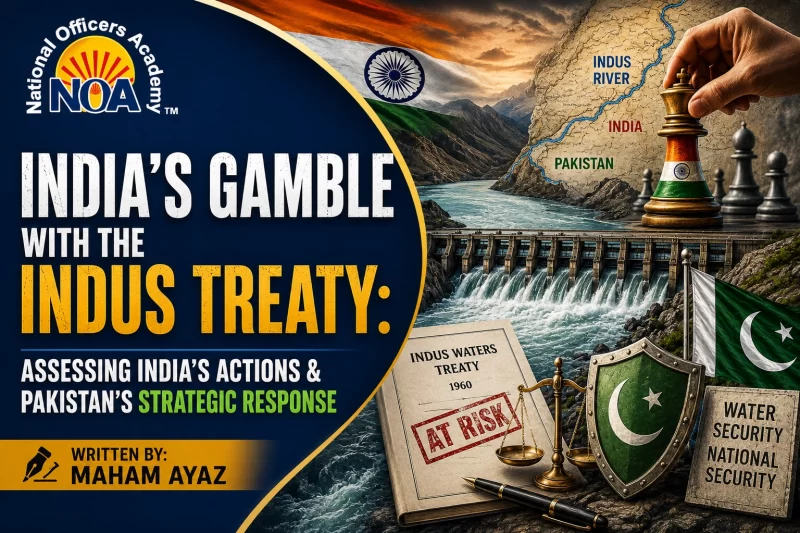
“The Indus Waters Treaty is one bright spot in a very depressing world picture that we see so often.”
— Dwight D. Eisenhower, 7 September 1961
The Indus Waters Treaty of 1960 is one of the most enduring examples of successful transboundary water cooperation.
For more than six decades, it has governed water-sharing arrangements between Pakistan and India, surviving three wars and numerous periods of political hostility. As the lower riparian state, Pakistan benefits significantly from the Treaty’s protective framework, which has remained effective despite difficult bilateral relations.
Often cited as a model of international cooperation, the Indus Waters Treaty provides a stable mechanism for water distribution in a geopolitically sensitive region.
The Indus Waters Treaty as Pakistan’s Lifeline
For Pakistan, the Indus Waters Treaty is not merely a diplomatic achievement. It is a national lifeline.
As the lower riparian state, Pakistan receives water from the three Western rivers:
- Indus
- Jhelum
- Chenab
These rivers account for more than 80% of Pakistan’s available surface water and form the backbone of its economy.
Nearly 90% of Pakistan’s agricultural output depends on irrigation, most of which comes from the Indus Basin. The Treaty provides legal guarantees for water access as well as technical and institutional mechanisms for dispute resolution and long-term planning.
It therefore serves as an essential pillar of Pakistan’s food security, economy, and national security.
“No armies with bombs and shellfire could devastate a land so thoroughly as Pakistan could be devastated by the simple expedient of India permanently shutting off the sources of waters that keep the fields and people of Pakistan green.”
— David Lilienthal, 1951
Given this critical importance, India’s recent action to hold the Treaty “in abeyance” raises serious concerns.
Such a move directly threatens Pakistan’s water security and violates the spirit of international cooperation upon which the Treaty was established.
For a country already facing severe water scarcity and climate-related pressures, disruption of the Treaty could have devastating effects on agricultural production, rural livelihoods, hydropower generation, and ecological stability.
India’s Shift Away from the Treaty’s Cooperative Spirit
India’s actions were not entirely unexpected. The shift was preceded by political rhetoric and formal notices that indicated a departure from the Treaty’s cooperative spirit.
Indian Prime Minister Narendra Modi’s statement that “blood and water cannot flow together” suggested the increasing politicization of water-sharing arrangements.
This position later appeared in two formal notices sent by India to Pakistan.
India’s First Notice
The first notice, issued on 25 January 2023, accused Pakistan of intransigence and sought to modify the Treaty unilaterally.
India’s Second Notice
The second notice, issued on 30 August 2024, referred to “fundamental and unforeseen changes in circumstances” as a reason for reconsidering the agreement.
These developments indicate that India’s move to suspend the Treaty was not sudden. Instead, it appears to be part of a broader strategic recalibration.
Holding the Indus Waters Treaty in Abeyance: Is It Legal?
India’s decision to hold the Treaty in abeyance following the Pahalgam attack marks a significant change in its approach to bilateral agreements.
India blamed Pakistan for the attack without presenting credible or reliable evidence and argued that suspending the Treaty was necessary as a countermeasure to alleged cross-border terrorism.
By holding the Treaty in abeyance, India effectively declared that it would no longer consider itself temporarily bound by its obligations under the agreement.
However, the unilateral suspension of a binding international agreement raises serious legal questions. Under international law, particularly the Vienna Convention on the Law of Treaties, India’s action appears to lack a legitimate legal foundation.
The Treaty Does Not Permit Unilateral Suspension
The Indus Waters Treaty contains no provision allowing its temporary suspension or abeyance.
Article XII(4) clearly states:
“The provisions of this Treaty shall continue in force until terminated by a duly ratified treaty concluded for that purpose between the two Governments.”
This language indicates that the Treaty remains permanent unless both countries formally agree to terminate it.
Article XII(3) further establishes that any modification must be mutually agreed upon. The Treaty therefore permits only bilateral changes, not unilateral suspension or amendment.
India’s decision to suspend the Treaty without Pakistan’s consent violates this basic principle of mutual agreement.
India’s Possible Justifications Under International Law
India may attempt to justify its action using two principles recognized under the Vienna Convention on the Law of Treaties:
- Material breach under Article 60
- Fundamental change in circumstances under Article 62
However, both arguments face serious legal difficulties.
The Material Breach Argument
India could argue that Pakistan committed a material breach by allegedly supporting the Pahalgam attack.
Under Article 60(3) of the Vienna Convention, a material breach must involve either:
- A repudiation of the Treaty not permitted by the Convention
- A violation of a provision essential to achieving the Treaty’s purpose
Even if the Pahalgam attack were attributed to the Pakistani state, which Pakistan denies, it would not constitute a violation of the Treaty’s water-sharing provisions.
Pakistan has neither rejected the Treaty nor failed to fulfil its central water-related obligations. Therefore, the legal requirements for establishing a material breach have not been met.
The Fundamental Change in Circumstances Argument
India may also rely on the principle of fundamental change in circumstances, known as rebus sic stantibus.
Article 62 of the Vienna Convention sets a very high standard for using this principle. It requires:
- The original circumstances must have formed an essential basis of the parties’ consent to the Treaty.
- The change must radically transform the remaining obligations under the Treaty.
The geopolitical rivalry between India and Pakistan, including tensions over Jammu and Kashmir, existed before the Treaty was signed and continued throughout its history.
These tensions cannot therefore be described as unforeseen changes in circumstances.
In the Gabcikovo-Nagymaros Project case between Hungary and Slovakia, the International Court of Justice rejected similar arguments.
The Court ruled that political instability and worsening bilateral relations did not meet the legal requirements for a fundamental change in circumstances. It emphasized that only changes affecting the Treaty’s central purpose could justify such an argument.
That standard does not appear to have been met in the present case.
Vienna Convention Provisions and Unilateral Suspension
Articles 42 and 57 of the Vienna Convention further weaken India’s legal position.
- Article 42: A Treaty remains binding unless it is terminated or suspended according to its own provisions or the Vienna Convention.
- Article 57: A Treaty may be suspended only through mutual agreement or according to its stated terms.
India’s unilateral suspension would therefore remain unlawful unless Pakistan agrees to it or India satisfies the exceptional legal requirements of the Vienna Convention.
Impact on Pakistan: Immediate and Strategic Concerns
India Cannot Immediately Stop the Rivers
Despite holding the Treaty in abeyance, India currently lacks the infrastructure required to withhold or divert the enormous volume of water flowing through the Western rivers, especially during the monsoon season.
These rivers carry tens of billions of cubic metres of water every year. India’s existing run-of-the-river hydropower projects are not designed for large-scale storage.
Run-of-the-river plants use a river’s natural flow and elevation to generate electricity without storing significant quantities of water.
Therefore, India cannot stop the rivers overnight or immediately carry out large-scale manipulation of water flowing into Pakistan.
The Greater Threat Lies in Dry-Season Manipulation
Although monsoon flows may exceed India’s ability to withhold water, the situation is different during the dry season.
During winter and early spring, river flows are lower, while the timing of water releases becomes extremely important for Pakistan’s irrigation requirements.
Even limited storage or diversion during this period could have serious consequences for:
- Agriculture
- Hydropower production
- Drinking water availability
- Food security
Without the Treaty’s checks and monitoring mechanisms, India could potentially alter the timing or reduce the volume of water released during important crop seasons.
Such disruption would increase Pakistan’s existing water stress and could create instability in water-dependent regions, particularly Punjab and Sindh.
Withholding Hydrological Data
Another serious consequence of holding the Treaty in abeyance is the possible suspension of hydrological data sharing.
Under the Treaty, India is required to provide Pakistan with river flow information, particularly during the monsoon season.
This data is essential for:
- Flood forecasting
- Dam management
- Agricultural planning
- Emergency preparedness
Pradeep Kumar Saxena, a former Indian Indus Waters Commissioner, stated that India could now withhold this information.
Such an action could seriously weaken Pakistan’s flood preparedness and increase the risk of infrastructure damage and humanitarian disasters in densely populated low-lying areas.
Potential Construction of New Infrastructure
Over the medium and long term, the most significant concern is India’s possible construction of new water infrastructure.
This may include:
- Storage reservoirs
- Diversion canals
- Additional hydropower projects
- Structures giving India greater control over river flows
Without the Treaty’s obligations, India may no longer feel required to share project designs or participate in international arbitration.
However, such projects would face major challenges. Most suitable locations are situated in Indian-administered Kashmir, which has difficult terrain, seismic risks, geological complications, and logistical limitations.
Large projects would require years of planning, major financial investment, and would likely generate strong political opposition.
Pakistan has repeatedly stated that any attempt to build major storage or diversion infrastructure on the Western rivers would be considered an existential threat and potentially an act of war.
Because these rivers are central to Pakistan’s economy and national security, such projects could cross a strategic red line.
Modern satellite surveillance would allow Pakistan to detect major construction activity. Pakistan also possesses diplomatic and military options to respond to such developments.
Although deeply destabilizing, the risk of pre-emptive or retaliatory action against such structures cannot be ignored if tensions escalate.
What Can Pakistan Do?
Engage the World Bank
The World Bank played a central role in negotiating the Indus Waters Treaty. Pakistan should urge it to reaffirm the Treaty’s continued validity and call upon both parties to meet their obligations.
Although India has considerable diplomatic influence, particularly with major powers such as the United States, Pakistan can build support among countries facing similar transboundary water challenges.
Possible partners may include:
- Bangladesh
- Egypt
- Vietnam
- Other water-stressed developing countries
Initiate Arbitration Under the Treaty
Pakistan has the right to begin formal dispute-resolution proceedings under the Indus Waters Treaty.
The Pakistan Commissioner for Indus Waters should formally declare that India’s unilateral suspension violates the Treaty.
If India refuses to cooperate and argues that the Treaty is no longer binding, Pakistan can approach the World Bank to initiate a Court of Arbitration under Annexure G.
Even if India refuses to participate, an ex parte decision could carry considerable diplomatic and legal weight.
A ruling in Pakistan’s favour would highlight India’s violation of international norms and present Pakistan as a state seeking a peaceful and lawful resolution.
Raise the Issue at the United Nations Security Council
As a non-permanent member of the United Nations Security Council, Pakistan can use this platform to present India’s action as a threat to regional peace and security.
The issue should be framed around the danger of depriving millions of Pakistanis of their right to water and turning a legal dispute into a humanitarian and security crisis.
Seek a United Nations General Assembly Resolution
Pakistan can also introduce a resolution in the United Nations General Assembly condemning India’s unilateral suspension of the Treaty.
The resolution should reaffirm that international water-sharing agreements remain binding under international law.
Although such a resolution would not be legally binding, it could generate global diplomatic support and increase pressure on India.
Pakistan should build alliances with other water-stressed states and present the issue within the broader framework of:
- Environmental justice
- Human rights
- Climate security
- Sustainable development
Request an Advisory Opinion from the International Court of Justice
Pakistan can request that the United Nations General Assembly seek an advisory opinion from the International Court of Justice.
Although advisory opinions are not legally binding, they carry significant legal and moral authority.
A clear opinion from the Court could strengthen Pakistan’s legal and diplomatic position and increase international pressure on India to return to full compliance with the Indus Waters Treaty.