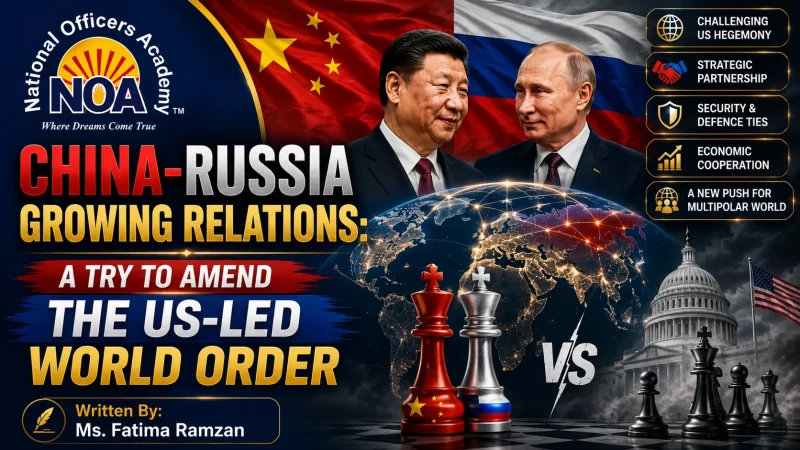
Written by: Ms. Fatima Ramzan
“The United States still thinks in terms of the Cold War and is guided by the logic of bloc confrontation, putting the security of narrow groups above regional security and stability, which creates a security threat for all countries in the region. The United States must abandon this behaviour.”
Introduction
These words were included in a joint statement issued by Chinese President Xi Jinping and Russian President Vladimir Putin during Putin’s visit to China following his re-election.
The visit was his first state visit after returning to office and also marked 75 years of diplomatic relations between China and Russia.
The joint statement, along with developments witnessed over the past few years, indicates that the United States-led liberal international order is experiencing growing pressure.
Combined with America’s domestic challenges and international policy failures, the increasing coordination between China and Russia suggests that a multipolar world may once again be emerging.
The US-Led Liberal World Order
The liberal international order was established after the Second World War, with the United States assuming a central leadership role.
According to the liberal school of thought, this system was based on several important principles:
- Economic openness
- International trade
- Multilateral institutions
- Security cooperation
- Democratic solidarity
Major institutions created or strengthened under this order included:
- The United Nations
- The International Monetary Fund
- The World Bank
- International trade organizations
- The North Atlantic Treaty Organization
The US dollar also became the world’s leading reserve currency, providing a strong economic foundation for America’s global leadership.
The Cold War and Bipolarity
The US-led international order underwent several changes after the Second World War.
During the Cold War, American freedom of action was limited by the bipolar structure of the international system.
The balance of power between the United States and the Soviet Union created a degree of order and stability.
The threat of mutually assured destruction also discouraged both powers from engaging in direct military confrontation.
The Rise of American Unipolarity
The dissolution of the Soviet Union ended the Cold War and firmly established the United States as the dominant global power.
America gained a level of international freedom that it had not previously experienced.
From the end of the Cold War until around 2016, the international system was generally characterized as unipolar.
The United States and its Western allies exercised considerable influence over global political, economic and security affairs.
Western countries also intervened in the internal affairs of other states under doctrines such as the “Responsibility to Protect.”
The Return of Multipolarity
According to political theorist John Mearsheimer, the international order has increasingly moved towards multipolarity, particularly since 2016.
Emerging powers such as China and Russia are challenging the United States in several areas, including:
- Economic influence
- Military power
- Diplomatic engagement
- Regional alliances
- International institutions
These developments are gradually reducing America’s ability to dominate the international system without opposition.
A Chinese Century?
China is widely viewed as a rising global power because of its remarkable economic growth over the past several decades.
Dr. Talat Ayesha Wizarat writes in her book Belt and Road Initiative: Emerging World Order that China may become the world’s largest economy between 2030 and 2035.
She argues that this transition could occur even earlier if the Belt and Road Initiative gains greater momentum.
China’s Use of Soft Power
China has mainly used economic influence and soft power to expand its global presence.
The Belt and Road Initiative is a central component of this strategy.
China presents the BRI as a programme designed to promote:
- Economic development
- Regional connectivity
- Infrastructure construction
- International trade
- Shared prosperity
The development of Gwadar Port under the China-Pakistan Economic Corridor is an important example of this approach.
CPEC is considered one of the flagship projects of the Belt and Road Initiative.
The String of Pearls
China’s expanding network of ports in the Indian Ocean is often described by Western analysts as the “String of Pearls.”
Some Western observers view China’s commercial activities in the Indian Ocean as part of a wider strategic and security framework.
Scholar Robert D. Kaplan has also argued that the balance of power in the Indian Ocean region is changing.
China’s Economic and Technological Strength
China has developed into one of the world’s largest manufacturing centres.
It has also established a strong position in:
- Semiconductor exports
- Renewable energy
- Solar technology
- Wind energy
- Artificial intelligence
- Science, technology, engineering and mathematics education
China reportedly exported approximately $49.4 billion worth of semiconductors during the first quarter of 2023.
It is also making substantial investments in artificial intelligence technologies and STEM education.
China’s Military Expansion
China’s economic rise has enabled it to increase its defence expenditure.
According to a recent report by the Stockholm International Peace Research Institute, China has the second-largest military budget in the world after the United States.
China has also strengthened its naval presence in the South China Sea to protect its strategic interests and counter American influence in the region.
China as a Diplomatic Power
China has increasingly presented itself as a major diplomatic power.
This role has become particularly visible in the Middle East.
China helped facilitate the restoration of diplomatic relations between Saudi Arabia and Iran.
It also supported mediation efforts between Palestinian groups, including Hamas and Fatah.
These initiatives demonstrate China’s reliance on diplomacy and soft power, in contrast with the United States’ greater dependence on military and coercive influence.
A Resurgent Russia
The United States’ invasion of Afghanistan after the September 11 attacks shifted American attention away from the Euro-Atlantic region.
This change created greater space for Russia to restore its influence following the disintegration of the Soviet Union.
Under President Vladimir Putin, Russia adopted a more assertive and expansionist foreign policy.
This approach was visible in:
- Russia’s actions in Georgia
- The annexation of Crimea
- The invasion of Ukraine
- Russia’s involvement in Syria
NATO Expansion and the Ukraine Conflict
John Mearsheimer argues that Western policies contributed significantly to the conflict in Ukraine.
According to this view, Russia repeatedly warned the United States and its allies that the eastward expansion of NATO threatened Russian security.
The possibility of Ukraine joining NATO was viewed by the Kremlin as a direct threat to Russia’s territorial and strategic interests.
The resulting conflict continues without a clear resolution.
Russia’s Role in the Middle East
Russia has also emerged as an influential player in the Middle East, particularly through its involvement in Syria.
As one of the five permanent members of the United Nations Security Council, Russia frequently challenges US policies and decisions.
The United States views Russia’s military and diplomatic actions as a threat to the liberal international order.
The Bear-Dragon Tandem
America’s hegemonic policies have encouraged closer cooperation between China and Russia.
Chinese President Xi Jinping has described the relationship as a “no-limits partnership” and a stabilizing force against increasing global pressure.
The two countries also issued a joint statement titled “Deepening China-Russia Comprehensive Strategic Partnership of Coordination for a New Era.”
The statement called for the depoliticization of international forums such as the G20 and the United Nations.
It also criticized alliances including:
- AUKUS
- QUAD
- NATO
China and Russia argue that these alliances promote Cold War-style confrontation and are designed to contain both countries.
They have instead called for greater cooperation to improve security in the Asia-Pacific region.
Expanding Economic Cooperation
China and Russia have significantly strengthened their economic relationship.
Trade between the two countries increased by approximately 170% over a period of ten years.
The two countries also cooperate extensively in the energy sector.
China has become a major importer of Russian energy, particularly after Western countries imposed sanctions on Russia.
China’s large consumer market offers important opportunities for Russian exports, especially oil and gas.
Western sanctions against Russia and the US trade war with China have brought the commercial and political interests of both countries closer together.
BRICS and the Shanghai Cooperation Organization
China and Russia have strengthened their cooperation through multilateral organizations.
Two of the most important platforms are:
- BRICS
- The Shanghai Cooperation Organization
Some Western analysts describe the SCO as a potential counterweight to NATO.
Through these organizations, China and Russia seek to strengthen regional cooperation and reduce Western influence.
Trade in Domestic Currencies
China and Russia have increased the use of their national currencies in bilateral trade.
Following Western sanctions, approximately 90% of trade between the two countries was reportedly conducted in the Chinese yuan and Russian rouble.
This arrangement helped reduce the impact of Western financial restrictions on the Russian economy.
It also represents a strategic effort to reduce dependence on the US dollar.
The growing use of national currencies could weaken one of the major foundations of the US-led global economic system.
Policy of Non-Interference
China and Russia claim to follow a policy of non-interference in each other’s internal affairs.
Although China has not openly supported the war in Ukraine, it has also avoided formally condemning Russia’s actions.
Both countries continue to pursue policies that protect their own national interests while challenging American influence.
American Imperialism and the Rules-Based World Order
A 2011 edition of Foreign Affairs carried the title “Is America Over?”
In recent years, several analysts have raised similar questions about the future of American global leadership.
While much attention is given to the role of China and Russia, some foreign policy experts argue that America’s own policy failures have weakened its position.
The Iraq War and Afghanistan Withdrawal
The invasion of Iraq and the withdrawal from Afghanistan damaged America’s reputation as a defender of democracy and human rights.
These actions created doubts about the consistency and effectiveness of US foreign policy.
The Impact of Trumpism
The “America First” approach under former President Donald Trump further weakened confidence in American leadership.
The United States withdrew from several multilateral agreements, including:
- The Paris Climate Agreement
- The Iran Nuclear Deal
- Other international cooperation arrangements
These unilateral decisions created space for other countries to increase their global influence.
The US-China Trade War
The trade war with China began under President Trump and continued under President Joe Biden.
The United States imposed restrictions and sanctions on Chinese companies involved in semiconductor manufacturing, artificial intelligence and other advanced technologies.
Protectionist measures included:
- A 100% tariff on Chinese electric vehicles
- Higher tariffs on steel and aluminium
- Restrictions on semiconductor imports
- Tariffs on medical supplies
- Controls on advanced technology exports
China responded by introducing similar measures against American goods.
These protectionist policies appear inconsistent with the principles of free trade promoted by the liberal international order.
Containment Strategies
American-led arrangements such as QUAD, AUKUS and I2U2 are viewed by China and Russia as containment strategies.
The eastward expansion of NATO has also contributed to growing tensions.
These policies have weakened America’s reputation as the uncontested leader of the international system.
US Policy Towards Gaza
Critics argue that unconditional American support for Israel during the Gaza conflict has exposed contradictions in the US-led rules-based order.
They maintain that the United States applies international rules selectively when the interests of its allies are involved.
This perception has damaged favourable public opinion of the United States in many parts of the world.
It has also created greater space for regional powers such as China to expand their economic and diplomatic influence, particularly in the Middle East.
What Lies Ahead?
The international system is at a crossroads as political and economic alliances increasingly shift from West to East.
For the United States to restore confidence in its leadership, it must rebuild the credibility of international institutions.
Organizations such as the United Nations should be empowered to fulfil their mandate of maintaining international peace and security.
Reduce Confrontation and Increase Cooperation
The United States should reduce confrontational policies and explore opportunities for international cooperation.
Potential areas of collaboration include:
- Climate change
- Refugee crises
- Pandemics
- Terrorism and extremism
- Global economic stability
- Regional security
Address the Ukraine Crisis
Russian security concerns should be addressed through meaningful negotiations to help resolve the conflict in Ukraine.
A diplomatic solution would require both sides to consider the security interests of all parties involved.
Support a Permanent Ceasefire in Gaza
The article recommends a permanent ceasefire in Gaza and stronger American pressure on Israel to stop military actions that have caused extensive civilian suffering.
Such a step could help the United States restore credibility regarding its commitment to human rights and international law.
Restore Liberal Values
The United States must renew its commitment to:
- Human rights
- International law
- Multilateral cooperation
- Free-market principles
- Diplomatic engagement
- Liberal democratic values
By consistently applying these principles, America may be able to reverse some of the damage caused by its recent policies.
Conclusion
The growing relationship between China and Russia represents a major challenge to the United States-led international order.
Their cooperation is based on shared economic interests, energy partnerships, diplomatic coordination and opposition to Western dominance.
Platforms such as BRICS and the Shanghai Cooperation Organization allow both countries to promote a more multipolar international system.
At the same time, America’s own military interventions, protectionist policies and inconsistent application of international rules have weakened its global reputation.
The future of the international order will depend not only on the rise of China and Russia but also on how the United States responds to its domestic and international challenges.
If America restores confidence in multilateral institutions, supports peaceful cooperation and applies liberal values consistently, it may preserve an important leadership role.
Otherwise, the growing influence of the East may further weaken the dominance of the West and accelerate the emergence of a multipolar world.