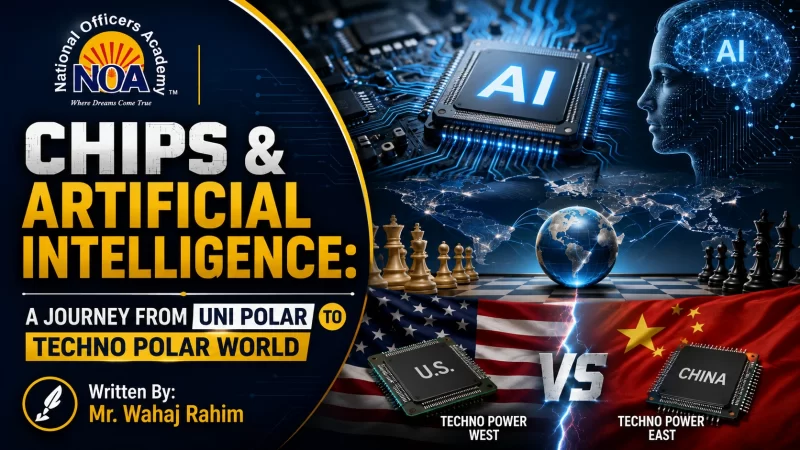
Written by: Mr. Wahaj Rahim
Introduction
The drastic and exponential dependence on technology following the artificial-intelligence boom has demonstrated that countries with access to advanced technology will increasingly shape the contours of the global order.
Time will tell whether the mighty dragon emerges victorious in the emerging technopolar world or whether the eagle maintains its dominance.
The world is constantly evolving. What is new today may become obsolete tomorrow, while innovations once considered beyond humanity’s reach are now available at the click of a button. Such is the transformative power of technology.
Humanity’s urge to dominate the world through military strength, international organisations or economic power has now led states towards what may be described as a prime mover of modern society: semiconductor chips.
The desire to remain relevant in the global economic race has made technological dominance an increasingly important national objective. The global economy’s dependence on silicon and chips has expanded dramatically, and the two major economic powers—the United States and China—are now competing intensely in science and technology.
Those who possess the means of technological progress, particularly the ability to produce faster and more efficient chips, may shape the international system for years to come.
Semiconductors: The Silicon Lottery
The term silicon lottery is commonly used in the technology industry to describe variations in the performance potential of semiconductor chips. In the geopolitical context, it can also describe those nations that have successfully developed advanced silicon-chip manufacturing capabilities.
Producing high-performance semiconductor wafers requires enormous investment in research and development. Not every country possesses the financial resources, technical expertise or institutional capacity necessary to compete in this demanding but highly rewarding industry.
States and companies that invested early in semiconductor production gained an important advantage. During the cryptocurrency-mining boom, global demand for high-performance chips increased substantially. However, when cryptocurrency markets weakened and specialised hardware became more widely available, attention increasingly shifted towards the broader potential of application-specific integrated circuits.
Application-Specific Integrated Circuit chips, commonly known as ASICs, are designed to perform specialised tasks with exceptional speed and efficiency. Their growing use contributed to deeper exploration of artificial intelligence and advanced computing.
Artificial Intelligence, Self-Awareness and Global Implications
From Specialised Processing to Artificial Intelligence
The development of ASIC processors encouraged scientists and engineers to create machines capable of performing highly specialised tasks efficiently and effectively.
Although the concept of artificial intelligence had existed for decades, the development of advanced processing systems provided AI research with a new source of momentum.
Early applications of artificial intelligence were largely designed to process large volumes of data and identify the most suitable solution from a given data pool. With time, machine learning, data analysis and computational innovation enabled AI systems to recognise patterns, retain information and improve their performance.
This technological evolution has greatly expanded the capabilities of artificial-intelligence systems.
The Expanding Capabilities of Artificial Intelligence
The functions performed by artificial intelligence depend upon the processing power available to the system and the quality of data on which it has been trained.
AI applications now extend across numerous sectors, including:
- Healthcare and complex surgical planning
- Defence and missile-guidance systems
- Data analysis and forecasting
- Education and academic research
- Creative writing and content production
- Gaming and entertainment
- Industrial automation
In defence technology, artificial intelligence may analyse previous flight data and adjust missile trajectories to reduce the risk of interception or detection.
In healthcare, AI-assisted systems can analyse medical information, assist in diagnosis and support specialists in planning complex procedures.
A Damocles’ Sword Over Human Creativity
The rapid expansion of artificial intelligence has created serious ethical, economic and creative concerns.
Without a comprehensive global policy framework, AI models have often been trained using large volumes of data without clear consent from the individuals who originally produced it.
Advanced AI systems can now generate content that may take human creators weeks or months to produce. Books, game narratives, films, scripts and other creative works can be generated at a fraction of the financial cost normally charged by human professionals.
This development creates a risk that writers, designers, artists and other creative professionals may become alienated from their crafts because machines can reproduce similar outputs quickly and cheaply.
According to the source article, reports have alleged that a large number of books were used without the permission of their authors to train artificial-intelligence models.
Such controversies have intensified debates about:
- Intellectual-property rights
- Data ownership
- Creative consent
- Copyright protection
- Compensation for original creators
Artificial Intelligence and Industrial Safety
The use of artificial intelligence in industrial automation has also raised concerns about safety and machine recognition.
The source article refers to an incident in South Korea in which an industrial robot failed to distinguish a worker from an object. Such incidents demonstrate the risks associated with deploying automated systems without adequate supervision, safety protocols and recognition mechanisms.
The Impact of AI on Education
The education sector has been among the areas most visibly affected by the artificial-intelligence revolution.
Students have increasingly turned to free AI platforms to reduce their academic workload. While these tools can support learning, their misuse has also created serious challenges.
These challenges include:
- Academic dishonesty
- AI-assisted cheating
- Reduced originality
- Declining creativity
- Difficulty distinguishing student work from machine-generated content
The blurred line between human-written and computer-generated work has forced educational institutions to reconsider assessment methods and academic-integrity policies.
Chips and the US-China Cold War 2.0
The race for semiconductor and artificial-intelligence dominance has become a central feature of the growing strategic rivalry between the United States and China.
The US Strategy to Contain the Chinese Dragon
The United States invested heavily in Taiwan’s semiconductor industry partly to ensure that Taiwan became indispensable to the global economy.
The strategic assumption was that Taiwan’s importance to international supply chains would increase the political and economic costs of any possible Chinese action against the island.
As a result, the Taiwan Semiconductor Manufacturing Company, commonly known as TSMC, emerged as one of the world’s leading semiconductor manufacturers.
Its advanced manufacturing capacity made Taiwan central to the production of increasingly sophisticated chips used in:
- Artificial intelligence
- Advanced computing
- Consumer electronics
- Defence systems
- Telecommunications
- Automotive technologies
Unforeseen Consequences and the Politics of Realisation
Many observers believed that heavy international investment in Taiwan’s semiconductor industry would discourage China from intensifying its claims over the island.
However, China continued to oppose American involvement in the Indo-Pacific and remained firm in its position regarding Taiwan.
At the same time, the United States became deeply dependent upon Chinese manufacturing, labour and supply chains. This interdependence complicated American efforts to restrict China’s access to advanced technology.
The outsourcing of semiconductor manufacturing also allowed Taiwan, with TSMC at its centre, to become a global leader in chip production.
Many American companies relied on China’s economies of scale and comparatively low production costs. Consequently, the United States faced challenges in domestic semiconductor manufacturing, research and supply-chain independence.
China was not fully contained by American control over global semiconductor networks. Instead, the vulnerabilities created through outsourcing and interdependence began to affect the United States itself.
The Mighty Eagle Flexes Its Talons
In an attempt to rebuild domestic technological strength and reduce vulnerable dependence on China, the United States introduced the CHIPS and Science Act and the Inflation Reduction Act.
On paper, these initiatives aimed to strengthen the technological foundations of the American economy and support the transition towards electric vehicles and clean-energy manufacturing.
However, they can also be interpreted as expressions of economic nationalism and strategic competition.
The CHIPS Act sought to encourage semiconductor production within the United States and protect American industries from growing Chinese competition.
The Inflation Reduction Act also introduced incentives designed to reduce dependence on Chinese battery and manufacturing supply chains.
Viewed through the lens of realism, these policies reflect:
- Balance-of-power politics
- Economic nationalism
- Strategic protectionism
- Neo-mercantilism
- Technological containment
These actions antagonised China and also created concerns among European countries affected by American industrial subsidies.
The United States’ withdrawal from the Trans-Pacific Partnership created another strategic vacuum in the region. China subsequently strengthened its economic position through regional arrangements such as the Regional Comprehensive Economic Partnership.
Xi’s Retaliation
Free trade generally benefits major producers, and China is no exception.
In response to American technological restrictions, Beijing adopted measures intended to protect its domestic industries and discourage other countries from following the United States’ approach.
China strengthened its industrial-development agenda through initiatives associated with Made in China 2025.
Beijing also introduced restrictions on the export of selected critical and rare-earth materials, reinforcing its influence over supply chains essential for advanced electronics and artificial intelligence.
China imposed countermeasures against American companies and accelerated the development of domestic semiconductor firms.
The Yangtze Memory Technologies Company, commonly known as YMTC, represents one of China’s efforts to become more competitive in advanced memory-chip production and reduce dependence upon foreign technology.
The European Union as an Emerging Technological Pole
The European Union has also introduced initiatives similar to the American CHIPS Act.
The primary objective is to strengthen domestic semiconductor production and reduce excessive dependence on external technology suppliers.
However, the European Union’s economic relationship with China remains extensive. Major European economies, particularly Germany, have developed strong trade and industrial connections with Beijing.
As a result, Europe faces the difficult task of strengthening technological sovereignty without damaging economically important relationships.
Technology as a Neo-Imperialist Instrument
Technological development has reinforced the division between the technological “haves” and “have-nots” within the international community.
Countries that control advanced technologies can influence other states through agreements presented as technological cooperation or security assistance.
These relationships may appear mutually beneficial, but they can also create forms of long-term dependency.
Technology as a Tool of Strategic Influence
Advanced military and technological systems allow powerful states to preserve their strategic importance and influence the foreign policies of dependent countries.
The source article points to Israel’s defence exports as an example of how advanced military technology can strengthen a country’s diplomatic relevance.
The sale of systems such as David’s Sling and Arrow missile-defence technology to European states illustrates how technological capability can generate political influence.
States purchasing such systems may become increasingly dependent upon the supplier for:
- Maintenance
- Software updates
- Training
- Spare parts
- Strategic cooperation
This dependence can reduce diplomatic criticism of the supplier and strengthen its position within international alliances.
Technological Dependency in the Developing World
Developing countries such as Pakistan and India remain heavily dependent on advanced military and technological suppliers.
Access to drones, surveillance systems, fighter aircraft, radar technology and other strategic equipment may be used as an instrument of pressure.
The suspension, approval or restriction of major defence deals can influence the strategic choices of recipient countries.
In this sense, the dominant powers of the Global North remain influential, although their tools of control are increasingly shifting from direct military intervention towards economic and technological incentives.
From a Multipolar to a Technopolar World
Traditionally, the concept of multipolarity focused upon countries such as the United States, China and Russia because of their military, political and economic influence.
Other states have attempted to emerge as independent poles, but military or demographic size alone does not necessarily establish global leadership.
The previous international system depended heavily upon military power and political clout. The emerging system, however, is becoming increasingly technopolar.
Countries controlling advanced technology can influence the foreign policies of other nations through neo-imperialist forms of technological pressure.
Technological Access as a Foreign-Policy Instrument
Countries that fall behind in technological development may align themselves with major powers in an effort to gain access to advanced systems.
Technological incentives can shape decisions relating to:
- Military alliances
- Defence procurement
- Diplomatic recognition
- Trade agreements
- Strategic partnerships
The source article refers to Türkiye’s decisions regarding NATO enlargement and its pursuit of advanced military aircraft as an illustration of how security and technology can shape diplomatic behaviour.
India’s procurement of advanced drones similarly reflects the growing importance of technological capability in national-security policy.
Pakistan’s Technological and Security Dependence
Pakistan’s use of American F-16 aircraft and Chinese J-10C fighter jets demonstrates its dependence upon external technological suppliers for national defence.
Such dependence creates long-term relationships involving training, maintenance, upgrades, weapons compatibility and political coordination.
Islamabad’s reliance on Beijing for advanced military technology also illustrates how technological partnerships are becoming central to international alignment.
Historical Continuity of Technological Power
Technology has always provided states with strategic advantages.
During the world wars, technological superiority played an important role in determining military outcomes.
The breaking of the German Enigma code weakened German submarine operations, while the development and use of atomic weapons transformed the final stages of the Second World War.
These examples demonstrate that technological capability has long influenced global power.
What distinguishes the present era is the speed and scale of dependence upon technology following the rise of artificial intelligence.
Conclusion
The exponential dependence upon technology after the artificial-intelligence boom has revealed that those with access to advanced technological systems will increasingly shape the international order.
Semiconductor chips, artificial intelligence, critical minerals, advanced processors and digital infrastructure have become central instruments of global power.
The United States and China are competing not only for economic superiority but also for control over the technological foundations of the future.
Meanwhile, Taiwan, the European Union, Japan and other technologically advanced actors are also becoming increasingly important within this emerging system.
The world is therefore moving beyond traditional military and economic multipolarity towards a technopolar order in which control over innovation, data and semiconductor production determines strategic influence.
Time will tell whether the Chinese dragon emerges as the leading force of this new order or whether the American eagle maintains its dominance.
In the author’s view, the United States has already lost part of its technological superiority, and the coming years may witness China or Japan assuming a more dominant position in the global technological hierarchy.