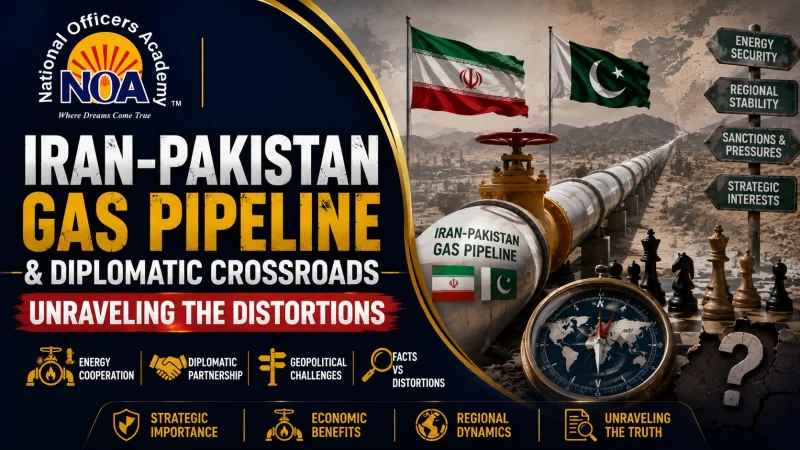
Written by: Hafiz Muhammad Umar
Introduction
A significant milestone in Pakistan-Iran economic connectivity was achieved on March 13, 2024, when Pakistan announced the commencement of construction on an 80-kilometre (49-mile) section of the Iran-Pakistan (IP) Gas Pipeline, commonly known as the Peace Pipeline. Originally conceived in 1994 as the Iran-Pakistan-India (IPI) Pipeline, the project transformed into a bilateral initiative after India’s withdrawal in 2009 due to pricing concerns, security considerations and growing U.S. sanctions on Iran following the U.S.-India civil nuclear agreement.
Despite repeated delays caused by financial constraints and international sanctions, Pakistan reaffirmed its commitment by initiating construction after securing administrative approvals and institutional backing. Today, the project stands at the intersection of energy security, economic necessity and geopolitical competition, making it one of the most strategically significant infrastructure projects in the region.
Pipeline Route and Bilateral Collaboration
The Iranian segment of the pipeline stretches approximately 1,100 kilometres, running from the South Pars Energy Zone through Fars, Bushehr, Kerman, Hormozgan and Sistan-Balochistan provinces.
The Pakistani section extends roughly 780 kilometres, including:
- 665 kilometres through Balochistan.
- 115 kilometres through Sindh, terminating at Nawabshah.
In September 2019, Pakistan’s Inter State Gas Systems (ISGS) and the National Iranian Gas Company (NIGC) signed a revised implementation agreement aimed at completing the project, estimated to cost around $158 million.
Iran reportedly invested nearly $2 billion in constructing its side of the pipeline, while Pakistan’s progress remained constrained by financing difficulties linked to U.S. sanctions.
Diplomatic Assertiveness and Institutional Support
Despite repeated objections from Washington regarding possible sanctions violations, Pakistan reiterated its commitment to the project.
On 7 March 2024, Foreign Office spokesperson Mumtaz Zahra Baloch stated that construction was proceeding in accordance with Pakistan’s commitment and that activities confined to Pakistani territory should not invite external objections.
Earlier, on 23 February 2024, Pakistan’s Cabinet Committee on Energy approved construction of the pipeline. Financial support was arranged through the Gas Infrastructure Development Cess (GIDC), while project oversight was entrusted to the Special Investment Facilitation Council (SIFC), enabling faster decision-making and reducing bureaucratic hurdles.
Extension, Legal Strategy and Regional Dynamics
Recognising the project’s strategic importance, Tehran reportedly granted Islamabad a 180-day extension until September 2024 to complete the initial pipeline segment and avoid possible international arbitration.
Legal experts advised Pakistan to adopt a phased construction strategy similar to the successful Iran-Gwadar electricity transmission project. Instead of immediately constructing the full pipeline, they recommended connecting Gwadar with Iran’s existing network through a shorter section that could potentially qualify for sanctions-related exemptions.
This phased approach would:
- Reduce immediate legal exposure.
- Ensure early gas supply to Gwadar.
- Lower dependence on volatile LNG markets.
- Strengthen regional energy connectivity.
Meanwhile, improving Saudi-Iran relations following China’s mediation in 2023 has created a more favourable regional environment for cross-border energy cooperation.
Energy Security and Socioeconomic Development
Once fully operational, the Iran-Pakistan Gas Pipeline is expected to deliver approximately 750 million cubic feet of natural gas per day, significantly easing Pakistan’s persistent energy shortages.
Key anticipated benefits include:
- Enhanced national energy security.
- Reduced dependence on expensive imported fuels.
- Annual savings estimated at up to $1 billion.
- Greater bargaining power in LNG negotiations.
- Improved industrial competitiveness.
- Employment generation in Balochistan and Sindh.
- Socioeconomic development in underdeveloped regions.
Economic Opportunities and Environmental Sustainability
The project also provides Iran with an opportunity to expand exports, utilise its vast natural gas reserves and reduce the impact of international economic isolation.
For Pakistan, the pipeline could strengthen bilateral economic relations, facilitate discussions on a future Free Trade Agreement (FTA) and support long-term industrial growth.
Natural gas also offers important environmental advantages over coal and furnace oil by:
- Reducing carbon emissions.
- Improving air quality.
- Supporting cleaner electricity generation.
- Lowering Pakistan’s carbon footprint.
From both economic and environmental perspectives, the pipeline remains one of Pakistan’s most viable long-term energy projects.
Navigating Diplomatic Crossroads
The pipeline has emerged as a major diplomatic challenge, reflecting the complex balance Pakistan must maintain between its strategic partnership with the United States and its regional cooperation with Iran.
Washington has repeatedly expressed support for Pakistan’s energy needs while simultaneously opposing the pipeline because of sanctions imposed on Tehran.
To avoid contractual penalties from Iran, Pakistan initiated construction on the first section of the pipeline while continuing diplomatic engagement with the United States.
Petroleum Minister Musadik Malik indicated that Pakistan would seek exemptions from U.S. sanctions, whereas the Foreign Office maintained that Islamabad would not request waivers from third parties. These differing public positions highlighted the complexity of Pakistan’s diplomatic balancing strategy.
Statements by U.S. Assistant Secretary of State Donald Lu reaffirmed Washington’s opposition to the project and underscored the geopolitical sensitivity surrounding Pakistan’s energy choices.
Conclusion
The Iran-Pakistan Gas Pipeline represents far more than an energy infrastructure project. It embodies Pakistan’s pursuit of energy security, economic resilience, regional connectivity and strategic autonomy amid an increasingly complex geopolitical environment.
As Islamabad balances competing pressures from Tehran and Washington, the project’s future will depend upon careful diplomacy, pragmatic policymaking and sustained political commitment. Successfully completing the pipeline could significantly strengthen Pakistan’s long-term energy security while deepening regional economic integration and reinforcing its strategic position in South Asia and the broader Middle East.