Written by: Hafiz Muhammad Umar
Introduction
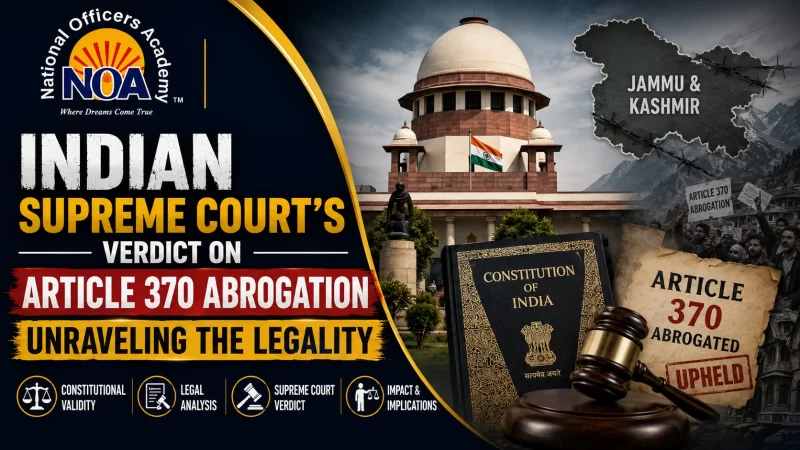
On 5 August 2019, the Government of India revoked Article 370 of the Constitution of India through a Presidential Order, ending the special constitutional status of the erstwhile State of Jammu and Kashmir. The move also led to the reorganization of the region into two Union Territories—Jammu and Kashmir and Ladakh. The constitutional changes were challenged before the Indian Supreme Court, which, on 11 December 2023, unanimously upheld the validity of the abrogation.
The verdict has generated significant legal and political debate. According to the source article, the judgment reflects historical distortions, selective constitutional interpretation and raises broader questions regarding federalism, democratic principles and international legal obligations.
The Indian Supreme Court’s Judgment
The petitioners argued that Article 370 had effectively become a permanent provision after the dissolution of the Jammu and Kashmir Constituent Assembly in 1957. Since the Assembly never recommended its abrogation, they maintained that Article 370 continued to govern the unique constitutional relationship between Jammu and Kashmir and the Union of India.
The five-judge Constitution Bench, headed by Chief Justice D.Y. Chandrachud, rejected these arguments and held that Jammu and Kashmir possessed no internal sovereignty after its accession to India. The Court further ruled that the Presidential Orders of 2019 were not mala fide or an improper exercise of constitutional authority.
While upholding the abrogation, the Court described the conversion of Jammu and Kashmir into Union Territories as temporary and directed the restoration of statehood along with legislative assembly elections.
Kashmir’s Constitutional History
The article argues that the Court’s interpretation of Article 370 overlooks the historical and constitutional context in which the provision evolved.
Although Article 370 was described as a temporary provision, its temporary nature was linked to ratification by the Jammu and Kashmir Constituent Assembly rather than automatic expiry.
According to the article, once the Constituent Assembly dissolved without recommending its repeal, Article 370 effectively continued to regulate the constitutional relationship between Jammu and Kashmir and the Union of India.
The article further argues that the Court relied heavily on the Maharaja’s 1949 proclamation while giving comparatively less weight to the democratically elected Constituent Assembly that later adopted the Jammu and Kashmir Constitution.
It also notes that the Court declined to examine the legality of converting a full-fledged state into Union Territories or the circumstances surrounding the imposition of President’s Rule that facilitated the constitutional changes.
Applicability of International Law
The article maintains that Kashmir remains an international dispute under established principles of international law.
It argues that international jurisprudence recognizes disputes involving conflicting legal claims between states, while the 1947 Instrument of Accession also carried an international dimension because it affected the sovereign rights of both India and Pakistan.
United Nations Resolutions
The article highlights UN Security Council Resolution 47 (21 April 1948) as one of the principal international legal instruments relating to Kashmir.
According to the source, the Resolution called for:
- Withdrawal of Pakistani forces.
- Subsequent withdrawal of Indian forces.
- Establishment of a UN-supervised administration.
- A free and impartial plebiscite to determine the future of Jammu and Kashmir.
The article further notes that the UN Security Council has continued to retain the Kashmir dispute on its agenda through multiple subsequent resolutions.
International Human Rights and Humanitarian Law
The article argues that developments in Indian Illegally Occupied Jammu and Kashmir (IIOJK) engage both international human rights law and international humanitarian law.
It refers to the OHCHR report of 8 July 2019, which expressed concern regarding alleged excessive use of force, pellet-firing shotguns and broader human rights violations.
The article also references international legal instruments including:
- Universal Declaration of Human Rights (UDHR).
- International Covenant on Civil and Political Rights (ICCPR).
- International Covenant on Economic, Social and Cultural Rights (ICESCR).
- Common Article 3 of the Geneva Conventions.
According to the article, Common Article 3 prohibits violence against civilians, torture, hostage-taking, degrading treatment and extrajudicial executions during armed conflicts.
Pakistan’s Legal and Diplomatic Options
The article outlines several legal and diplomatic mechanisms available to Pakistan within the framework of international law.
International Court of Justice (ICJ)
- Invoke contentious jurisdiction through compromissory clauses.
- Utilize the Forum Prorogatum mechanism.
- Seek an Advisory Opinion through the UN General Assembly.
International Criminal Court (ICC)
The article suggests pursuing temporary acceptance of ICC jurisdiction under Article 12(3) of the Rome Statute while requesting investigation of alleged human rights violations.
Universal Jurisdiction
Pakistan could assist diaspora communities and civil society organizations in pursuing legal proceedings under universal jurisdiction laws in foreign states.
CERD Mechanism
The article proposes utilizing the Inter-State Communication Mechanism under the Convention on the Elimination of All Forms of Racial Discrimination (CERD) to raise allegations of racial discrimination.
United Nations Human Rights Council (UNHRC)
The article recommends engaging both treaty-based and charter-based UNHRC mechanisms to highlight alleged human rights violations in IIOJK.
Magnitsky-Style Human Rights Sanctions
The article proposes seeking targeted sanctions against individuals allegedly responsible for human rights violations through Magnitsky-style sanctions regimes.
OECD National Contact Points
It also recommends utilizing the OECD Guidelines for Multinational Enterprises to promote corporate accountability by filing complaints against businesses allegedly linked to human rights abuses.
Conclusion
According to the source article, the Indian Supreme Court’s judgment on Article 370 extends beyond a constitutional interpretation and carries broader implications for federalism, democracy and international law. It argues that Pakistan possesses multiple legal and diplomatic avenues to pursue the Kashmir issue through international institutions, human rights mechanisms and judicial forums while continuing diplomatic engagement on the international stage.