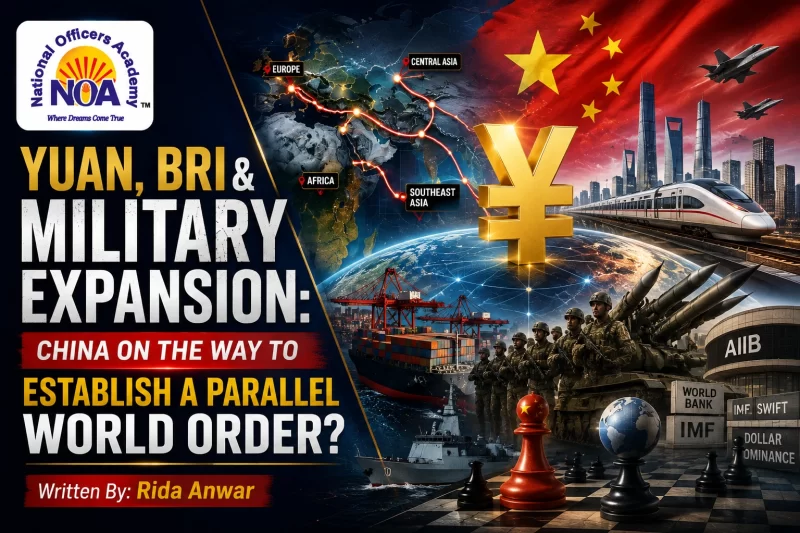
Written By: Rida Anwar
Yuan, BRI & Military Expansion: China on the Way to Establish a Parallel World Order?
During the Cold War, there was a thin global order represented by the United Nations and two bounded but powerful orders: one led by the capitalist United States and the other by the communist Soviet Union. After 1991, however, the world became largely unipolar, with the United States emerging as the global hegemon.
Since 2017, particularly with Donald Trump’s rise to power and the United States’ changing approach towards global leadership, the international system has increasingly moved towards multipolarity. This shift has provided China with an opportunity to pursue the establishment of a parallel bounded order capable of challenging elements of the existing US-led global system.
Under President Xi Jinping’s leadership, China promotes a vision of a multipolar world in which it plays a leading role. Beijing combines economic influence, regional military power and ideological narratives that contrast with Western liberal values. Its strategy includes greater cooperation with countries of the Global South, expansion of partnerships through the Shanghai Cooperation Organization (SCO), and the Belt and Road Initiative (BRI), which extends China’s influence through trade, infrastructure and strategic connectivity.
China’s proposed international order emphasises non-interference in the internal affairs of other states, scepticism towards the universality of Western liberal democratic values, and a balance of power in which the United States becomes one major actor among several.
China is simultaneously developing alternatives to US-centred structures in technology, governance, finance and security while investing heavily in innovation and infrastructure. This approach is supported by China’s expanding military presence in the Asia-Pacific and strategic partnerships with countries such as Russia, North Korea and Iran.
China’s vision therefore not only challenges US hegemony but also presents an alternative model based on what Beijing describes as fairness and development, particularly for developing countries of the Global South. Yet this strategy remains complex, combining military expansion in regional hotspots with economic diplomacy and increasing influence over international governance institutions.
China’s Vision for a New World Order
China envisions a multipolar international system in which power is distributed among several major states rather than concentrated in a single superpower. Its approach emphasises national sovereignty, opposition to interference in domestic affairs and resistance to the universal application of Western liberal democratic values.
China seeks to transform aspects of the existing liberal international order into a more regionally focused system, with Beijing serving as a leading actor in Asia and an increasingly influential global power.
Central to this strategy is the Belt and Road Initiative (BRI), which expands China’s economic relationships and infrastructure investments across Asia, Africa, Europe and other regions. The initiative strengthens long-term partnerships while helping China develop economic structures that can operate alongside established Western-dominated institutions.
China’s advances in artificial intelligence, quantum computing, semiconductors and other strategic technologies also seek to reduce dependence on Western technology and increase Beijing’s ability to influence future global technological standards.
Global Reception and Challenges
China’s narrative appeals to many developing countries because it promises a development-focused international system with greater emphasis on sovereignty and infrastructure investment. However, Beijing’s ambitions face resistance from established Western powers and some regional neighbours.
The emergence of competing institutional, economic and technological systems could deepen divisions within the international order and create increasingly parallel spheres of global governance.
Yuan Preparing to Compete with the Dollar
China is actively promoting the international use of the yuan, or renminbi (RMB), alongside its digital currency, the digital yuan (e-CNY). These efforts form an important part of China’s strategy to reduce dependence on the US dollar and increase its influence over the global financial system.
China is facilitating greater international use of the yuan by encouraging cross-border trade settlements, negotiating bilateral arrangements for local-currency transactions and expanding financial infrastructure such as the Cross-Border Interbank Payment System (CIPS).
The article notes that the yuan’s share of global foreign-exchange markets reached approximately 8.5 percent in 2025. Beijing is also encouraging yuan-based payments in strategic sectors such as iron ore trading as part of its effort to establish the currency as a more credible international reserve and settlement currency.
Promotion of the Digital Yuan (e-CNY)
China has established an international digital yuan operations centre in Shanghai to encourage greater international adoption of the e-CNY.
The People’s Bank of China (PBOC) has highlighted three important platforms for accelerating the internationalisation of the digital yuan:
- A cross-border digital payment platform designed to streamline international transactions.
- A blockchain service platform supporting secure on-chain payments and cross-chain transactions.
- A digital asset platform intended to integrate digital assets into existing financial systems.
These initiatives seek to improve the efficiency of cross-border payments, provide alternatives to dollar-dominated systems and advance China’s vision of a multipolar international monetary system.
CIPS and the SWIFT System
CIPS and SWIFT perform different but increasingly interconnected roles within the global financial system.
SWIFT is an international financial messaging network connecting thousands of financial institutions across more than 200 countries and territories. It facilitates communication concerning transactions in multiple currencies but does not itself perform the settlement of funds.
CIPS, launched by China in 2015, specialises in clearing and settling international transactions denominated in renminbi. Its settlement capabilities make it an important component of China’s efforts to internationalise the yuan.
According to the article, CIPS has established connections with more than 1,400 financial institutions across over 100 countries. Nevertheless, it remains considerably smaller than SWIFT and continues to rely upon SWIFT messaging for many transactions.
The relationship between the two systems is therefore more nuanced than direct competition. SWIFT and CIPS have also pursued compatibility and interoperability.
Strategically, however, the expansion of CIPS could reduce China’s vulnerability to dollar-centred financial systems and provide greater financial resilience to countries concerned about sanctions or dependence on US financial influence.
The Alternative to the ICJ
China has launched the International Organization for Mediation (IOMed) as a new mechanism for resolving international disputes. Based in Hong Kong, the institution focuses on mediation involving states, foreign investors and international commercial disputes.
More than 30 countries, including Pakistan, joined as founding members. Chinese Foreign Minister Wang Yi described the initiative as reflecting “Chinese wisdom” and promoting cooperative and non-confrontational methods of dispute resolution.
Unlike the International Court of Justice (ICJ), which adjudicates disputes and can issue binding judgments in cases within its jurisdiction, IOMed focuses on flexible mediation designed to facilitate negotiated settlements and preserve relationships between disputing parties.
The initiative represents another dimension of China’s effort to provide additional, non-Western mechanisms within international governance, particularly for developing countries.
Emerging Military and Technological Power
China is simultaneously strengthening its military and technological capabilities, particularly across the South China Sea, East China Sea and wider Asia-Pacific region. These developments are positioning China as an increasingly formidable regional military power.
Diplomatically, Beijing has strengthened cooperation with Russia and other states through organisations such as the Shanghai Cooperation Organization, reinforcing its broader ambition to reduce Western dominance and strengthen alternative centres of global power.
Historical Context of China’s Military Development
The People’s Liberation Army (PLA) historically depended significantly on foreign military equipment, particularly Russian technology, to meet its defence requirements.
Over recent decades, however, China has invested extensively in state-owned and private defence industries to increase domestic military production. Technological self-reliance has become strategically important because it allows the PLA to obtain military equipment without excessive dependence on foreign suppliers.
Perceptions of Chinese Military Equipment
Chinese weapons have historically faced criticism concerning quality, performance and limited combat testing compared with established Western systems. Some defence analysts have also argued that equipment exported by China may differ from systems supplied to the PLA itself.
However, the article points to the May 2025 Pakistan-India military confrontation as an event that generated renewed debate regarding the capabilities of Chinese-origin defence equipment. It cites the reported use of J-10C aircraft, JF-17 Thunder fighters, PL-15 air-to-air missiles and Chinese-origin radar and airborne systems by Pakistan.
The episode contributed to wider international discussion about the effectiveness and growing sophistication of Chinese military technology.
China’s Military Parade and Strategic Ambitions
China’s military parade commemorating the 80th anniversary of the conclusion of World War II highlighted Beijing’s continuing military modernisation under President Xi Jinping.
The display showcased new weaponry, aircraft, missiles and large numbers of military personnel, illustrating China’s growing defence-industrial capabilities.
The parade also reflected China’s broader transition from dependence on imported military technology towards self-sufficiency in defence manufacturing and greater participation in international arms markets.
China’s military ambitions extend beyond the commercial benefits of arms exports. Self-reliance in defence technology is regarded as an important component of national security because it provides the PLA with greater control over military supply chains and strengthens its ability to respond rapidly during crises.
The display also carried an international strategic message, particularly for the United States and its allies: China increasingly possesses the military capabilities required to pursue its strategic interests and expects recognition as a major global power.
Market Dynamics and Buyer Preferences
Chinese defence equipment appeals to many countries of the Global South because of several factors:
- Comparatively lower prices.
- A wide variety of available military systems.
- Fewer usage restrictions than some Western suppliers.
- Flexible financing arrangements.
- Greater accessibility for countries with limited purchasing options.
China has also used flexible payment mechanisms, including arrangements involving minerals, energy and other resources.
However, penetrating mature defence markets dominated by established American and European manufacturers remains a major challenge for China’s arms industry.
China’s Expansion of Diplomatic Relations
China’s diplomatic expansion in 2025 reflects a proactive strategy for influencing the international order through political, economic, technological, security and cultural instruments.
Central to this approach is China’s concept of a “community with a shared future,” which emphasises mutual development and interdependence through partnerships rather than conventional military alliances.
The Belt and Road Initiative remains one of China’s most important diplomatic and economic instruments. Through infrastructure investment and expanding trade relationships across Asia, Africa and Europe, Beijing seeks to strengthen economic interdependence and diversify its international partnerships.
The article notes that trade among BRI partners grew by approximately 6.4 percent in 2024. China has also strengthened economic relationships with Southeast Asian countries to diversify trade and reduce vulnerability to protectionist measures.
In technology, the Made in China 2025 strategy seeks to strengthen high-tech manufacturing, while China is simultaneously investing in sustainability initiatives and emerging industries.
China also combines economic influence with security cooperation through BRI partnerships and regional organisations such as the SCO. At the same time, cultural institutions and diplomatic initiatives provide Beijing with additional instruments of soft power.
Critics interpret some aspects of this strategy as increasingly assertive or expansionist, while China portrays its policies as supporting cooperation, development and a more multipolar international system.
China and Russia’s Relationship
China’s relationship with Russia has become an important element of the emerging international balance of power. Meetings between President Xi Jinping and President Vladimir Putin have reinforced the political and strategic partnership between Beijing and Moscow.
Both governments advocate changes in global governance and seek a more multipolar international system. Their cooperation has become particularly important amid Russia’s confrontation with Western states following the Ukraine war.
However, the relationship remains asymmetrical. Russia’s economic difficulties and Western sanctions have increased its dependence on China, leading some analysts to describe Moscow as the junior partner in the relationship.
China has maintained significant economic engagement with Russia while simultaneously navigating international criticism and attempting to preserve its wider diplomatic and economic interests.
Is China Establishing a Parallel World Order?
China’s growing influence cannot be understood through any single initiative. Rather, Beijing is simultaneously expanding its presence across several pillars of international power:
- Economic connectivity: through the Belt and Road Initiative.
- Monetary influence: through internationalisation of the yuan and digital yuan.
- Financial infrastructure: through the expansion of CIPS.
- International dispute resolution: through institutions such as IOMed.
- Military power: through PLA modernisation and defence-industrial self-reliance.
- Technological power: through AI, semiconductors, quantum computing and advanced manufacturing.
- Diplomatic influence: through the SCO, Global South partnerships and closer relations with Russia.
Taken together, these initiatives indicate that China is attempting to expand its strategic autonomy while creating institutions and networks capable of operating alongside existing Western-led structures.
Whether this ultimately produces a completely parallel world order remains uncertain. China continues to participate extensively in existing international institutions and remains deeply integrated into the global economy. Nevertheless, its expanding economic, financial, diplomatic, technological and military capabilities are contributing to a gradual redistribution of global power.
Conclusion
China’s vision for a new global order challenges US dominance while presenting an alternative model based on sovereignty, development and multipolarity. Through the Belt and Road Initiative, yuan internationalisation, CIPS, emerging international institutions, military modernisation and technological development, Beijing is steadily expanding its ability to influence the rules and institutions of global governance.
China’s growing relationship with Russia and its expanding engagement with the Global South further reflect a shift in the international balance of power away from an exclusively Western-centred system.
China may not yet have established a fully parallel world order, but it is increasingly developing the economic, financial, technological, diplomatic and military foundations required to shape one. The ultimate outcome will depend on how China manages its growing power, how other states respond, and whether the emerging multipolar system produces greater cooperation or deeper geopolitical fragmentation.