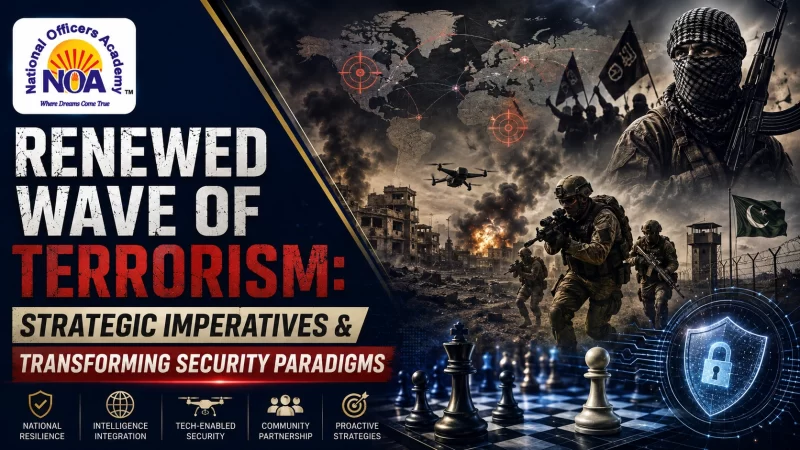
Renewed Wave of Terrorism: Strategic Imperatives & Transforming Security Paradigms
Pakistan is facing a renewed wave of militancy and terrorism, with recent incidents targeting Chinese nationals, strategic locations and major economic projects. Such attacks threaten socio-political stability, national security and economic confidence.
Pakistan’s contemporary terrorism challenge has deep links with the regional security environment that emerged after 9/11 and the prolonged conflict in Afghanistan. The withdrawal of US and NATO forces and the Taliban’s return to power in Afghanistan in August 2021 fundamentally transformed regional security dynamics.
The new phase of militancy poses particular challenges to Pakistan’s economic and strategic interests. Attacks on infrastructure, foreign nationals and development projects can undermine investment, damage economic confidence and threaten strategic initiatives such as the China-Pakistan Economic Corridor (CPEC).
Challenges at the Border: Pakistan’s Struggle Against External Terrorism and Afghan Instability
Pakistan’s military and law-enforcement institutions have spent years combating terrorism, yet the security environment remains challenging. One of the most serious concerns is the continued activity of the Tehreek-i-Taliban Pakistan (TTP) and its associated groups.
Pakistan has repeatedly called upon the Afghan Taliban authorities to prevent Afghan territory from being used by militant organisations for attacks inside Pakistan. Despite these demands, cross-border terrorism continues to strain relations between Islamabad and Kabul.
The TTP’s militant campaign has sought to pressure Pakistan into making political and territorial concessions. This poses a direct challenge to the sovereignty and constitutional authority of the Pakistani state.
Pakistan’s security situation has deteriorated considerably since the Taliban returned to power in Afghanistan in August 2021. The continued presence of militant networks across the border has created significant challenges for Pakistan’s counterterrorism strategy.
Effective management of this threat requires:
- Improved border security and surveillance.
- Stronger intelligence coordination.
- Diplomatic engagement with Afghanistan.
- Action against cross-border militant networks.
- Greater regional cooperation against terrorism.
Unveiling the Shadows: Allegations of State-Sponsored Terrorism and Transnational Operations
State-sponsored terrorism and allegations of transnational intelligence operations have increasingly become subjects of international concern. India’s Research and Analysis Wing (RAW), established in 1968 as the country’s external intelligence agency, has faced allegations regarding clandestine activities beyond India’s borders.
International attention intensified following allegations concerning plots against Sikh separatist figures in North America. Canadian Prime Minister Justin Trudeau publicly alleged a potential link between Indian government agents and the killing of Sikh leader Hardeep Singh Nijjar in Canada, allegations rejected by India.
Separately, US authorities pursued a case involving an alleged plot to kill a Sikh separatist figure in the United States. These developments generated wider international debate about sovereignty, intelligence operations and extraterritorial violence.
Such allegations demonstrate the importance of transparent investigations, accountability and adherence to international law. Counterterrorism and intelligence operations must remain consistent with democratic norms and the sovereignty of other states.
Securing Prosperity: Balancing Security and Economic Cooperation in the China-Pakistan Relationship
Security has become increasingly important to the future of the China-Pakistan Economic Corridor under China’s Belt and Road Initiative. Terrorist attacks targeting Chinese nationals have demonstrated how militancy can directly threaten economic cooperation between Pakistan and China.
Pakistan has repeatedly condemned attacks on Chinese citizens and reaffirmed its commitment to protecting Chinese personnel and projects. China has similarly called for effective investigations and stronger protection of its nationals.
Both countries have remained committed to advancing the second phase of CPEC, with increasing emphasis on:
- Employment generation.
- Industrial cooperation.
- Innovation.
- Green energy.
- Regional development.
- Special Economic Zones.
- Regional connectivity.
Projects such as Gwadar Port and the M-8 motorway remain important for strengthening trade links and regional integration.
Internal and External Security Threats to CPEC
CPEC faces a combination of internal and external security challenges. Internally, insurgent and separatist organisations in Balochistan have targeted infrastructure projects and Chinese personnel in attempts to disrupt economic activity and undermine stability.
Externally, the broader India-Pakistan rivalry and instability in Afghanistan complicate the regional security environment. Militant organisations such as the TTP and Islamic State Khorasan Province (IS-K) can exploit weak border controls and instability to threaten personnel and infrastructure.
Protecting CPEC therefore requires a comprehensive strategy involving Pakistan, China and other regional stakeholders.
A Comprehensive Security Strategy for CPEC
Pakistan should strengthen existing security arrangements for CPEC through a multidimensional approach involving:
- Dedicated security arrangements for CPEC projects and personnel.
- Stronger legal and institutional mechanisms.
- Improved intelligence coordination.
- Enhanced people-to-people relations between Pakistan and China.
- Chinese-language learning opportunities for Pakistani students.
- University partnerships, exchanges and scholarships.
- Greater engagement between local communities and development projects.
Security and socioeconomic development must complement each other if CPEC is to remain sustainable over the long term.
Strategic Imperatives: Navigating Afghanistan’s Complex Security Dynamics
Afghanistan’s internal security environment remains complicated by the presence of multiple militant organisations, particularly IS-K and the TTP.
The Afghan Taliban authorities face their own security challenges from IS-K while their approach towards the TTP continues to create serious friction with Pakistan.
Islamabad has consistently maintained that the TTP issue cannot be ignored or indefinitely managed through negotiations alone. A sustainable bilateral relationship requires meaningful action against groups using Afghan territory to conduct violence inside Pakistan.
Pakistan and Afghanistan nevertheless share permanent geographic and socioeconomic realities, including:
- A common border.
- Ethnic and cultural connections.
- Economic interdependence.
- Bilateral and transit trade.
- Religious and historical ties.
These factors make sustained engagement essential despite political disagreements.
Building an Afghan Consensus Against the TTP
The Afghan authorities need a coherent approach towards the presence and future of the TTP. Measures proposed in the article include dispersing militant cadres, preventing anti-Pakistan violence and strengthening cooperation with Islamabad against groups refusing to abandon terrorism.
Any sustainable arrangement must be verifiable and enforceable. At the same time, Pakistan should continue using diplomatic engagement alongside security measures to prevent bilateral relations from becoming permanently defined by militancy.
Navigating the Afghan Quagmire: Pakistan’s Counterterrorism Dilemma
The Taliban’s return to power in August 2021 initially generated expectations in Islamabad that the security relationship with Afghanistan might improve. Instead, increasing militant violence has transformed Afghanistan into one of Pakistan’s most serious foreign-policy and national-security challenges.
Escalating terrorism can undermine development programmes, discourage foreign investment and weaken Pakistan’s economic recovery.
Combating the TTP has become increasingly difficult because of disagreements between Islamabad and Kabul over the presence and activities of militants operating from Afghan territory.
Cross-border military tensions have further complicated relations. Pakistan has signalled its willingness to protect its territory against militant threats, while Afghan authorities have emphasised the defence of Afghanistan’s sovereignty.
This creates the risk that militant attacks could escalate into broader interstate tensions.
Dialogue Must Accompany Counterterrorism
Pakistan has simultaneously attempted to maintain diplomatic and economic engagement with Afghanistan. Bilateral discussions on trade and transit demonstrate that both countries possess strong incentives to prevent security disputes from destroying their broader relationship.
However, Pakistan must also confront weaknesses within its own counterterrorism framework. Political instability, inconsistent policymaking and the absence of a coherent long-term counterterrorism strategy have contributed to an environment in which militant organisations have been able to reorganise.
An effective policy must therefore combine:
- Diplomatic pressure on Afghanistan.
- Intelligence-based counterterrorism operations.
- Improved border management.
- Political stability at home.
- Economic development in vulnerable regions.
- Consistent implementation of national counterterrorism policies.
Transforming Security Paradigms in Pakistan’s Newly Merged Districts
Pakistan’s response to terrorism must begin with a clearer and more coherent domestic security framework. Responsibilities among civilian law-enforcement agencies, military institutions and intelligence organisations should be clearly defined to reduce duplication and improve accountability.
The merger of the Federally Administered Tribal Areas (FATA) with Khyber Pakhtunkhwa in 2018 represented a major transformation in the governance of Pakistan’s former tribal regions. However, the Newly Merged Districts (NMDs) continue to face serious challenges related to militancy, governance and socioeconomic development.
Drivers of Terrorism in the Newly Merged Districts
Terrorism and extremism in the NMDs arise from interconnected socioeconomic, political, security and ideological factors.
Major drivers include:
- Poverty and socioeconomic inequality.
- Limited access to quality education.
- Insufficient employment opportunities.
- Weak governance structures.
- Corruption.
- Ethnic and tribal tensions.
- Proximity to the Afghanistan-Pakistan border.
- Weak border-management mechanisms.
- Movement of militants and illicit goods.
Security measures alone cannot permanently resolve these challenges. Counterterrorism must be integrated with political inclusion, institutional reform and socioeconomic development.
Applying Lederach’s Pyramid to Conflict Resolution
Lederach’s conflict-transformation framework provides a useful approach for addressing insecurity in the Newly Merged Districts. Rather than focusing exclusively on elite-level decision-making, the model emphasises engagement at multiple levels of society.
This requires coordination among:
- National political and security leadership.
- Local political and community leaders.
- Religious scholars and civil society.
- Tribal representatives.
- Grassroots communities.
Such engagement can strengthen local ownership of peacebuilding and reduce the social space available to extremist organisations.
Reforming the National Action Plan
Pakistan’s National Action Plan (NAP) requires consistent implementation and adaptation to emerging security threats.
Counterterrorism reforms should focus on intelligence coordination, prosecution capacity, counter-extremism programmes, border security, terror financing and rehabilitation initiatives.
Implementation should also involve clearly defined responsibilities among federal institutions, provincial governments and security agencies.
Strengthening Civil-Military Coordination
Counterterrorism requires effective coordination between civilian and military institutions. Policy disagreements and institutional competition can undermine the continuity necessary for long-term security strategies.
Clear institutional responsibilities, parliamentary oversight, intelligence coordination and effective civilian law enforcement can strengthen Pakistan’s overall counterterrorism architecture.
A Transforming Security Paradigm for Pakistan
Pakistan’s renewed terrorism challenge demonstrates that military operations alone cannot provide permanent security. A sustainable strategy must address both the immediate manifestation of terrorism and the structural conditions that enable militancy.
Pakistan’s evolving security paradigm should therefore prioritise:
- National resilience: strengthening political stability, governance and socioeconomic development.
- Intelligence integration: improving coordination among intelligence and law-enforcement institutions.
- Technology-enabled security: using surveillance, data analysis and modern border-management systems.
- Community partnership: involving local populations in counter-extremism and peacebuilding initiatives.
- Proactive counterterrorism: identifying and disrupting militant networks before attacks occur.
- Regional diplomacy: strengthening engagement with Afghanistan and other regional actors.
- Economic security: protecting CPEC, foreign investment and strategic infrastructure.
- Institutional reform: clarifying the responsibilities of civilian, military and intelligence institutions.
Conclusion
Pakistan’s renewed wave of terrorism is not merely a conventional security challenge. It threatens economic recovery, foreign investment, regional connectivity, political stability and Pakistan’s strategic partnerships.
The changing regional environment following the Taliban’s return to power in Afghanistan, the resurgence of the TTP, threats to CPEC and instability in the Newly Merged Districts demonstrate the need for a transformed security paradigm.
Pakistan must combine effective counterterrorism operations with stronger intelligence coordination, border management, diplomatic engagement, institutional reform and socioeconomic development. Communities in vulnerable regions must become active partners in peacebuilding rather than passive recipients of security policy.
Ultimately, defeating terrorism requires more than eliminating individual militants. Pakistan must strengthen the political, economic and institutional resilience of the state so that extremist organisations can no longer exploit governance gaps, social grievances and regional instability.