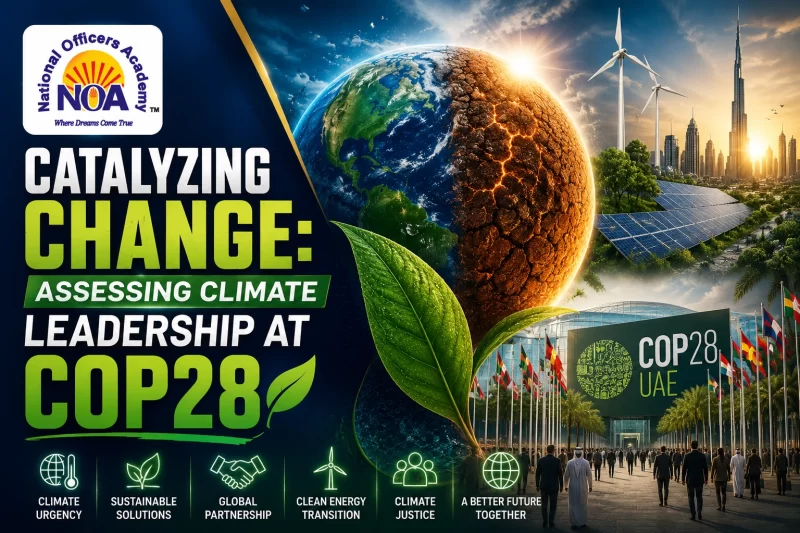
Catalyzing Change: Assessing Climate Leadership at COP28
Embracing Tomorrow: COP28’s Historic Leap Towards Sustainable Energy
The COP28 climate summit in Dubai marked a significant shift towards reducing global fossil fuel consumption, signalling a transition away from the “oil age.” The agreement, achieved after two weeks of negotiations, sent a compelling message to investors and policymakers worldwide about the international community’s shared responsibility to address the climate crisis and forge a sustainable path forward.
The final text of the Conference of the Parties (COP) represented the first formal acknowledgement within the COP framework of the need to transition away from conventional and polluting energy sources such as coal, oil and gas towards cleaner and renewable alternatives.
The agreement laid the groundwork for stronger future initiatives and continued global dialogue on sustainable practices. Although some countries considered the commitment weaker than required, the acknowledgement itself established an important precedent by recognising the urgency of addressing climate change and shifting towards environmentally responsible energy sources.
The agreement called for a transition away from fossil fuels in energy systems towards achieving net zero by 2050. Its major energy objectives included:
- Tripling global renewable energy capacity by 2030.
- Accelerating efforts towards the phase-down of unabated coal power.
- Improving global energy efficiency.
- Advancing technologies such as carbon capture and storage for difficult-to-decarbonise industries.
Bridging the Gap: From Rhetoric to Action in Climate Leadership
As governments attempt to translate these commitments into practice, COP28 provides a cooperative, though pragmatic, blueprint for collective climate action. However, the discourse surrounding climate leadership in developed countries remains complex.
Developed nations frequently project themselves as champions of climate action while providing insufficient financial assistance to developing countries attempting to transition towards cleaner energy sources. Genuine climate leadership requires more than ambitious declarations; it requires the financial resources necessary to enable a global transition towards sustainable practices.
Without substantive financial commitments, the rhetoric of climate leadership risks becoming hollow, exposing a significant gap between promises and meaningful action.
COP21 in Paris in 2015 represented a pivotal moment when nations committed themselves to efforts to limit global temperature rise to 1.5°C above pre-industrial levels. Achieving this objective depends upon three interconnected pillars:
- Mitigation.
- Adaptation.
- Climate finance.
Among these, adequate financial support remains one of the greatest challenges. Scientists have warned that exceeding critical temperature thresholds could produce severe and potentially irreversible consequences, including melting ice formations, increasing extinction risks, groundwater depletion and extreme heat.
The COP process must therefore move beyond incremental progress and confront the financial barriers preventing effective climate action. The commitments made in Paris can only become transformative if accompanied by adequately funded initiatives.
Economic and political dynamics within the G7 and European Union have also complicated international unity on climate action. COP28 consequently represented an opportunity for wealthy countries to reassess their priorities and place environmental stewardship and global well-being above narrow political and economic interests.
Crossroads of Crisis: Reflections on 2023 and the Urgency of Climate Action
The climate crisis has made the question of whether the international community is acting quickly enough increasingly urgent. Global emissions must decline substantially if the world is to remain within internationally agreed climate targets.
The Chinese Academy of Sciences warned that the strong 2023–2024 El Niño could trigger interconnected climate pressures, including:
- Intensification of marine heatwaves.
- Ocean deoxygenation.
- Damage to marine ecosystems.
- Sea-level rise.
- Declining crop yields.
- Reduction in ocean biodiversity.
Research from the University of Exeter has similarly highlighted the danger of crossing critical climate “tipping points,” which could generate abrupt or irreversible changes in natural systems and threaten the stability of human societies.
Biodiversity loss compounds these challenges. Research cited in the article involving approximately 71,000 animal species found population declines across a substantial share of species globally. Threats to ecosystems and species are increasingly visible across both tropical and developed regions.
The environmental crisis is also inseparable from economic inequality. Climate and biodiversity pressures coexist with homelessness, chronic hunger and declining human development in many societies.
At the same time, global wealth remains highly concentrated. This imbalance raises a fundamental climate justice question: those with the fewest resources frequently face the greatest consequences of environmental degradation despite contributing comparatively little to the problem.
Navigating the Shadows: Assessing the Depth of COP28’s Impact
COP28 produced a landmark acknowledgement of the need to transition away from fossil fuels. Yet the effectiveness of this commitment depends upon implementation.
Agriculture also emerged as an important issue because the sector contributes significantly to global emissions and biodiversity loss. The presence of major agribusiness corporations at COP28 demonstrated the economic interests surrounding efforts to transform food and agricultural systems.
Individuals can contribute through behavioural changes, including greater reliance on renewable energy and more sustainable consumption patterns. Nevertheless, individual choices cannot substitute for systemic government action.
The Loss and Damage Fund
One of COP28’s most significant developments was the operationalisation of the Loss and Damage Fund, designed to assist vulnerable developing countries confronting climate-related destruction.
Initial pledges amounted to approximately $700 million. However, according to the article, this represented less than 0.2 percent of the estimated losses developing countries face from climate catastrophes.
Several critical questions therefore remain regarding the fund:
- How should financial resources be distributed?
- Which countries should qualify as recipients?
- How should recipient countries be selected?
- How can accountability in the utilisation of funds be ensured?
- How can sustainable and predictable financing be secured?
Resolving these questions will be essential if the Loss and Damage Fund is to become an effective instrument of climate justice rather than merely a symbolic achievement.
Opportunities and Challenges of COP28’s Global Stocktake
The Global Stocktake agreed upon at COP28 called for major changes in the global energy system, including:
- Tripling renewable energy capacity by 2030.
- Doubling the rate of energy-efficiency improvements by 2030.
- Accelerating efforts towards the phase-down of unabated coal power.
- Phasing out inefficient fossil-fuel subsidies.
- Transitioning away from fossil fuels in a just, orderly and equitable manner.
Despite these commitments, weaknesses remain. The language provides room for continued fossil-fuel production, while the absence of strong accountability mechanisms raises questions about what will happen if countries fail to meet their commitments.
The contradiction is particularly visible when states supporting the Global Stocktake simultaneously continue expanding their fossil-fuel industries.
Climate Finance Remains Inadequate
Climate finance witnessed some progress at COP28, including additional commitments to the Green Climate Fund. Nevertheless, financial mobilisation remains far below the scale required by developing countries.
The persistent gap between climate-finance commitments and actual requirements continues to undermine trust between developed and developing countries.
Food Systems and Inclusive Climate Action
COP28 also addressed inclusion, gender, young people, indigenous communities and persons with disabilities.
The conference gave greater recognition to resilient food systems as an important component of climate adaptation. The Declaration on Sustainable Agriculture, Resilient Food Systems and Climate Action was endorsed by 158 countries, reflecting growing recognition of the vulnerability of agriculture to climate change.
Unravelling the Intersectionality of Climate Change and Social Justice
Climate change is not solely an environmental problem; it is also a profound question of social justice.
The Industrial Revolution generated unprecedented economic growth but also established unsustainable patterns of production and consumption. Countries that industrialised first accumulated enormous wealth while contributing disproportionately to historical greenhouse-gas emissions.
Many poorer countries of the Global South now confront some of the harshest consequences despite possessing far fewer resources for mitigation and adaptation.
Climate Change and Food Insecurity
The article identifies severe climate-related food insecurity affecting vulnerable regions and countries, including South Sudan, Madagascar, Pakistan, Somalia, Sudan, Chad, the Sahel and the Dry Corridor.
Food insecurity can intensify economic hardship and social unrest, further weakening communities already struggling with poverty and limited institutional capacity.
Disproportionate Impact on Vulnerable Groups
Climate-induced disasters do not affect all members of society equally. Particularly vulnerable groups include:
- Women and girls.
- Children.
- Persons with disabilities.
- Transgender people.
- Elderly populations.
- Indigenous communities.
- Low-income households.
Economic disruption following disasters can increase domestic violence and other risks faced by women and girls, while damaged healthcare infrastructure can further restrict access to essential services.
Indigenous communities are especially vulnerable because their livelihoods and cultural identities are often closely connected with natural resources. The UN High Commissioner for Human Rights has warned that the livelihoods and cultural identities of more than 370 million indigenous people are under threat.
Climate Change Deepens Existing Inequalities
Climate disasters can reinforce the cycle of poverty. Low-income families may lose their homes, livelihoods and opportunities to educate their children, while wealthier households generally possess savings and diversified income sources that improve their ability to recover.
Geography also shapes vulnerability. South Asian countries such as Pakistan, India and Nepal face significant risks associated with glacier melting, floods and changing climate patterns.
According to evidence cited in the article, between 2010 and 2020 human mortality from floods, droughts and storms was 15 times higher in highly vulnerable regions.
Climate change therefore deepens socio-economic and political inequalities both within and between states, making climate justice an essential component of international climate policy.
Building Pakistan’s Resilience Against Climate-Induced Disasters
Pakistan is highly vulnerable to climate-induced disasters, which disproportionately affect poor and marginalised communities. Repeated disasters have produced severe socioeconomic and infrastructural losses.
Unsustainable development practices, including the overexploitation of mountain ecosystems and illegal encroachments, further intensify disaster risks.
Lessons from Pakistan’s 2010 Floods
The 2010 monsoon floods demonstrated the scale of Pakistan’s vulnerability. According to the article, the disaster:
- Caused approximately $10 billion in financial losses.
- Resulted in around 2,000 deaths.
- Destroyed 17,553 villages.
- Affected approximately 160,000 square kilometres.
The floods also exposed serious weaknesses in disaster preparedness and response, including poor coordination among agencies, overlapping responsibilities, inadequate emergency supplies, communication failures and infrastructure damage.
Moving Towards Comprehensive Disaster Risk Reduction
Pakistan needs to transition towards a technologically driven, forward-looking and adaptable Disaster Risk Reduction (DRR) framework.
An effective strategy should be indigenous, need-based and geographically specific rather than relying exclusively on uniform national responses.
Centralised coordination remains important for national planning, but local communities must also be incorporated into disaster preparedness and response because they frequently serve as the first responders during emergencies.
Pakistan should therefore:
- Integrate DRR principles into public-sector development projects.
- Improve coordination among disaster-management institutions.
- Use technology for forecasting and early-warning systems.
- Develop geographically specific response mechanisms.
- Engage local communities in disaster planning.
- Strengthen emergency communication and infrastructure.
- Secure equitable climate financing for vulnerable communities.
Combining institutional coordination with community participation can significantly strengthen Pakistan’s resilience against natural and human-induced disasters.
Integrating Conflict Theory and Structural Functionalism into Climate Policy
Karl Marx’s Conflict Theory and Structural Functionalism provide useful perspectives for understanding climate policy, particularly in Pakistan.
Conflict Theory: Climate Change as an Issue of Power and Inequality
Conflict Theory highlights disparities between those who contribute most to environmental degradation and those who bear the greatest consequences.
From this perspective, climate change reflects inequalities in wealth, resources and political power. Wealthier states and social groups possess greater capacity to adapt to environmental shocks, while poorer populations often face greater exposure despite contributing relatively little to global emissions.
Climate policy must therefore address questions of distributive justice, access to resources and the unequal allocation of environmental costs and benefits.
Structural Functionalism: Climate Resilience Through Institutional Coordination
Structural Functionalism emphasises the interdependence of different components of society and their contribution to overall social stability.
Applied to climate policy, this perspective suggests that governments, communities, businesses, educational institutions, disaster-management agencies and civil society must function cooperatively.
No single institution can independently manage climate change. Effective mitigation and adaptation therefore require a holistic strategy that coordinates the strengths and responsibilities of different societal institutions.
Towards an Equitable Climate Strategy for Pakistan
Combining insights from both perspectives suggests that Pakistan’s climate strategy must simultaneously address inequality and institutional coordination.
A comprehensive approach should:
- Prioritise vulnerable and low-income communities in climate financing.
- Strengthen coordination between federal, provincial and local institutions.
- Ensure equitable access to adaptation resources.
- Integrate community participation into disaster-management policies.
- Expand renewable energy and sustainable development.
- Strengthen climate-resilient agriculture and infrastructure.
- Promote climate justice in international negotiations.
- Improve transparency and accountability in climate-finance utilisation.
Conclusion
COP28 marked an important milestone in global climate diplomacy by formally recognising the need to transition away from fossil fuels, expanding renewable energy ambitions, operationalising the Loss and Damage Fund and bringing agriculture and resilient food systems more prominently into climate negotiations.
Yet the summit also demonstrated the persistent gap between climate ambition and climate action. Inadequate financing, weak accountability mechanisms, continued fossil-fuel expansion and profound inequalities between developed and developing countries continue to undermine global climate leadership.
For Pakistan, climate change is not an abstract environmental concern. It is directly connected with disaster vulnerability, food security, poverty, inequality, infrastructure and economic stability. Building resilience therefore requires comprehensive disaster-risk reduction, climate-sensitive development, stronger institutions, community participation and equitable access to international climate finance.
The true measure of climate leadership after COP28 will not be the strength of declarations alone, but whether governments translate those commitments into adequately financed, equitable and measurable action.