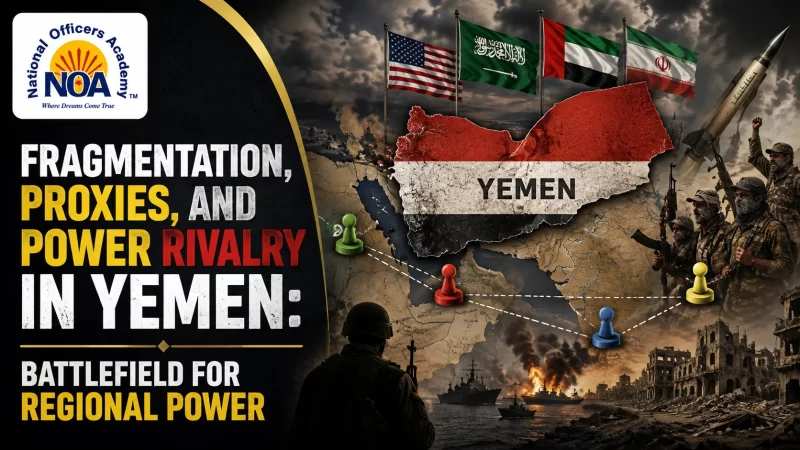
Fragmentation, Proxies, and Power Rivalry in Yemen: Battlefield for Regional Power
Yemen has effectively been a failed state since 2012. Before that, it was not truly a failed state but a divided one—North Yemen and South Yemen existed as separate entities until they signed a unification agreement in May 1990. That union, however, was always an uneasy marriage. Power remained concentrated in Sana’a under President Ali Abdullah Saleh, whose regime survived until it collapsed during the Arab Spring in 2012. When Saleh fell, Yemen lost its center of gravity. It has never recovered.
At the most basic level, Yemen has once again fragmented into north and south. But this fragmentation is complicated and hardened by the presence of the Houthis and by the competing ambitions of two powerful neighbors: Saudi Arabia and the United Arab Emirates. What is unfolding in Yemen today is not merely a civil war. It is a proxy battleground where regional powers are fighting out their strategic rivalries, often at the cost of Yemeni lives.
The Historic Persistence of Conflict
Yemen’s civil war began in 2014 when Houthi insurgents—Shiite rebels with links to Iran and a history of revolting against the Sunni government—took control of Yemen’s capital and largest city, Sana’a, demanding lower fuel prices and a new government. Following failed negotiations, the rebels seized the presidential palace in January 2015, leading President Abd Rabbu Mansour Hadi and his government to resign.
Beginning in March 2015, a coalition of Gulf states led by Saudi Arabia launched a campaign of economic isolation and air strikes against the Houthi insurgents, with U.S. logistical and intelligence support.
In February 2015, after escaping from Sana’a, Hadi rescinded his resignation, and a UN-supported transitional council was formed to govern from the southern port city of Aden. However, a Houthi advance forced Hadi to flee Aden for exile in Saudi Arabia. While he attempted to return to Aden later that year, he ultimately ruled as president in exile.
Meanwhile, a long-standing southern separatist movement gave rise to the Southern Transitional Council (STC) in 2017. The STC subsequently took control of much of southwestern Yemen, including Aden, creating a challenge for Hadi and the internationally recognized government. A Saudi-brokered agreement in 2019 sought to address this by incorporating the STC into the internationally recognized government, though the faction continued to present political and security challenges.
In April 2022, Yemen’s internationally recognized but unpopular president, Abd Rabbu Mansour Hadi, resigned after ten years in power to make way for a new seven-member presidential council more representative of Yemen’s political factions. Rashad al-Alimi, a Hadi adviser with close ties to Saudi Arabia and powerful Yemeni politicians, chairs the new council.
Discord over Support for Proxy Forces
Aiming to eliminate the Houthis, who had toppled the Yemeni government, Saudi Arabia formed a coalition that included the UAE and began launching a full-scale offensive involving air strikes, land, sea and air blockades, and troop deployments.
While these efforts succeeded in retaking southern areas such as Aden, a stalemate emerged along frontlines near the former borders of South Yemen—the People’s Democratic Republic of Yemen—and North Yemen—the Yemen Arab Republic.
Although Saudi Arabia and the UAE agreed on the need to curb the expanding influence of Iran and the Houthis, they disagreed over which anti-Houthi factions should receive support.
Saudi Arabia primarily backed the Hadi government and Al-Islah, the political party supporting his administration. Riyadh justified its military intervention by arguing that it was responding to a request for assistance from Hadi. Al-Islah was formed in 1990 through an alliance involving powerful northern tribes, the Muslim Brotherhood, and other Sunni Islamist elements. Saudi Arabia had already cultivated relations with several of these factions.
In contrast, the UAE questioned Hadi’s leadership qualities and doubted his ability to govern effectively while operating largely from Riyadh. Abu Dhabi also maintained its opposition to the Muslim Brotherhood and consequently supported alternative factions.
The UAE backed the Southern Transitional Council, local armed factions supporting the Council, and the National Resistance Forces, which included supporters of former president Ali Abdullah Saleh. Emirati support for the STC intensified friction between the Hadi government and the Council, creating a contradiction within the Saudi-led intervention itself.
Geography and Saudi Arabia’s Deepest Vulnerability
Yemen shares a 1,370-kilometer border with Saudi Arabia. Much of this border runs through vast and sparsely inhabited terrain that is extremely difficult to secure completely. For Saudi Arabia, this frontier represents one of its most significant geographical security vulnerabilities.
The UAE, by contrast, is geographically removed from Yemen, with Saudi Arabia and Oman lying between the two countries. As a result, developments in Yemen constitute a more immediate security concern for Saudi Arabia, while they provide the UAE with broader strategic opportunities.
This difference in geography explains much of the divergence between Saudi and Emirati objectives in Yemen.
Saudi Intervention in the North and UAE Intervention in the South
Saudi Arabia and the UAE primarily concentrated their interventions in different areas of Yemen. Saudi Arabia focused on northern regions and areas near the Saudi-Yemeni border. Riyadh’s primary objective was to eliminate the threat to its frontier by weakening or defeating the Houthis.
Neither Saudi forces nor Yemeni government forces, however, were able to achieve decisive results in northwestern Yemen, the principal Houthi stronghold. The Houthis proved capable of sustaining an effective insurgency and employing guerrilla warfare tactics.
In contrast, UAE forces operating primarily in southern Yemen and along western coastal regions achieved greater battlefield success, including the recapture of Aden in July 2015 and Mocha in January 2017. These successes contributed to perceptions that Emirati-backed forces were performing more effectively than their Saudi-backed counterparts.
In July 2019, the UAE announced the “strategic redeployment” of its troops from Hodeida while simultaneously strengthening financial support for Yemeni proxy forces operating in the south.
Abu Dhabi’s backing of the STC complicated the Riyadh-led coalition’s war effort and weakened the authority of the Hadi government, placing Saudi Arabia and the UAE increasingly at odds.
The UAE’s strategic ambitions appeared to extend beyond restoring the Hadi government. Influence over southern Yemen offered access to vital maritime locations, including Socotra, a Yemeni island strategically positioned near the entrance to the Gulf of Aden.
Diverging Saudi and Emirati Objectives
Saudi Arabia and the UAE initially fought together against the Houthis, but their strategic interests increasingly diverged over time.
Saudi Arabia’s primary objective has remained relatively consistent: prevent a hostile, Iran-aligned entity from dominating Yemen and threatening its southern border. Riyadh has consequently continued to support Yemen’s territorial unity under the Presidential Leadership Council (PLC).
The UAE, however, appears to have increasingly accepted the possibility that a unified Yemen may no longer be realistic. Instead, it has supported forces favouring the re-emergence of an independent South Yemen, effectively reviving elements of the pre-1990 political order.
A divided Yemen could serve Emirati strategic ambitions. Influence over southern Yemen provides access to the Arabian Sea, proximity to the Red Sea, leverage around Bab el-Mandeb, and a forward strategic position overlooking the Horn of Africa.
The Southern Transitional Council and the Fracturing of the South
The clearest expression of Emirati strategy has emerged through the Southern Transitional Council. Originally a component of the Saudi-backed PLC, the STC later broke away and launched an offensive against rival southern factions.
The STC briefly seized control of Aden and pushed PLC forces northward. This internal confrontation exposed the depth of the Saudi-UAE divergence over Yemen’s political future.
Riyadh responded decisively, signalling that it would not tolerate the further fragmentation of the southern front. Under Saudi pressure—and following developments reportedly involving the detention or disappearance of senior STC leaders—the STC announced that it was disbanding and closing its offices.
Whether this represents a genuine end to southern separatist ambitions or merely a tactical retreat remains uncertain.
Saudi Arabia has made its position explicit: factions attempting to establish a separate southern state or undermine the PLC risk exclusion from the internationally recognized political framework. Whether this approach can restore political coherence to southern Yemen or simply freeze another stage of the conflict remains to be seen.
A Broader Pattern: Africa and the Arab World
Yemen is not an isolated case. Saudi Arabia and the UAE are competing for influence across fragile states in the Arab world and Africa, including Sudan and Libya.
In Sudan, the UAE has backed the Rapid Support Forces (RSF) led by Mohamed Hamdan Dagalo, commonly known as Hemeti, while Saudi Arabia has supported the Sudanese Armed Forces. In Libya, the UAE has backed Khalifa Haftar.
The broader pattern is consistent: fragmented and institutionally weak states become arenas in which external and regional powers pursue strategic interests through local partners and proxy forces.
Yemen’s Curse: Geography without Power
Yemen illustrates a different kind of geopolitical curse. It lacks substantial natural resources, possesses weak institutions, and occupies an exceptionally important strategic location.
Under such circumstances, geography becomes a liability rather than an asset. Unlike Saudi Arabia or the UAE—where resource wealth combined with stronger state structures generates regional influence—Yemen’s strategic location has made it vulnerable to intervention and competition among external powers.
Iran, Saudi Arabia, and the UAE all project influence inside Yemen, while ordinary Yemenis continue to bear the greatest costs.
Yemen’s prolonged suffering is therefore not merely accidental. It is the product of geographical vulnerability, state collapse, political fragmentation, proxy warfare, and the relentless logic of regional power politics. As competing powers pursue influence over Yemen’s territory, ports, borders, and maritime approaches, the prospects for lasting political stability remain deeply uncertain.