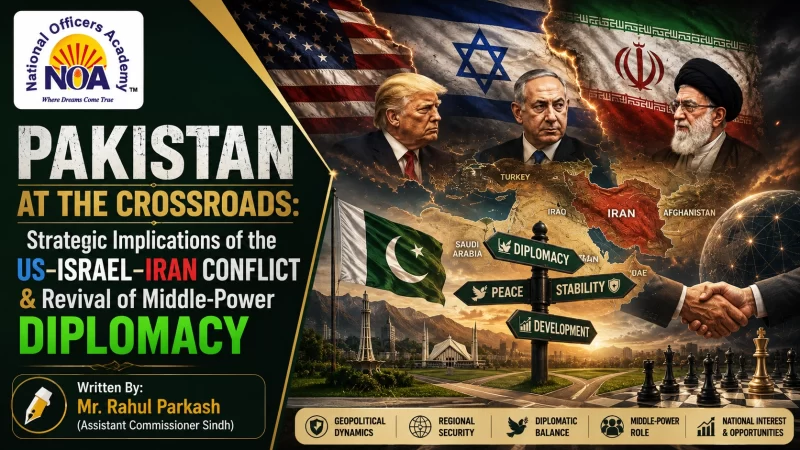
Written By: Mr. Rahul Parkash (Assistant Commissioner Sindh)
Pakistan at the Crossroads: Strategic Implications of the US–Israel–Iran Conflict & Revival of Middle-Power Diplomacy
The recent attacks on Iran by the United States and Israel represent a significant escalation in Middle Eastern geopolitics, with far-reaching implications for regional stability and countries such as Pakistan. According to leading think tanks such as the Council on Foreign Relations and the Atlantic Council, these strikes form part of a broader strategic effort to curb Iran’s regional influence, degrade its military capabilities, and reinforce deterrence in an increasingly volatile security environment.
Analysts argue that this confrontation reflects deeper structural tensions within the international system, where major powers seek to maintain dominance and prevent the emergence of regional challengers.
Understanding the Conflict Through the Realist Lens
Viewed through the lens of international relations theory, the situation closely corresponds with realism as explained by John Mearsheimer. He argues that the international system is “anarchic,” meaning that there is no higher authority capable of guaranteeing the security of states. Consequently, countries concentrate on survival and the accumulation of power.
From this perspective, U.S. and Israeli actions can be interpreted as attempts to preserve the existing regional balance and prevent Iran from altering the distribution of power in the Middle East. Other analysts, including Arvind Soni, similarly frame the developments as part of a continuing geopolitical struggle shaped by deterrence, alliance-building, and strategic signalling rather than isolated military actions.
Security Implications for Pakistan
For Pakistan, the consequences extend far beyond the immediate conflict zone. The International Institute for Strategic Studies has warned that continued instability involving Iran could generate spillover effects for neighbouring states, particularly across sensitive border regions.
Pakistan shares a long and strategically important border with Iran, making instability on the Iranian side particularly consequential for Balochistan. A prolonged conflict could intensify cross-border militancy, separatist violence, illicit movement, and broader security pressures.
There are also concerns that external intelligence actors could exploit regional instability and separatist militant organisations, further aggravating the insurgency in Balochistan.
Potential Refugee Influx
Continued attacks and instability inside Iran could produce refugee movements towards Pakistan. A significant influx would have far-reaching socioeconomic implications, particularly for communities and infrastructure in border areas.
Pakistan’s experience with decades of Afghan displacement demonstrates how prolonged refugee populations can place substantial pressure on employment, public services, housing, security institutions, and local resources.
Risk of Transnational Mobilisation
A further concern would arise if prolonged conflict resulted in state collapse, foreign occupation, or a sustained insurgency inside Iran. Such circumstances could potentially attract armed ideological networks from neighbouring countries.
For Pakistan, this could create the risk of mobilisation among sectarian or militant groups, producing security challenges similar in character to the cross-border mobilisation witnessed during the conflict in Afghanistan.
Economic Consequences for Pakistan
The economic effects could be equally serious. Findings cited from the Institute of Policy Studies Islamabad indicate that increases in global oil prices and disruptions to regional trade routes can impose substantial costs on Pakistan’s economy.
Higher energy prices could:
- Fuel domestic inflation.
- Increase Pakistan’s import bill.
- Place additional pressure on foreign-exchange reserves.
- Increase transportation and electricity-generation costs.
- Raise food and commodity prices.
- Disproportionately affect lower-income households.
Greater uncertainty in international markets could also discourage foreign direct investment and disrupt remittance flows from the Middle East, further weakening Pakistan’s economic stability.
Social and Sectarian Pressures at Home
The conflict could also generate new social pressures within Pakistan. Regional wars often strengthen ideological narratives and influence public attitudes, potentially intensifying political divisions and sectarian debates.
Traditional media and social media can significantly shape public perceptions of international conflicts, sometimes pushing political leaders towards more rigid or emotionally charged positions.
A refugee influx from Iran could simultaneously increase pressure on local resources, urban infrastructure, and public services, particularly in less-developed border regions. These concerns reflect a wider pattern identified by conflict researchers: wars occurring outside a country’s borders can nevertheless generate serious domestic socioeconomic and political stresses.
Domestic Political and Institutional Implications
The crisis could reshape Pakistan’s domestic policy priorities. States confronting instability beyond their borders frequently redirect resources and political attention towards security.
Such a shift could affect development priorities and influence the institutional balance between civilian leadership and the security establishment. For Pakistan, escalating regional tensions may increase the role of security institutions in shaping foreign and national-security policy.
Political actors may also attempt to use the crisis to mobilise public support, potentially making it more difficult to develop a stable, balanced, and nationally agreed diplomatic approach.
Pakistan’s Diplomatic Balancing Act
Diplomatically, Pakistan must simultaneously manage several important relationships. It shares deep historical, cultural, geographical, and religious connections with Iran, while also maintaining important relations with the United States and strong economic and strategic partnerships with Gulf countries.
Pakistan has therefore generally pursued a cautious and pragmatic approach: supporting de-escalation and dialogue while avoiding complete alignment with any single side.
This approach reflects Pakistan’s need to preserve strategic autonomy in a region increasingly divided by competing interests.
The Saudi Security Dimension
Pakistan’s defence relationship with Saudi Arabia adds another layer of strategic complexity. Security commitments and longstanding defence cooperation between Islamabad and Riyadh mean that any widening confrontation involving Gulf states could create significant strategic pressure on Pakistan.
If attacks on American or allied facilities in Gulf countries intensify, Islamabad could face increasingly difficult choices between its relationships with Iran, Saudi Arabia, other GCC states, and the United States.
The central challenge for Pakistan would therefore be to prevent regional commitments from drawing it directly into a broader confrontation while simultaneously maintaining confidence among its major partners.
Pakistan’s Historical Role as a Diplomatic Bridge
Pakistan’s diplomatic history demonstrates that it has previously played meaningful roles during periods of international crisis and great-power rivalry.
Pakistan and the US–China Rapprochement
One of the most important examples was the US–China rapprochement. Pakistan operated as a discreet diplomatic channel between Washington and Beijing.
Under the leadership of President Yahya Khan and with Pakistan’s diplomatic support, Henry Kissinger’s historic secret journey to Beijing helped prepare the ground for the subsequent normalisation of relations between the United States and China—one of the most consequential diplomatic breakthroughs of the Cold War.
Pakistan and the Soviet-Afghan Conflict
Pakistan also played a central role during the Soviet-Afghan War as a frontline state coordinating with the United States and other regional actors.
Beyond security cooperation, Pakistan participated in the diplomatic process surrounding the Geneva Accords, which helped establish the framework for the withdrawal of Soviet forces from Afghanistan.
Mediation Between Iran and Saudi Arabia
Pakistan has repeatedly attempted to reduce tensions between Iran and Saudi Arabia, offering its diplomatic services as a potential intermediary between two major regional powers.
Its relationships with both countries provide Islamabad with an opportunity to maintain channels of communication during periods of heightened rivalry.
United Nations Peacekeeping
Pakistan has also established a longstanding record of participation in United Nations peacekeeping missions across Africa and other conflict-affected regions.
These contributions have strengthened Pakistan’s international credentials as a country capable of supporting conflict management, peacebuilding, and international security.
Facilitating US–Taliban Negotiations
After 9/11, Pakistan again demonstrated its potential value as an intermediary by helping facilitate dialogue between the United States and the Taliban, particularly during the diplomatic process leading towards the Doha Agreement.
Pakistan’s geographic position, regional relationships, and influence over relevant actors allowed it to serve as an important link in negotiations intended to facilitate an end to the prolonged Afghan conflict.
Reviving Pakistan’s Middle-Power Diplomacy
These historical examples suggest that Pakistan possesses both diplomatic experience and strategic reach that could become relevant during the present crisis.
Rather than attempting to resolve the entire confrontation through a single initiative, Islamabad could adopt a gradual approach based on confidence-building measures, backchannel diplomacy, and limited cooperation on specific issues.
Potential areas of engagement include:
- Supporting humanitarian coordination.
- Facilitating backchannel communication.
- Promoting confidence-building measures.
- Supporting maritime security arrangements.
- Helping facilitate ceasefire negotiations.
- Coordinating diplomatic initiatives with China and Gulf states.
- Encouraging multilateral mechanisms for regional stability.
Such an approach would allow Pakistan to strengthen its diplomatic influence while attempting to manage the considerable risks associated with direct involvement in the conflict.
From Strategic Balancing to Active Mediation
Islamabad is pursuing a broad diplomatic approach aimed at improving communication between the United States and Iran. This involves maintaining its position as a potential neutral intermediary, preserving backchannel dialogue, and coordinating with influential regional and international partners.
Cooperation with China and Gulf countries could strengthen multilateral efforts to contain escalation. If carefully executed, this strategy could enhance Pakistan’s diplomatic relevance without compromising its strategic autonomy.
The larger opportunity is the revival of middle-power diplomacy: using diplomatic access, geographical importance, relationships with competing blocs, and experience in conflict mediation to exercise influence beyond the country’s material capabilities.
The Islamabad Accord and Pakistan’s Emerging Mediatory Role
Recent developments in the conflict between the United States and Iran have moved towards a more diplomatic phase. Both sides are discussing a ceasefire under what has been described as the “Islamabad Accord.”
With diplomatic access to Washington, Tehran, GCC capitals, and Beijing, Pakistan has sought to bring the conflicting parties back towards negotiations and support efforts aimed at ending hostilities.
Following discreet shuttle diplomacy, Islamabad has supported efforts towards a temporary ceasefire and high-level engagement between American and Iranian officials.
Led by Pakistan’s political and military leadership, such an initiative would underscore the country’s potential evolution into a more active middle power capable of mediating between major international actors and contributing to conflict resolution in one of the world’s most unstable regions.
Conclusion
The U.S.–Israel attacks on Iran demonstrate the continuing importance of power politics, deterrence, strategic competition, and balance-of-power calculations in international relations.
For Pakistan, the consequences are multidimensional. Regional escalation could threaten border security, intensify militancy, generate refugee pressures, increase energy costs, worsen inflation, create domestic political and sectarian tensions, and complicate relations with Iran, the Gulf states, and the United States.
Yet the crisis may simultaneously provide Pakistan with an opportunity to revive its historical role as a diplomatic bridge. Its experience in facilitating US–China rapprochement, participating in Afghan diplomacy, maintaining relations with Iran and Saudi Arabia, contributing to UN peacekeeping, and facilitating US–Taliban negotiations provides useful diplomatic precedents.
Pakistan therefore stands at a crossroads. Through strategic restraint, balanced diplomacy, confidence-building initiatives, and carefully calibrated mediation, Islamabad can seek to protect its national interests while positioning itself as a constructive middle power in an increasingly fragmented international order.