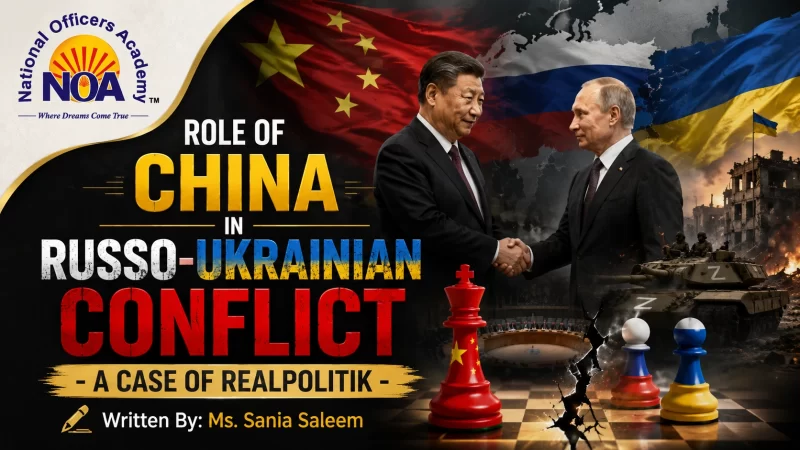
Role of China in Russo-Ukrainian Conflict — A Case of Realpolitik
China’s role in the Russo-Ukrainian conflict reflects a careful exercise in realpolitik, balancing strategic partnership with Russia, economic interests in Europe, competition with the United States, and Beijing’s ambition to shape an emerging multipolar world order.
Shortly before Russia’s invasion of Ukraine in February 2022, Beijing and Moscow proclaimed their “no limits” partnership. Since then, Russia’s growing economic dependence on China has strengthened Beijing’s leverage over Moscow. At the same time, China has attempted to maintain the image of a diplomatic actor rather than becoming a direct participant in the conflict.
China as Russia’s Strategic Lifeline
A weakened but functioning Russia serves China’s geopolitical interests. Moscow remains an important partner in challenging the U.S.-led international order and advancing the idea of a more multipolar global system.
China therefore has little interest in seeing Russia suffer a decisive strategic defeat, the collapse of Vladimir Putin’s government, or prolonged instability along its northern frontier. Such developments could undermine Beijing’s geopolitical position and disrupt its economic links with Russia, Central Asia and Europe.
Ukraine War and the Contest Over World Order
For Beijing, the Ukraine conflict extends beyond Russia and Ukraine. Its outcome could influence the wider competition over the future international order.
A Ukrainian victory achieved with extensive Western assistance could strengthen Washington’s claim that U.S.-led alliances and institutions remain capable of confronting major geopolitical challenges. Conversely, a prolonged conflict that strains Western resources and contributes to economic and political pressures internationally may reinforce China’s narrative that the existing global order requires transformation.
Beijing’s Three Major Stakes in the Conflict
China has three broad strategic interests in the Russo-Ukrainian war. First, it seeks to prevent a catastrophic Russian defeat or political breakdown that could weaken one of Beijing’s most important strategic partners.
Second, China views the conflict through the prism of its wider geopolitical competition with the United States. The outcome could either reinforce or weaken Western influence over the international system.
Third, Beijing wants influence over the eventual peace process and post-war economic landscape. Its diplomatic initiatives therefore serve not only political objectives but also its longer-term ambition to participate in Ukraine’s eventual reconstruction and economic recovery.
China Between Mediation and Military Support
China has sought to position itself as a potential mediator while maintaining close relations with Moscow. This balancing strategy allows Beijing to retain influence without assuming the enormous political and economic costs associated with direct participation in the war.
An overt decision to provide extensive military assistance to Russia would fundamentally alter this position. It could transform China from an influential third party into a direct strategic adversary of the United States and European states in the Ukrainian theatre.
Europe and the United States as Constraints on Beijing
China’s substantial economic relationship with Europe creates an important constraint on its policy choices. European states possess leverage because Beijing has significant commercial interests in maintaining access to European markets.
The United States and Europe can therefore attempt to deter direct Chinese military involvement by making clear that such assistance would carry serious diplomatic and economic consequences.
The Costs of Direct Chinese Intervention
Open Chinese military involvement could undermine many of the advantages Beijing has gained from maintaining strategic ambiguity. It could damage China’s economic relations with Western countries, weaken its credibility as a diplomatic mediator and intensify geopolitical polarization.
More importantly, direct intervention would provide no guarantee of Russian victory. China could consequently bear considerable economic and reputational costs while becoming more deeply involved in a prolonged European conflict.
Realpolitik at Work
China’s approach demonstrates the logic of realpolitik: states pursue power, strategic advantage and national interests while avoiding unnecessary costs. Beijing benefits from its relationship with Moscow, but it also benefits from remaining sufficiently detached from the conflict to engage Europe, the Global South and Ukraine itself.
Thus, China seeks neither Russia’s collapse nor an uncontrolled escalation of the war. Its preferred position is one in which Beijing retains leverage over Moscow, presents itself as an alternative diplomatic power, challenges U.S. dominance and preserves access to important global markets.
Ultimately, China is attempting not merely to influence how the Russo-Ukrainian conflict ends, but also to ensure that it possesses a meaningful role in shaping the geopolitical and economic order that follows it.