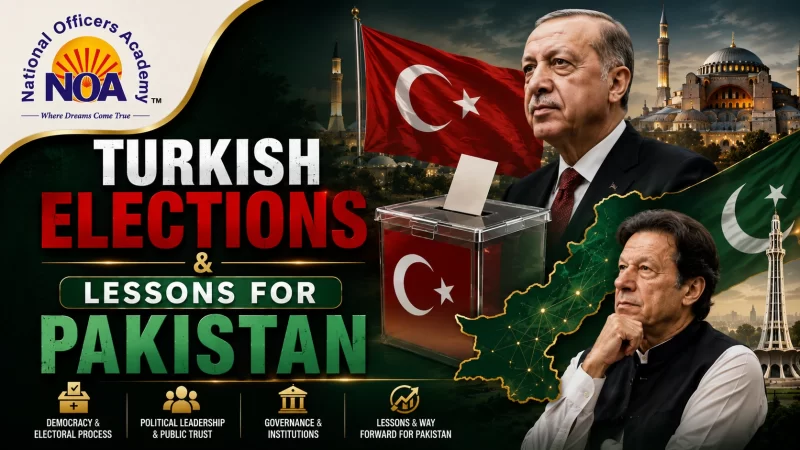
Turkish Elections & Lessons for Pakistan
Turkey’s electoral experience offers important lessons for Pakistan regarding democratic continuity, electoral credibility, institutional responsibility and public confidence. The article contrasts Turkey’s 2023 presidential election with Pakistan’s electoral experience, particularly the controversies surrounding the 2018 general election.
Despite the devastating February 2023 earthquake, Turkey proceeded with its scheduled presidential and parliamentary elections on 14 May. Voter participation remained remarkably high, reflecting public engagement with the political process. Arrangements were also made for Turkish citizens abroad to participate in voting, demonstrating the importance of electoral accessibility.
A particularly significant feature was Turkey’s adherence to its constitutional electoral procedure. In the first presidential round, Recep Tayyip Erdoğan received 49.51% of the vote, falling short of the majority required for victory. Rather than bypassing the legal requirement, Turkey proceeded to a runoff election on 28 May. Erdoğan subsequently secured the majority and was declared the winner.
Turkey and Pakistan: Contrasting Political Scenarios and Commitment to Democracy
According to the article, Turkey’s experience illustrates the importance of respecting electoral rules even when political competition is extremely close. Political actors accepted the necessity of the second round rather than allowing political expediency to override established procedures.
The comparison with Pakistan highlights concerns surrounding electoral manipulation, institutional credibility and political mistrust. Although Pakistan enacted the Elections Act, 2017 with the expectation of strengthening electoral governance, controversies surrounding subsequent elections raised questions about implementation and public confidence in the democratic process.
Another lesson concerns the role of political leadership during institutional crises. The article points to the response of Turkish opposition forces during the 2016 attempted coup, when political rivals opposed the military takeover despite their disagreements with Erdoğan. This is presented as an example of placing constitutional continuity above partisan advantage.
For Pakistan, therefore, credible democracy requires more than simply conducting elections. It depends upon rule-based electoral competition, institutional neutrality, political tolerance, public trust and acceptance of constitutional procedures. Political parties must strengthen democratic norms rather than seek short-term advantage through extra-constitutional means.
Turkey’s experience ultimately reinforces a fundamental democratic principle: the legitimacy of government depends not merely on who wins an election, but on whether citizens trust the process through which that victory is achieved.