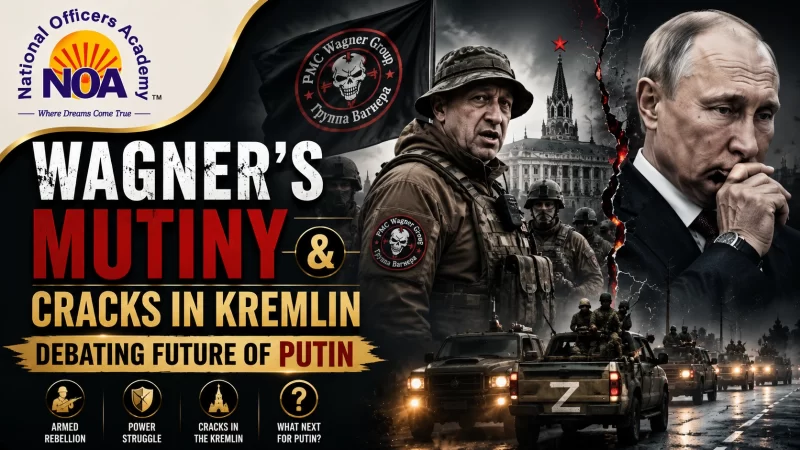
Wagner’s Mutiny & Cracks in Kremlin: Debating the Future of Putin
The Wagner Group’s June 2023 rebellion represented one of the most serious internal challenges to Vladimir Putin’s authority during his long rule. Led by Yevgeny Prigozhin, Wagner forces seized control of Rostov and advanced toward Moscow after turning against Russia’s military leadership. Putin denounced the rebellion as an act of betrayal, while Prigozhin described his advance as a “march for justice” rather than an attempted military coup.
The immediate confrontation ended after Belarusian President Alexander Lukashenko mediated an agreement between the Kremlin and Prigozhin. Although the rebellion was halted before reaching Moscow, its political significance extended beyond the battlefield. The ease with which Wagner forces occupied important military facilities raised questions about the strength of Russia’s security establishment and the durability of Putin’s centralized authority.
The mutiny also exposed possible cracks within the Kremlin and Russia’s political elite. According to the article’s analysis, sections of the Russian elite had already become increasingly uncomfortable with the economic and political consequences of the Ukraine war and Western sanctions. Prigozhin’s challenge demonstrated that an influential figure could openly confront the Russian establishment, potentially encouraging further divisions within the elite.
However, the revolt did not necessarily mean that another coup was imminent. Putin retained considerable institutional and security power, while potential challengers faced substantial risks. The greater danger identified in the analysis was the possibility of an elite split, particularly if Russia suffered major military setbacks, economic deterioration or further challenges to domestic security.
The future of a post-Putin Russia therefore remained uncertain. A severe battlefield defeat or economic crisis could potentially push sections of the Russian establishment toward leadership change and negotiations over the Ukraine conflict. Yet Putin’s departure would not automatically produce a liberal or pro-Western political system. Much would depend upon which factions within Russia’s political, military and security establishment emerged dominant.
The Wagner mutiny ultimately demonstrated that even a highly centralized political system can contain internal vulnerabilities. Rather than immediately ending Putin’s rule, the rebellion raised deeper questions about elite cohesion, military loyalty, political succession and the long-term stability of the Kremlin.