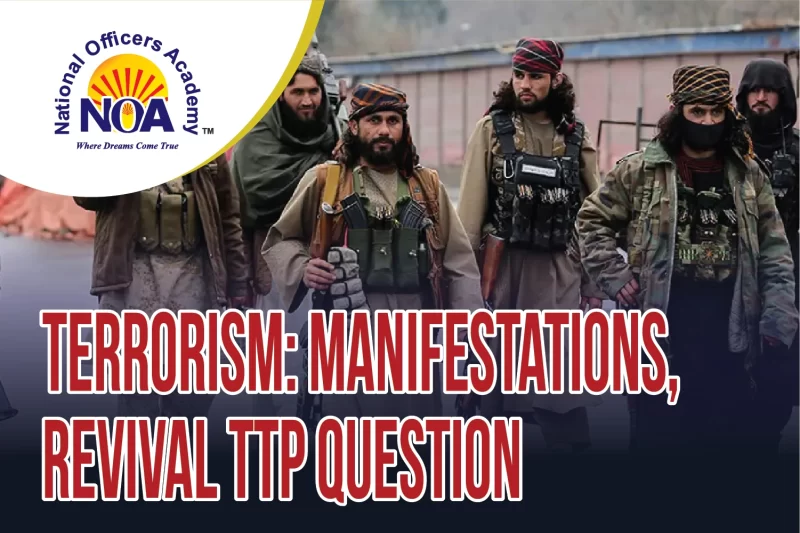
Terrorism in Pakistan: Manifestations, Evolution and the Revival of the TTP Threat
Terrorism has emerged as one of the most complex security challenges confronting Pakistan. In recent years, terrorist activity associated with the Tehreek-i-Taliban Pakistan (TTP) and other militant networks has intensified security concerns, particularly in Khyber Pakhtunkhwa and Balochistan.
The challenge, however, extends far beyond conventional armed violence. Terrorism has evolved alongside technology, political instability, transnational networks and changing methods of warfare. Understanding its historical development, manifestations and organizational evolution is therefore essential for assessing the renewed TTP threat and its implications for Pakistan.
Decoding Terrorism and Its Primary Manifestations
Terrorism: A Growing Threat
Pakistan has paid a considerable human, economic and political price in confronting terrorism. The resurgence of militant activity has consequently revived debate over earlier counterterrorism policies, including negotiations and the reintegration of militants without sufficiently robust legal procedures and guarantees.
The country’s experience also demonstrates that security threats do not necessarily emerge through conventional warfare alone. Subversion, proxy networks, political destabilization and irregular warfare can be employed to exploit the internal vulnerabilities of a state.
Historical Evolution of Terrorism
Terrorism is not exclusively a modern phenomenon. Its historical roots can be traced to ancient political and religious movements that employed violence and assassination to pursue their objectives. The Sicarii Zealots of the first century and the later Assassins are frequently cited among historical examples.
The concept acquired greater political significance during the French Revolution, when terror became associated with organized political violence.
Despite extensive academic and political debate, there remains no universally accepted definition of terrorism. Broadly, however, modern terrorism involves the use or threat of violence and fear to pursue political, ideological or strategic objectives.
Terrorism and the Nexus Between State and Non-State Actors
Modern terrorism involves a complicated interaction among governments, non-state organizations, criminal networks and ideologically motivated groups.
Recruitment into militant organizations may be facilitated by:
Religious or ideological motivations
Ethnic and social divisions
Economic inequalities
Political grievances
Financial incentives
Financing is equally important. Non-state militant organizations may obtain resources through foreign sponsors, smuggling, coercion, corruption and criminal activities. The interaction among politics, organized crime and corruption can therefore create an environment in which militant organizations acquire financing, manpower and influence.
Guerrilla warfare represents another dimension of unconventional conflict. Derived from the Spanish word guerra, meaning war, the term “guerrilla” came to signify irregular or “little war” tactics involving smaller forces operating outside conventional military structures.
The Impact of 9/11 on the Global Terrorism Discourse
The September 11, 2001 attacks fundamentally transformed international perceptions of terrorism and global counterterrorism policies.
The subsequent War on Terror reshaped security doctrines, military interventions and political narratives across the world. Muslim-majority states became deeply affected by these developments as terrorism increasingly became intertwined with wider geopolitical and strategic considerations.
The experience also demonstrated a fundamental difficulty: terrorism cannot be defeated through a single military or policing strategy. Its causes, manifestations and organizational structures vary considerably across societies and regions.
The Complex Relationship Between the TTP and Afghan Taliban
The relationship between the Tehreek-i-Taliban Pakistan and the Afghan Taliban constitutes an important dimension of Pakistan’s contemporary security challenge.
Although the TTP has not formally been part of the Afghan Taliban, elements associated with the TTP provided support during the Afghan Taliban’s conflict against US-led forces. This historical relationship subsequently complicated Pakistan’s efforts to address the TTP threat.
The multiplicity of militant factions further complicates negotiations. Different groups may possess distinct leadership structures, sponsors and objectives, making the formulation of a comprehensive settlement extremely difficult.
The challenge for Pakistan is therefore not merely to negotiate with individual militant factions but to establish an effective framework that prevents armed groups from reorganizing and reintegrating into settled areas without adequate security guarantees.
Terrorism’s Changing Tactics: The Technology Dimension
Modern terrorism has increasingly incorporated information technology, cyberspace, satellite communications and other technological capabilities into conventional methods.
This evolution has considerably expanded the range of potential targets. Contemporary terrorist and extremist networks may seek to exploit digital technologies to:
Disrupt financial institutions and information systems
Manipulate or damage digital data
Spread propaganda through social media
Exploit religious, ethnic and socioeconomic divisions
Disrupt communications and critical infrastructure
Influence and radicalize vulnerable sections of society
The continuing development of artificial intelligence and other emerging technologies introduces an additional challenge. States must therefore continuously adapt their security and regulatory systems to prevent new technologies from being exploited by violent actors.
Terrorism as a Multidimensional Security Threat
Terrorism can no longer be understood exclusively through bombs, armed attacks or conventional militancy. It increasingly operates across physical, informational, financial, technological and psychological domains.
Political instability can create an enabling environment in which such networks reorganize and exploit institutional weaknesses.
The contemporary spectrum of threats can include attacks against financial institutions, cyber intrusions, disruption of communications, propaganda, social polarization, attacks on defence-related infrastructure, trafficking networks and manipulation of vulnerable youth.
Pakistan therefore requires an adaptive counterterrorism architecture capable of responding to both conventional militancy and emerging forms of asymmetric and technologically enabled threats.
Debating the Revival of the TTP Threat
Political Instability and the Growth of Terrorist Networks
Political and economic instability can create opportunities for terrorist organizations to regroup and strengthen their networks.
The TTP has attempted to capitalize on vulnerabilities by reorganizing its structure and extending its influence beyond traditional strongholds. Such expansion creates a particularly difficult challenge because it intersects with existing religious, ethnic, political and socioeconomic fault lines.
TTP’s Expansion Through New Administrative Units
The article reports that the TTP announced additional so-called “administrative units” covering areas including Kalat, Makran, southern Punjab and northern Punjab.
According to The Khorasan Diary, as cited in the source material, the TTP at that time claimed 12 such units: seven in Khyber Pakhtunkhwa, one in Gilgit-Baltistan and two each in Balochistan and Punjab.
These organizational developments occurred alongside reports of internal disagreements within the militant network.
The relationship between these developments and possible pressure from the Afghan Taliban remained uncertain. The source notes conflicting reporting over whether the Afghan Taliban was attempting to restrain the TTP or whether support for the organization remained intact.
Internal Conflicts and Leadership Struggles Within the TTP
Internal competition over positions, authority and resources has also produced divisions within the TTP.
The source material cites several reported clashes involving TTP commanders in 2022 and the period surrounding it. These incidents suggest that organizational expansion does not necessarily imply complete internal cohesion.
Historically, other militant organizations, including Al Qaeda, have reportedly attempted to mediate disputes among factions. The ability of the TTP leadership to manage internal disagreements therefore remains an important factor in assessing the organization’s cohesion and operational capacity.
Absorption of New Militant Groups
Another important feature of the TTP’s organizational strategy has been the incorporation of smaller militant factions.
The article reports that a North Waziristan-based group led by Yasir Dawar pledged allegiance to TTP chief Noor Wali Mehsud. It further states that several groups had merged with the TTP since July 2020.
Such mergers potentially provide militant organizations with additional manpower, local networks and geographical reach.
The development becomes particularly significant when groups operating in areas already affected by militancy become incorporated into a broader organizational structure.
TTP’s Focus on Northern Punjab and the Lal Masjid Factor
Northern Punjab has particular strategic significance because of its proximity to Islamabad and Rawalpindi.
The article also identifies the legacy of Lal Masjid as an ideological and symbolic factor. The 2007 military operation against militants inside Lal Masjid was followed by a wave of militant violence, while Abdul Rasheed Ghazi subsequently became a symbolic figure for the TTP and associated extremist networks.
The emergence of a northern Punjab chapter therefore reflects both strategic considerations and the continued symbolic influence of earlier episodes of militancy.
Growing TTP Influence in Balochistan
The TTP’s attempted penetration into Baloch-majority regions represents another significant security concern.
According to the source material, militant groups led by individuals identified as Mazar Baloch, Akram Baloch and Asim Baloch reportedly joined the TTP from areas including Makran, Kalat and Quetta.
The precise numerical strength of these groups remained uncertain. Nevertheless, their reported alignment with the TTP suggested an attempt by the organization to broaden its geographical and recruitment base.
This is particularly consequential because Balochistan already faces a separate nationalist insurgency. The emergence of additional militant networks can therefore further complicate the province’s security environment.
A Complex Security Challenge for Pakistan
Pakistan’s security forces have conducted extensive counterterrorism operations against the TTP and other militant networks. Nevertheless, the changing geographical and organizational character of terrorism presents a continuing challenge.
TTP militancy in Khyber Pakhtunkhwa and the former tribal areas, its attempts to expand into Punjab and Balochistan, and the simultaneous presence of the Baloch nationalist insurgency create overlapping security pressures.
The source also cautions against assuming a proven organizational connection between the TTP and Baloch insurgent groups, noting that stronger evidence would be required to establish such a relationship.
The broader lesson is that terrorism in Pakistan has become an increasingly multidimensional challenge. Political instability, socioeconomic vulnerabilities, militant mergers, technological transformation and geographical expansion can reinforce one another.
Pakistan’s response must consequently evolve beyond traditional counterterrorism approaches. A comprehensive strategy requires stronger institutions, political stability, effective intelligence coordination, technological preparedness and policies capable of preventing militant organizations from exploiting vulnerable communities.
If insecurity, militancy and violence persist over an extended period, their consequences will not remain confined to the security sphere. They can directly undermine Pakistan’s political stability, economic development and national cohesion.