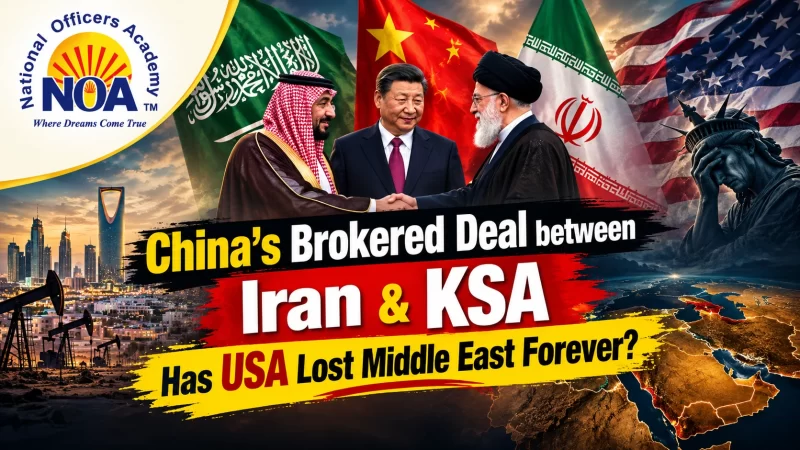
Growing Influence of China in the Middle East: Inevitable Change in American Unipolar World Order
China’s engagement with the Middle East expanded significantly after Deng Xiaoping’s modernization programme increased the country’s demand for oil and gas. By the end of 1993, China had established diplomatic relations with all Arab countries. With the beginning of the new millennium, China was importing nearly half of its energy requirements from the Middle East while simultaneously expanding exports, investments, infrastructure development and technological cooperation across the region.
Unlike the United States, China has generally sought to avoid direct involvement in regional conflicts. Instead, Beijing has relied heavily on economic diplomacy, infrastructure investment and mutually beneficial partnerships. This approach has enabled China to strengthen its relationships with Saudi Arabia, the United Arab Emirates, Iran and other regional states without assuming the same security role traditionally played by Washington.
2022: A Year of Flourishing Cooperation
The year 2022 witnessed considerable diplomatic engagement between China and Middle Eastern states. Foreign ministers from Bahrain, Kuwait, Oman and Saudi Arabia visited Beijing, while the UAE maintained high-level diplomatic contact with China. Turkey also sought stronger economic relations with Beijing, while Iran worked to advance its long-term economic and strategic partnership with China.
These developments reflected Beijing’s growing ability to maintain relationships with states that often have competing strategic interests.
Strategic Cooperation Agreements
China developed strategic cooperation agreements with Algeria, Egypt, Iran, Saudi Arabia and the United Arab Emirates.
Its approach towards Iran, however, remained cautious. Despite the long-term partnership between Beijing and Tehran, China sought to avoid allowing this relationship to develop into direct confrontation with the United States.
Trade and Investment in Arab Countries
Economic relations form the foundation of China’s influence in the Middle East.
At a March 2022 meeting, Arab League foreign ministers praised China’s efforts towards peaceful settlement of regional conflicts and expressed interest in strengthening cooperation. According to the article, bilateral trade between China and Arab countries reached approximately $330 billion in 2021, excluding investments associated with the Belt and Road Initiative and other infrastructure and technology projects.
China’s economic engagement therefore extends far beyond energy imports and increasingly includes investment, infrastructure, logistics and technological cooperation.
Development of Port Infrastructure in Saudi Arabia and the UAE
Saudi Arabia and the UAE occupy strategically important positions connecting Asia, Africa and Europe.
Saudi Arabia has sought to develop major transportation and logistics hubs, including the ports of Dammam and Jeddah. The UAE has similarly developed major port and logistics infrastructure. These developments have complemented China’s Belt and Road Initiative by creating maritime infrastructure capable of facilitating Chinese trade with international markets.
Saudi Arabia: A Major Chinese Partner
Saudi Arabia emerged as one of China’s most important partners in the Gulf. Formal diplomatic relations between Beijing and Riyadh were established in 1990, although their strategic engagement had begun earlier.
Their relationship subsequently expanded into infrastructure, energy and technological cooperation. China participated in projects such as the Mecca monorail and entered an agreement with Saudi Arabia concerning peaceful nuclear cooperation in 2012.
Despite increasing Saudi-Chinese cooperation, the article emphasizes that the United States remained a strategic Saudi partner and an important supplier of advanced military equipment.
Restoration of Saudi–Iran Relations: China’s Diplomatic Role
One of the clearest demonstrations of China’s expanding diplomatic influence came through its mediation between Saudi Arabia and Iran.
The two regional rivals announced the restoration of diplomatic relations following talks in Beijing in March 2023. The agreement provided for reopening diplomatic missions and reviving previous agreements concerning security, trade and investment.
China was particularly well placed to facilitate the agreement because it maintained substantial relations with both Saudi Arabia and Iran and purchased oil from both countries. The development consequently highlighted Beijing’s growing diplomatic role in the Gulf.
UAE Infrastructure and the Belt and Road Initiative
The UAE has also become an important component of China’s maritime connectivity strategy.
Abu Dhabi Ports and Dubai-based DP World developed and upgraded port infrastructure connecting the Gulf with the wider maritime network towards the Suez Canal. Alongside facilities in Egypt and Oman, these projects contributed to the development of China’s maritime Belt and Road Initiative.
Chinese Investment in Gulf Ports
According to the article, Chinese investment in Gulf ports and infrastructure had exceeded $177 billion by 2019.
These investments provided China with improved trade routes towards Africa and Europe, while Gulf countries benefited from investment, transit revenues and opportunities to diversify their economies.
China and the Reconstruction of Syria
China’s Middle Eastern engagement also expanded into Syria.
In January 2022, China and Syria signed a memorandum concerning Syrian participation in the Belt and Road Initiative. The article identifies Chinese expertise in constructing ports, roads and railways as a potentially important component of Syria’s reconstruction.
China’s Investment in Iraq
Iraq has also attracted significant Chinese investment.
According to the article, Beijing invested approximately $10.5 billion in Iraq in 2021 through Belt and Road and energy-related projects. Iraq was also identified as one of China’s major oil suppliers.
China and Egypt
Egypt occupies an important geographical position within the Belt and Road Initiative.
China has participated in major Egyptian infrastructure developments, including projects associated with the new administrative capital and the Economic-Technological Development Area in the Suez Canal Economic Zone. The article states that agreements worth approximately $18 billion were signed between China and Egypt in 2018.
Multilateral Forums as Instruments of Chinese Foreign Policy
China has supplemented bilateral diplomacy with multilateral institutions.
The Forum on China-Africa Cooperation (FOCAC) facilitates engagement with African states, while the China-Arab States Cooperation Forum (CASCF) provides a platform for cooperation with members of the Arab League.
The Shanghai Cooperation Organization (SCO) has similarly become increasingly relevant to China’s engagement with Middle Eastern countries, providing another platform through which Beijing can broaden regional relationships.
China vs the United States in the Middle East
China’s growing influence does not necessarily mean that Beijing seeks to replace the United States in every aspect of Middle Eastern affairs.
The article argues that China has generally attempted to avoid direct involvement in regional security conflicts and confrontation with Washington. Its primary emphasis has instead remained on economic relationships, investment, connectivity and diplomatic engagement.
This creates an important distinction between the two powers: while Washington has historically maintained extensive security and military relationships across the region, China’s expanding influence has been driven primarily through economic and diplomatic instruments.
Conclusion
China has steadily developed multidimensional political and economic relationships throughout the Middle East. Its trade, foreign investment, technical cooperation, infrastructure projects and strategic partnerships have considerably expanded Beijing’s regional presence.
However, China’s rise does not automatically imply that the United States has been displaced from the Middle East. The article instead presents an increasingly diversified regional order in which Middle Eastern countries have greater opportunities to develop relationships with multiple great powers.
China has incorporated 21 Arab countries into the Belt and Road Initiative, strengthening the infrastructure linking Asian production with markets in Europe and Africa. Its growing economic and diplomatic footprint therefore illustrates a broader transformation of the regional balance rather than the simple replacement of one dominant power by another.