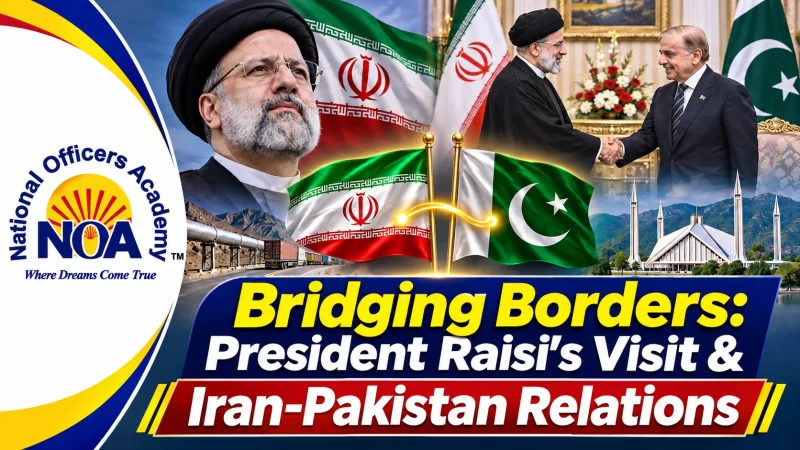
Bridging Borders: President Raisi’s Visit & Iran-Pakistan Relations
Iranian President Dr. Ebrahim Raisi’s official visit to Pakistan from April 22 to 24, 2024, represented an important diplomatic development in relations between the two neighbouring countries. The visit highlighted their deep historical, cultural, religious, and geographical connections while creating opportunities to strengthen bilateral cooperation in trade, energy, security, and regional development.
Pakistan and Iran share longstanding civilizational ties, a common border, and membership in regional and international organizations, including the Organization of Islamic Cooperation (OIC) and the Economic Cooperation Organization (ECO).
These connections have provided a foundation for diplomatic engagement, although economic constraints, border-security concerns, geopolitical rivalries, and international sanctions have frequently complicated bilateral cooperation.
President Raisi’s arrival in Islamabad was marked by a warm official reception and expressions of friendship between the two countries. His visit was particularly significant because it took place shortly after Pakistan’s February 2024 general elections and the formation of a new government led by Prime Minister Shehbaz Sharif.
President Raisi’s Three-Day Visit to Pakistan
During his three-day visit, President Ebrahim Raisi held meetings with Pakistan’s senior political and military leadership to discuss issues of mutual interest.
These engagements included meetings with Prime Minister Shehbaz Sharif, President Asif Ali Zardari, and Chief of Army Staff General Syed Asim Munir.
The discussions addressed bilateral trade, economic connectivity, border security, energy cooperation, regional stability, and developments in the Middle East.
President Raisi’s Visit to Lahore
President Raisi also visited Lahore, where he paid homage to the renowned poet-philosopher Allama Muhammad Iqbal at his mausoleum and laid a floral wreath.
Allama Iqbal’s intellectual and literary legacy holds particular significance in Pakistan-Iran relations because of his contributions to Persian poetry, Islamic philosophy, and the intellectual traditions shared by both societies.
During his engagements in Lahore, President Raisi met with Punjab’s political leadership, including Chief Minister Maryam Nawaz Sharif.
The visit provided an opportunity to highlight cultural connections and discuss possibilities for enhanced provincial and economic cooperation.
President Raisi’s Visit to Karachi
President Raisi subsequently travelled to Karachi, Pakistan’s principal commercial and industrial centre.
His engagements highlighted the potential for stronger business-to-business relationships, industrial cooperation, and commercial investment between Pakistan and Iran.
The Sindh government organized an official reception in his honour, reflecting the importance attached to the visit.
These engagements demonstrated that bilateral cooperation extends beyond diplomatic relations and encompasses economic, cultural, and people-to-people connections.
Visit Amid Rising Tensions in the Middle East
President Raisi’s visit occurred during a particularly sensitive period in Middle Eastern politics.
Following the Hamas-led attacks on Israel on October 7, 2023, Israel launched extensive military operations in the Gaza Strip. The resulting conflict produced a severe humanitarian crisis, widespread destruction, and significant civilian casualties.
The conflict also intensified regional tensions involving Iran, Israel, Lebanon, Syria, and other actors.
Iran-Israel Confrontation and Regional Security
Israel has long accused Iran of supporting armed organizations operating against Israeli interests, including Hezbollah in Lebanon and other Iran-aligned groups across the region.
Iran, meanwhile, has maintained that its regional policies support resistance movements and counter Israeli influence.
These competing positions have contributed to longstanding hostility between Tehran and Tel Aviv.
Israeli Strike in Damascus and Iran’s Retaliation
On April 1, 2024, an Israeli strike on a building associated with Iran’s diplomatic compound in Damascus killed senior members of Iran’s Islamic Revolutionary Guard Corps, including high-ranking commanders.
The attack significantly escalated tensions between the two countries.
Iran responded on April 13–14, 2024, by launching drones and missiles towards Israel, marking a major direct military confrontation between the two regional rivals.
Many of the incoming projectiles were intercepted by Israeli and allied defensive systems.
Subsequently, reports emerged of a limited Israeli strike near Isfahan in Iran on April 19, 2024.
These developments demonstrated the danger of further escalation across the Middle East.
Pakistan and Iran’s Shared Position on Palestine
During his visit, President Raisi and Prime Minister Shehbaz Sharif reiterated their governments’ support for the Palestinian people and expressed concern over the humanitarian situation in Gaza.
Pakistan has historically supported Palestinian self-determination and advocated a negotiated political settlement based on relevant international legal principles and United Nations resolutions.
Iran has also maintained a strongly critical position towards Israeli policies.
Although the two countries differ in certain regional security approaches, their diplomatic positions on Palestinian rights provided an important area of convergence during President Raisi’s visit.
The visit thus carried significance not only for bilateral relations but also for discussions surrounding the wider Middle Eastern crisis.
Pakistan-Iran Trade Relations Amid Political and Economic Pressures
Economic cooperation emerged as one of the central objectives of President Raisi’s visit.
Both countries acknowledged that their existing bilateral trade remained below its potential, considering their geographical proximity, shared border, and complementary economic requirements.
The $10 Billion Bilateral Trade Target
During the April 2024 visit, Pakistan and Iran agreed to work towards increasing bilateral trade to US$10 billion over the following five years.
The two governments also signed eight agreements and memoranda of understanding covering different fields of cooperation.
These arrangements reflected an intention to strengthen economic connectivity and expand institutional cooperation.
Both sides emphasized the need to promote trade, improve border infrastructure, encourage commercial exchanges, and develop mechanisms capable of facilitating legitimate business transactions.
Opportunities for Expanding Bilateral Trade
Pakistan and Iran possess considerable potential for commercial cooperation in several sectors.
- Energy: Natural gas, electricity, petroleum products, and energy infrastructure.
- Agriculture: Food products, agricultural commodities, and veterinary cooperation.
- Manufacturing: Industrial inputs, machinery, and manufactured goods.
- Transportation: Road, rail, and cross-border freight connectivity.
- Border Markets: Development of legal commercial facilities along the Pakistan-Iran border.
- Tourism: Religious tourism, cultural exchanges, and travel-related services.
- Regional Connectivity: Integration with wider trade corridors and economic infrastructure.
Greater economic cooperation could improve market access, generate employment, encourage investment, and strengthen the economies of border communities.
However, practical implementation remains dependent on financial arrangements, customs procedures, regulatory compliance, political stability, and international sanctions.
The Iran-Pakistan Gas Pipeline: Energy Cooperation and Geopolitical Constraints
The Iran-Pakistan gas pipeline has remained one of the most significant yet controversial projects in bilateral relations.
Pakistan faces recurring challenges involving energy availability, imported fuel costs, industrial competitiveness, and foreign exchange pressures.
Iran possesses substantial natural gas resources, making energy cooperation an attractive possibility for Pakistan.
Background of the Iran-Pakistan Gas Pipeline
The Iran-Pakistan gas pipeline project was developed to facilitate the supply of Iranian natural gas to Pakistan.
The project received renewed attention in March 2013, when leaders of the two countries participated in a ceremony marking progress on the proposed pipeline arrangement.
Iran completed substantial pipeline infrastructure on its side of the border, while Pakistan’s required cross-border segment remained incomplete during the period covered by this article.
The project faced delays associated with financing, infrastructure development, commercial conditions, and concerns about United States sanctions on Iran.
Potential Benefits for Pakistan’s Energy Sector
Supporters of the pipeline argue that access to Iranian natural gas could provide several economic advantages.
- Improved Energy Security: Diversifying natural gas supply sources could reduce dependence on limited alternatives.
- Industrial Competitiveness: Reliable energy supplies could support manufacturing and export-oriented industries.
- Reduced Transportation Costs: Pipeline supplies may offer logistical advantages compared with certain alternative energy arrangements.
- Regional Integration: Energy infrastructure could strengthen long-term economic relations between neighbouring countries.
- Economic Development: Improved energy availability could support industrial investment and employment generation.
Nevertheless, the actual financial benefits would depend on contractual gas prices, pipeline development costs, domestic demand, financing arrangements, and the availability of alternative energy supplies.
United States Sanctions and Pipeline Delays
One of the major obstacles to implementing the pipeline has been the international sanctions environment surrounding Iran.
The United States has repeatedly warned that certain business transactions involving Iranian entities could expose participants to sanctions.
These warnings have complicated Pakistan’s efforts to pursue energy cooperation while maintaining important economic and diplomatic relations with Washington.
Pakistan therefore faces a difficult policy choice: securing potentially beneficial regional energy supplies while managing sanctions exposure and preserving access to international financial markets.
Potential Contractual Penalties
The original analysis also highlights concerns that delays in fulfilling the pipeline agreement could expose Pakistan to significant contractual liabilities.
Such risks underline the importance of examining the project’s commercial, financial, and legal arrangements.
However, potential penalties should not be treated as confirmed payable amounts without reviewing the relevant contractual provisions and the status of any dispute-resolution proceedings.
Iran-Saudi Arabia Reconciliation: Opportunities and Challenges
The restoration of diplomatic relations between Iran and Saudi Arabia in 2023 represented an important development in Middle Eastern diplomacy.
China facilitated the agreement, which created opportunities for renewed diplomatic engagement between the two regional rivals.
The reconciliation was significant for Pakistan because Islamabad maintains close relations with Saudi Arabia while also sharing a long border and historical connections with Iran.
Reducing Regional Diplomatic Tensions
Improved relations between Tehran and Riyadh offered the possibility of reducing regional polarization and encouraging economic cooperation.
For Pakistan, reduced tensions between these countries could help ease the diplomatic pressures associated with maintaining balanced relationships in the Middle East.
It could also create opportunities for cooperation involving trade, energy, investment, and regional connectivity.
Pakistan’s Balancing Role
Pakistan has historically sought to maintain constructive relations with both Saudi Arabia and Iran.
However, differences between these countries have sometimes complicated Pakistan’s diplomatic choices.
The China-mediated reconciliation provided an opportunity for Islamabad to pursue stronger relations with Tehran without necessarily undermining its longstanding partnership with Riyadh.
This development also strengthened the broader argument that regional cooperation could produce economic benefits for countries facing financial and developmental challenges.
Pakistan-Iran Border Security and Counterterrorism Cooperation
Despite their historical connections, Pakistan and Iran have experienced recurring tensions over cross-border militant activity.
Both governments have accused armed organizations operating near their common border of threatening national security.
The January 2024 Border Crisis
In January 2024, bilateral relations experienced a serious diplomatic and military crisis following Iranian strikes inside Pakistan.
Iran stated that its operations targeted militant elements, while Pakistan condemned the strikes as violations of its sovereignty.
Pakistan subsequently carried out retaliatory strikes inside Iran, stating that its targets were terrorist hideouts.
The confrontation created the possibility of a wider bilateral crisis.
However, diplomatic engagement helped de-escalate tensions, and both countries subsequently reaffirmed the importance of cooperation.
Security Commitments During President Raisi’s Visit
During the April 2024 visit, Pakistan and Iran emphasized their commitment to preventing cross-border militancy and strengthening security coordination.
Areas of concern included:
- Cross-border terrorism and militant activity.
- Smuggling and illegal commercial networks.
- Human trafficking and organized crime.
- Border surveillance and security coordination.
- Information sharing between relevant institutions.
- Protection of legitimate trade and transportation routes.
Stronger security cooperation was viewed as essential for improving diplomatic relations and enabling economic activity along the border.
Pakistan’s Economic Dilemma: National Interests Amid External Constraints
Pakistan’s economic vulnerabilities have frequently influenced its foreign policy choices.
The country has faced recurring balance-of-payments difficulties, pressure on foreign exchange reserves, fiscal constraints, and dependence on external financing.
These challenges can reduce the flexibility available to policymakers when pursuing relationships with countries facing international sanctions.
Dependence on International Financial Institutions
Pakistan’s engagements with the International Monetary Fund (IMF), World Bank, and other international financial institutions have remained important for economic stabilization and development financing.
During the period surrounding President Raisi’s visit, Pakistan was pursuing external financial support to address macroeconomic pressures.
The original analysis refers to anticipated IMF financing and development funding requirements, including infrastructure projects such as the Diamer-Bhasha Dam.
These financing requirements contributed to concerns about the economic consequences of possible sanctions associated with certain forms of trade with Iran.
Energy Needs Versus Financial Vulnerability
Pakistan’s energy challenges create a strong economic incentive to examine regional supply arrangements.
However, sanctions exposure, financing restrictions, international banking arrangements, and diplomatic considerations can constrain available options.
The challenge is therefore not simply whether Pakistan should cooperate economically with Iran, but how it can pursue national energy and trade interests without exposing its economy to disproportionate financial risks.
The Need for an Independent and Balanced Foreign Policy
The original analysis argues that economic dependence limits Pakistan’s ability to formulate foreign policy exclusively around national priorities.
It maintains that Islamabad should develop greater financial resilience, diversify its international partnerships, and improve domestic economic performance.
A stronger export base, sustainable external accounts, and more competitive domestic industries could gradually increase Pakistan’s room for independent diplomatic decision-making.
At the same time, national independence in foreign policy requires careful assessment of international legal obligations, economic consequences, and strategic realities.
America’s Response to President Raisi’s Visit to Pakistan
The United States responded to the growing diplomatic and economic engagement between Pakistan and Iran by emphasizing the risks associated with transactions involving sanctioned Iranian entities.
Washington’s Warning About Potential Sanctions
During a State Department briefing on April 23, 2024, US officials advised businesses and governments considering transactions involving Iran to remain aware of potential sanctions risks.
The warning came as Pakistan and Iran announced their intention to expand bilateral trade and strengthen economic cooperation.
Washington also emphasized the importance of its economic relationship with Pakistan, including trade and investment links.
Pakistan’s Diplomatic Response
Pakistan maintained that its relationship with Iran was rooted in geography, shared history, cultural connections, and legitimate national interests.
Islamabad also emphasized the need for constructive diplomatic engagement with the United States.
The situation highlighted the complexity of Pakistan’s foreign policy, which must simultaneously manage relations with neighbouring countries and major international economic partners.
United States Sanctions Related to Pakistan’s Missile Programme
The original article also discusses US sanctions announced in April 2024 against entities accused of supplying equipment or materials associated with Pakistan’s ballistic missile programme.
These designations involved companies based in China and Belarus.
Previously, the United States had also announced restrictions involving Chinese entities accused of supporting Pakistan’s missile development activities.
Pakistan criticized what it regarded as discriminatory applications of export-control policies and emphasized its sovereign security requirements.
The missile-related sanctions and the warnings concerning Iran trade were separate policy matters, although both contributed to wider diplomatic debate about Pakistan-US relations.
Status of the Iran-Pakistan Gas Pipeline Project
The Iran-Pakistan gas pipeline remains a central example of the competing economic and geopolitical considerations affecting bilateral cooperation.
The project was intended to connect Iranian natural gas supplies with Pakistan’s energy infrastructure.
However, the development of the Pakistani section was repeatedly delayed.
Infrastructure and Implementation Challenges
The original analysis highlights the significant construction work carried out on the Iranian side and the incomplete infrastructure required for gas transportation into Pakistan.
Its central concern is that prolonged delays could undermine Pakistan’s energy objectives and create contractual complications.
Completion of the project would require suitable financing, technical development, commercial agreements, and management of sanctions-related legal risks.
The Need for Diplomatic Engagement
The article argues that Pakistan should engage the United States through high-level diplomatic channels to communicate its energy requirements and economic constraints.
Pakistan could also examine lawful commercial arrangements, seek appropriate sanctions guidance or exemptions where available, and assess alternative energy options.
Such engagement would allow Islamabad to pursue its economic interests while reducing the risk of unintended financial consequences.
President Raisi’s Visit and Complex Regional Dynamics
The April 2024 visit occurred against a backdrop of overlapping developments in the Middle East and South Asia.
These included the Gaza conflict, direct Iran-Israel military exchanges, China-mediated regional diplomacy, and renewed efforts to improve economic connectivity.
The Gaza Conflict and Regional Polarization
At the time of President Raisi’s visit, the war in Gaza had entered its seventh month.
The original article cited more than 34,000 reported Palestinian deaths during this period, alongside widespread injuries, displacement, and destruction.
These figures reflected reporting available in April 2024 rather than present-day casualty totals.
The conflict intensified debates about international humanitarian law, civilian protection, and the diplomatic responsibilities of major world powers.
Iran-Israel Escalation and Its Regional Consequences
The April 2024 exchanges between Iran and Israel demonstrated how rapidly regional tensions could escalate into direct confrontation.
Pakistan, as a neighbouring country of Iran, had an interest in preventing further instability that could affect regional security, energy markets, and trade relations.
President Raisi’s visit therefore assumed additional diplomatic significance.
Renewed Regional Diplomatic Engagement
During the same period, Pakistan was pursuing stronger cooperation with Saudi Arabia and other regional partners.
The improvement in Iran-Saudi Arabia relations, together with diplomatic engagements involving Pakistan, indicated possibilities for greater regional cooperation.
Such developments could support economic integration, improved connectivity, and the reduction of longstanding political tensions.
Pakistan and Afghanistan Trade Dynamics: Prospects and Challenges
Regional economic cooperation extends beyond relations between Pakistan and Iran.
Pakistan’s trade and transit relationships with Afghanistan also influence the broader connectivity of South Asia, Central Asia, and the Middle East.
Pakistan-Afghanistan Transit Trade
Pakistan and Afghanistan have periodically engaged in negotiations concerning cross-border trade, transit arrangements, and customs procedures.
Improved trade facilitation could benefit transport businesses, exporters, importers, and border communities.
However, security concerns, border restrictions, administrative disputes, and political tensions have frequently disrupted commercial activity.
Prospects for Regional Trade with India
The original analysis also notes that sections of Pakistan’s business community have supported improved trade relations with India.
Supporters argue that greater regional trade could lower transportation costs, expand markets, and promote economic efficiency.
Nevertheless, political disputes and security concerns continue to complicate bilateral economic engagement.
The Importance of Regional Economic Integration
The broader argument is that Pakistan’s economic future would benefit from a regional environment that encourages legitimate trade, connectivity, and investment.
Improved relations with Iran, Afghanistan, India, and other neighbouring countries could create opportunities for economic development.
However, sustainable integration requires political stability, effective border management, and mutual confidence.
American Warnings and the Need for Regional Cooperation
The original article argues that Pakistan should neither disregard American sanctions warnings nor abandon the possibility of beneficial economic engagement with Iran.
Instead, it advocates a balanced approach that considers national economic requirements alongside international diplomatic realities.
Finding a Diplomatic Middle Ground
Pakistan’s policymakers must examine the economic costs and benefits of regional energy projects while assessing their legal and financial feasibility.
High-level diplomatic engagement, technical consultations, and transparent negotiations could help clarify the available options.
Exploring Alternatives for Energy Security
A comprehensive energy strategy should compare regional pipeline projects with domestic production, renewable energy, liquefied natural gas, efficiency improvements, and other available sources.
Such an assessment would help determine which options provide the greatest long-term economic benefit with manageable financial and geopolitical risks.
Promoting Shared Regional Prosperity
Pakistan, Iran, and other regional countries face common challenges involving inflation, energy costs, unemployment, and economic vulnerability.
Greater cooperation in lawful trade, infrastructure development, and industrial investment could contribute to regional prosperity.
The central challenge is to translate diplomatic agreements into commercially viable and institutionally sustainable projects.
Pakistan-Iran Relations: Expanding Trade Horizons
Pakistan and Iran share a long land border that provides substantial opportunities for legitimate cross-border commerce.
However, limited infrastructure, inadequate formal trade channels, and regulatory constraints have contributed to informal and illicit trading activity.
Expanding Legal Border Markets
The original analysis argues that establishing additional border markets could encourage legitimate commercial activity and reduce dependence on smuggling.
Such markets could offer local communities opportunities to engage in regulated trade while generating customs revenue and improving economic conditions.
Effective border markets would require suitable roads, customs facilities, financial arrangements, security measures, and transparent regulations.
Reducing Fuel Smuggling
Informal trade in fuel and other commodities has remained a concern along the Pakistan-Iran border.
Differences in domestic prices, taxation, market conditions, and access to legitimate commercial channels can encourage unauthorized trade.
Formal trading arrangements could help improve revenue collection, reduce criminal networks, and support economic livelihoods.
Connecting Trade with CPEC
The China-Pakistan Economic Corridor (CPEC) offers potential infrastructure linkages that could support wider regional commercial activity.
Improved road networks, logistics facilities, and industrial zones could strengthen trade connectivity between Pakistan, Iran, and other regional markets.
However, extending such integration would require detailed negotiations, economic feasibility assessments, and agreements among participating countries.
Reviving Regional Road and Rail Connectivity
The original article highlights the importance of regional transport infrastructure, including connections associated with the historical Regional Cooperation for Development (RCD) framework.
Improved road and railway networks could facilitate commercial movement across Pakistan, Iran, and Türkiye.
Reliable transport infrastructure would lower logistical barriers and potentially strengthen the competitiveness of regional businesses.
Fostering Regional Prosperity: Leveraging Relations for Economic Growth
The future of Pakistan-Iran relations depends not only on high-level diplomacy but also on sustained economic cooperation, institutional coordination, and development in border regions.
Economic Potential of Balochistan and Sistan-Baluchestan
The communities living on both sides of the Pakistan-Iran border share longstanding cultural, linguistic, tribal, and commercial connections.
Pakistan’s Balochistan province and Iran’s Sistan and Baluchestan province possess significant opportunities for cross-border development.
Improved cooperation could encourage investment in transportation, agriculture, energy, local businesses, and border infrastructure.
Developing Additional Border Crossing Points
Alongside Taftan, the original article identifies locations such as Gabd-Reemdan and Koh-e-Malik Siah as potential areas for expanding trade infrastructure.
Effective development of border crossings could facilitate lawful trade, reduce transport costs, and strengthen economic ties.
Such initiatives would require coordination between customs authorities, security agencies, commercial institutions, and regional administrations.
Gwadar as a Regional Economic Hub
Gwadar occupies an important position in Pakistan’s long-term economic and connectivity plans.
Its geographical location offers potential opportunities for maritime trade, logistics, industrial development, and links with neighbouring economies.
Closer cooperation with Iran could support regional infrastructure integration and economic activity around Gwadar and adjoining border regions.
However, the realization of this potential depends on commercial demand, investment, security, governance, and infrastructure development.
Attracting Foreign Investment
Pakistan has sought to improve its investment environment through administrative reforms, special economic zones, and investor facilitation mechanisms.
The original article refers to one-window investment arrangements intended to simplify procedures and encourage foreign participation in economic activities.
Such initiatives could help reduce administrative delays and make investment opportunities more accessible.
Increasing Exports and Reducing External Imbalances
One of Pakistan’s longstanding economic challenges has been the need to expand and diversify exports.
Weak export performance can contribute to foreign exchange shortages, pressure on the rupee, and current account difficulties.
Stronger regional trade, improved infrastructure, and competitive industrial production could support export growth.
Iran-Pakistan economic cooperation may contribute to these objectives if supported by transparent regulatory frameworks and commercially sustainable arrangements.
Strategic Importance of Pakistan-Iran Relations
Pakistan’s relationship with Iran must be evaluated within the broader framework of national security, regional stability, and economic diplomacy.
Iran is an important geographical neighbour, and developments along the shared border can directly influence Pakistan’s internal security and commercial interests.
Securing the Common Border
Border security is essential for preventing militant activity, protecting infrastructure, and enabling legitimate commercial exchange.
Regular consultations between civilian and security institutions can help reduce misunderstandings and prevent isolated incidents from escalating into wider diplomatic disputes.
Strengthening Economic Diplomacy
Pakistan can pursue stronger economic relations with Iran through carefully structured agreements, improved customs procedures, and expanded cooperation in permissible sectors.
Such initiatives should be supported by sound economic analysis and careful assessment of sanctions-related restrictions.
Maintaining Balanced International Relationships
Pakistan’s foreign policy must accommodate its relations with Iran, Saudi Arabia, China, the United States, and other important international partners.
These relationships need not always be viewed as mutually exclusive.
However, competing strategic interests and international sanctions create complex policy choices that require careful diplomatic management.
Prioritizing National Economic Interests
The original analysis emphasizes that foreign policy should primarily serve a country’s long-term national interests.
For Pakistan, these interests include energy security, economic growth, internal stability, regional peace, and stronger international trade.
Achieving these objectives requires practical diplomacy supported by institutional capacity and domestic economic resilience.
Conclusion: Towards Stronger Iran-Pakistan Relations
President Ebrahim Raisi’s April 2024 visit to Pakistan represented an important moment in the history of bilateral relations.
The visit reinforced the historical friendship between the two countries and highlighted opportunities for expanding trade, energy cooperation, border security, cultural exchange, and regional connectivity.
However, the future of Pakistan-Iran relations remains influenced by complex geopolitical and economic realities, including international sanctions, domestic financial constraints, regional security challenges, and the broader competition among major powers.
The proposed expansion of bilateral trade, development of border markets, and pursuit of energy cooperation demonstrate the potential benefits of closer economic engagement.
At the same time, successful implementation requires transparent policymaking, realistic financial planning, regulatory compliance, and sustained diplomatic coordination.
Pakistan must seek to strengthen its economic sovereignty while maintaining constructive relations with its neighbours and major international partners.
President Raisi’s death in a helicopter crash on May 19, 2024, occurred less than a month after his Pakistan visit, giving the diplomatic engagement additional historical significance.
Nevertheless, the future of relations between Pakistan and Iran depends on the long-term institutional commitments of both countries rather than on individual political leaders.
Ultimately, Pakistan’s national interests can best be served through balanced diplomacy, stronger regional connectivity, improved energy security, and sustainable economic cooperation with Iran and the wider region.