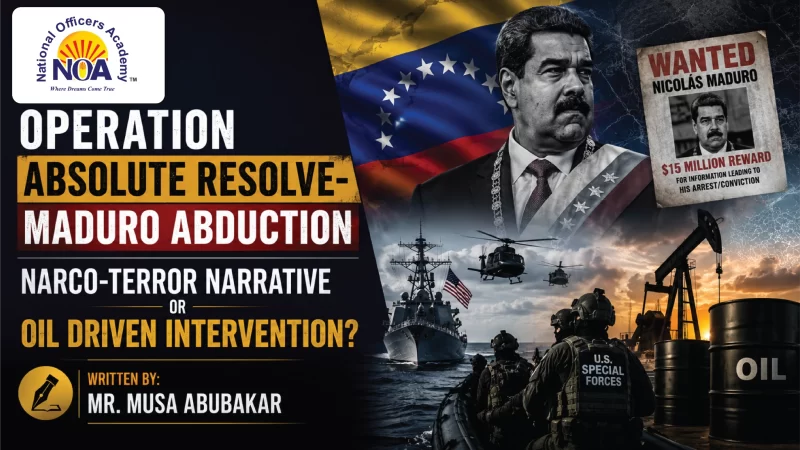
Written By: Mr. Musa Abubakar
Nicolás Maduro and his wife walked handcuffed into a Manhattan federal court on January 5, 2026. For many Venezuelans, the capture of Maduro was “good riddance,” as they celebrated Trump’s action. However, in a rapidly changing world, capturing the head of state of a sovereign country marked the demise of the Western-led “rules-based” world order.
On January 3, Venezuelan President Nicolás Maduro, along with his wife, was abducted from his palace in what Trump called a “law enforcement operation.” Undoubtedly, Maduro lacked legitimacy following the 2024 elections, corruption ran rampant, drug cartels were allegedly run and supported by elements of the Venezuelan military, and various international organizations were investigating Maduro over human rights abuses. But were these truly the reasons behind Trump’s law-enforcement operation, and do they legitimize the abduction of a head of state? Or were there other motives that the “powers that be” foresaw in seizing access to Venezuela’s massive oil reserves?
The discussion ahead examines what Operation Absolute Resolve was actually about and whether the narco-terror narrative concealed a broader strategic and oil-driven intervention.
Narrative Building
Trump, through his political messaging and psychological operations, built a strong narrative against Latin American states, particularly Venezuela and Cuba. The “narco-terrorist” frame was used as the core justification for Maduro’s capture, based on the indictment of Maduro and members of his inner circle by the Southern District of New York for allegedly conspiring to import cocaine into the United States.
The second frame was that of “freeing the Venezuelan people” from corrupt, illegitimate, and despotic rule. Soon, the United States began a military build-up around Venezuela and started targeting alleged cartel boats involved in narco-trafficking. These operations were frequently criticized for displaying a “might is right” approach and for setting troubling precedents for the international order.
Operation Absolute Resolve
Operation Absolute Resolve took place on January 3, 2026, in Caracas, Venezuela, with the stated objective of capturing President Nicolás Maduro and Cilia Flores. Ordered by Donald Trump, the operation began at 2:01 a.m. with coordinated airstrikes and electronic warfare involving more than 150 U.S. aircraft, including F-22s, F-35s, and B-1 bombers. Sites such as Fuerte Tiuna and La Carlota Air Base were targeted to disable Venezuelan defences.
Delta Force and the 160th Special Operations Aviation Regiment then raided Maduro’s residence at Fuerte Tiuna and captured the couple. The mission lasted approximately 150 minutes, involved cyber-jamming of Venezuelan systems, caused Venezuelan casualties, and ended with Maduro being transported to the United States to face narco-terrorism charges.
Building the Rationale of the U.S. Adventure in Venezuela
It is no hidden secret, the article argues, that Trump’s motive in Venezuela was oil under the cover of narco-terrorism. Trump repeatedly referred to oil, saying that the United States would “run” Venezuela and “fix oil infrastructure.”
Chevron, ENI, and other oil companies have sought licenses, while an initial deal involving 50 million barrels of oil has reportedly been made between Washington and Caracas.
Moreover, with the Middle East facing turmoil, Gulf states have halted or faced disruptions to oil supplies amid Iranian bombing and the blockade of the Strait of Hormuz, a gateway for a significant share of global oil trade. From this perspective, the United States and Israel had an incentive to safeguard a constant supply of oil by securing access to Venezuelan reserves.
The dots, therefore, appear to connect when the developments are viewed holistically. The article contends that the attack on Iran was orchestrated long before and that its potential consequences were calculated. Operation Absolute Resolve, in this interpretation, represents another U.S. intervention carried out under a specious narrative: Maduro was removed to facilitate access to Venezuelan oil before further destabilization of the Middle East.
Nullifying the Counterargument: Narco-Terror in Venezuela
Some argue that Maduro ran cartels responsible for increasing drug abuse in the United States. However, the article raises several counterarguments:
- Drugs entering the United States largely travel through routes connected to the Mexican border and, to a lesser extent, through Canada, according to the article’s interpretation of U.S. Justice Department information.
- The accusation that Maduro ran the “Cartel de los Soles” became increasingly contested, weakening one of the central claims used against him.
- Drug cartels and their trafficking channels across Latin America remained intact even after the military action, undermining the argument that violating Venezuelan sovereignty was necessary to dismantle narcotics networks.
One could argue that Maduro’s removal by any means was justifiable to stop ongoing human suffering. However, this argument becomes difficult to sustain when assessed against the operation’s aftermath. If the goal was humanitarian, why were the mechanisms of oppression—including the military high command and intelligence services—left largely intact? If the goal was justice, why was Maduro brought before a New York court on drug charges rather than prosecuted internationally for alleged crimes against humanity?
The selective application of justice, the article argues, suggests that the humanitarian frame functioned as a convenient cloak for a broader strategic objective: gaining access to Venezuela’s oil resources.
The Machiavellian Prince
The Trump administration’s conduct can be interpreted through Machiavellian ideas concerning deception, power, and the strategic use of force against opponents. The article argues that the actions of the U.S.-led order are undermining the very international system it helped create—a system that at least maintained the appearance of being rules-based.
Trump explicitly stated that “we’re in charge” after toppling a sovereign government. He also signalled the possibility of a second strike “if they don’t behave,” illustrating an international environment in which the use of hard military power against another state’s sovereignty is increasingly conceivable.
Realism at Play: The Donroe Doctrine
The capture of Nicolás Maduro during Operation Absolute Resolve illustrates principles associated with Realism in international relations through what Donald Trump labelled the “Donroe Doctrine,” a modern reinterpretation of the Monroe Doctrine.
From a realist perspective, states prioritize power, security, and national interests over international norms or legal constraints. In this context, the United States acted unilaterally in Venezuela, demonstrating its willingness to use military force to protect its strategic influence in the Western Hemisphere.
The operation signalled that Washington seeks to maintain regional dominance and prevent rival powers, particularly China and Russia, from expanding their political and economic presence in Latin America. The doctrine therefore reflects a shift toward transactional realism, in which U.S. foreign policy focuses less on promoting democratic values and more on preserving strategic advantage, securing access to resources such as Venezuela’s vast oil reserves, and deterring external powers from challenging American influence in the region.
Conclusion
The article argues that Maduro was removed to facilitate access to Venezuelan oil, including for major oil companies with political and commercial interests in the United States. Trump’s intervention, according to this interpretation, has changed little for ordinary Venezuelans: the promised “freedom” has not materialized, trafficking networks continue to operate, and much of the existing Venezuelan power structure remains intact.
Venezuelans continue to flee to Colombia, contrary to predictions of a large-scale homecoming among the Venezuelan diaspora. From this perspective, Maduro’s capture appears less like a humanitarian or counter-narcotics operation and more like an attempt to secure access to one of the world’s largest concentrations of oil reserves.
The episode also illustrates the growing strain on the U.S.-led international order. Even some traditional American allies have increasingly challenged aspects of Washington’s foreign policy, particularly unilateral actions that raise questions about sovereignty and international law.
Ultimately, Operation Absolute Resolve represents more than the removal of Nicolás Maduro. It reflects an emerging international environment shaped by hard power, strategic resources, great-power competition, and declining confidence in the rules-based order. Whether this accelerates a wider transformation of the international system will depend on how other powers respond to the expanding use of unilateral force and whether U.S. hegemony can withstand the pressures of an increasingly multipolar world.