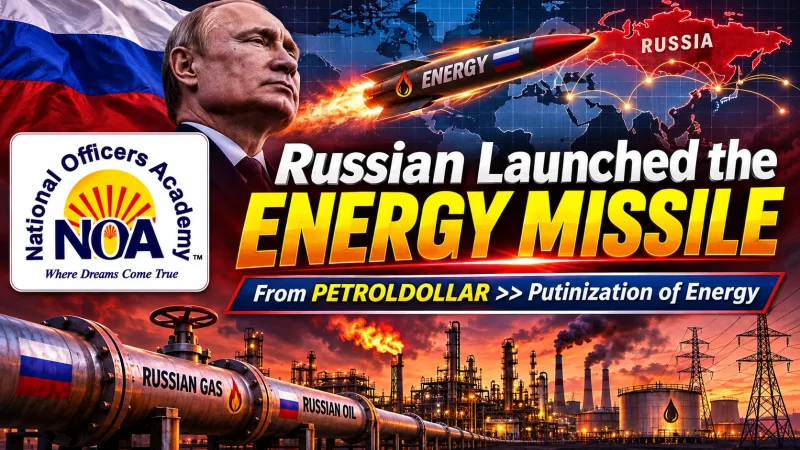
Russia Launched the Energy Missile
From Petrodollar to Putinization of Energy
Great powers frequently employ non-military instruments to expand their economic and political influence, shape the foreign policies of other states and create spheres of influence.
Among the most important of these instruments are economic tools.
Powerful states may use:
- Foreign assistance
- Trade restrictions
- Economic sanctions
- Embargoes
- Boycotts
- Energy supplies
to influence the behaviour of weaker or dependent countries.
From this perspective, economic decisions are rarely completely separated from political objectives.
Russia provides one of the clearest contemporary examples of a state converting its enormous energy resources into an instrument of foreign policy.
Russia’s Energy Resources
Russia is one of the world’s leading energy powers.
Its strategic importance arises not only from the size of its reserves but also from the diversity of its energy resources.
Russia possesses major reserves of:
- Natural gas
- Oil
- Coal
- Uranium
The source notes that Russia occupies leading global positions in proven natural gas, coal and oil reserves.
It identifies Russia as holding approximately:
- 32 percent of proven natural gas reserves
- 10 percent of explored coal reserves
- 12 percent of proven oil reserves
- 8 percent of proven uranium reserves
This enormous resource base has enabled Moscow to become one of the most important producers and exporters of oil and natural gas in international markets. :chatgpt-content-reference{index=”1″}
Dominant Actors in the Russian Energy Industry
Russia’s energy companies play an important role not only in the national economy but also in the formulation of state policy.
A significant proportion of major Russian energy companies operate under direct or indirect state influence.
Important companies include:
- Gazprom
- Rosneft
- Transneft
- Lukoil
Gazprom, in particular, has historically exercised significant influence because of its dominant position in the natural-gas sector.
These companies have therefore become important instruments through which Russia can connect economic policy with strategic and foreign-policy objectives. :chatgpt-content-reference{index=”2″}
The Energy Corridors of Russia
Russia’s influence does not arise only from the energy resources located within its own territory.
It also benefits from extensive pipeline infrastructure connecting former Soviet republics and European markets.
Russia transports oil and natural gas from several neighbouring states to international consumers.
This creates strategic leverage because countries whose energy exports depend on Russian transit routes may become vulnerable to Russian political and commercial pressure.
Soviet Pipeline Legacy
One of Russia’s greatest strategic advantages comes from infrastructure inherited from the Soviet Union.
During the Soviet period, pipelines carrying oil and natural gas from Central Asia and the Caucasus were constructed through Russian territory.
This created long-term interdependence between Russia and several former Soviet republics.
Similarly, much of the energy infrastructure supplying Eastern Europe historically passed through Russian territory.
Constructing alternative pipelines requires enormous investment, making existing routes strategically valuable.
Russia also benefits from geography because it lies close to major energy-consuming markets such as:
- Europe
- China
- Japan
Energy geography therefore gives Russia both commercial opportunities and geopolitical leverage. :chatgpt-content-reference{index=”3″}
Three Important Strategies in Russian Energy Diplomacy
Russia has developed several methods for using energy as an instrument of foreign policy.
1. Buying Cheap and Selling at Higher Prices
Russia can import or obtain energy resources from neighbouring producers at favourable prices and subsequently sell them into international markets at higher rates.
2. Carrot-and-Stick Pricing
Russia may use preferential energy prices as an incentive for friendly states while imposing higher prices or supply pressure on governments pursuing policies Moscow opposes.
3. Changing Pipeline Routes
Russia can seek alternative pipeline routes when political or security objectives require bypassing particular transit countries.
This gives Moscow the ability to restructure patterns of dependence and reduce the bargaining power of neighbouring states. :chatgpt-content-reference{index=”4″}
Energy as a Foreign-Policy Instrument
Energy occupies a unique position among economic instruments because hydrocarbon resources are strategically essential and geographically concentrated.
States possessing large oil and natural-gas reserves can therefore transform them into diplomatic and strategic leverage.
Energy became particularly important in Russian foreign policy after Vladimir Putin became President in 2000.
Rising global oil prices strengthened Russia’s economy and increased the government’s ability to pursue a more assertive foreign policy.
Energy policy consequently became a central component of Russia’s return as a major international actor.
Putin and the Weaponization of Energy
The source argues that Russia has repeatedly used energy supplies as political leverage.
The Russia-Ukraine war made this strategy particularly visible.
Energy became a weapon in two different ways:
- Military forces targeted fuel depots, refineries and energy infrastructure
- Russia used oil and natural-gas supplies to pressure European governments
Restricting an adversary’s access to fuel is a traditional method of warfare.
However, Russia expanded this logic beyond the battlefield by using energy exports as a geopolitical instrument against states supporting Ukraine.
Russia’s Gas Cut-Off to Poland and Bulgaria
In April 2022, Russian state-controlled energy giant Gazprom stopped natural-gas supplies to Poland and Bulgaria.
The decision followed disagreements over Moscow’s demand that certain European customers pay for Russian gas through a new payment mechanism linked with the Russian ruble.
The episode demonstrated Russia’s willingness to use energy supplies directly as political leverage.
Previous Use of the Energy Weapon
Russia’s use of energy pressure did not begin with the 2022 Ukraine war.
The source points to previous gas disputes involving Ukraine.
In 2009, Russia cut natural-gas supplies during a dispute that affected Ukraine and several European states.
The interruption increased pressure on Kyiv and eventually contributed to an unfavourable long-term gas transit arrangement.
Russia again used supply pressure against Ukraine in 2014 during another payment and political dispute. :chatgpt-content-reference{index=”5″}
Nord Stream 2 and Europe’s Dependence
The Nord Stream 2 pipeline became one of the most controversial energy projects in Europe.
The pipeline was designed to transport Russian natural gas directly to Germany through the Baltic Sea.
The source notes that Nord Stream 2 had a planned capacity of approximately 55 billion cubic metres of gas annually.
Critics argued that the project was not necessary purely for transit capacity because Europe already possessed considerable pipeline infrastructure connecting it with Russian gas.
Instead, the strategic significance of Nord Stream 2 lay in its ability to:
- Bypass Ukraine as a transit country
- Reduce Ukraine’s strategic importance
- Deepen Germany’s dependence on Russian gas
- Increase Moscow’s leverage over European energy security
The pipeline became a major point of disagreement between Russia, Germany, Ukraine and the United States. :chatgpt-content-reference{index=”6″}
Putin’s Demand for Rubles
Following Western sanctions imposed after Russia’s invasion of Ukraine, President Vladimir Putin introduced a new payment mechanism for Russian gas exports.
European buyers were required to make payments through arrangements involving Russian rubles and Gazprombank.
The policy served several strategic purposes.
Protecting Russian Energy Revenues
The payment mechanism helped reduce the possibility that Russian gas revenues could be frozen or seized under Western sanctions.
Supporting the Ruble
Requiring transactions linked with the Russian currency increased demand for the ruble and helped support its value.
Protecting Gazprombank
The mechanism also increased Gazprombank’s importance to European energy transactions, potentially complicating efforts to sanction the institution.
Testing European Unity
Different EU countries had different levels of dependence on Russian natural gas.
The ruble demand therefore exposed divisions within Europe regarding how aggressively to confront Moscow. :chatgpt-content-reference{index=”7″}
Energy Embargo Against Russia – Europe’s Dilemma
Western countries imposed wide-ranging economic sanctions against Russia following the invasion of Ukraine.
However, imposing a complete embargo on Russian energy proved much more difficult.
Europe had developed deep dependence on Russian:
- Natural gas
- Oil
- Coal
Rapidly cutting these supplies risked:
- Energy shortages
- Industrial disruption
- Higher inflation
- Economic recession
- Political backlash
This dependence limited Europe’s ability to use energy sanctions immediately and demonstrated the strategic vulnerability created by excessive reliance on a single supplier.
Europe’s Energy Insecurity as Russian Leverage
The source argues that Russia calculated that European governments would remain reluctant to impose an immediate full-scale energy embargo because of domestic economic costs.
That calculation reflected the unequal level of dependence across European states.
Countries such as Germany, Italy and Hungary faced particularly difficult trade-offs because of their dependence on Russian energy supplies.
Higher natural-gas prices further increased the political and economic costs of confrontation. :chatgpt-content-reference{index=”8″}
Energy Exports – Russia’s Great Strategic Leverage
Energy exports have historically generated a large share of Russia’s foreign earnings and government revenue.
The source notes that energy represented approximately 60 percent of Russian revenues in 2021.
This gave Moscow enormous financial and political leverage.
One of the major contradictions of Europe’s policy towards Russia during the early phase of the Ukraine war was that European governments simultaneously:
- Provided financial and military support to Ukraine
- Continued purchasing substantial quantities of Russian energy
Energy payments therefore continued providing significant revenue to Moscow despite broader sanctions.
Europe’s Dependence on Russian Natural Gas
Before the full restructuring of European energy supplies, Russia was one of the European Union’s dominant natural-gas providers.
The source notes particularly high dependence in countries such as:
- Austria
- Germany
- Italy
Such dependence demonstrated how energy trade can create strategic vulnerability when supply becomes concentrated in one geopolitical competitor.
Russia as an Energy and Commodity Superpower
Russia’s leverage extends beyond oil and gas.
The country also holds significant positions in several strategically important commodity markets.
These include:
- Uranium enrichment
- Nickel
- Palladium
- Coal
- Other industrial minerals
This wider commodity base increases Russia’s importance to global industrial supply chains and makes complete economic isolation more difficult.
India and Russian Oil
The source also notes that countries outside Europe continued buying Russian energy after the invasion of Ukraine.
India, for example, increased purchases of discounted Russian crude.
This demonstrated an important limitation of Western sanctions:
Even if European and North American countries reduce Russian energy imports, Moscow can redirect some supplies towards large Asian markets.
Europe Searches for Alternatives to Russian Energy
The Ukraine war forced European governments to accelerate diversification away from Russian energy.
Several alternatives were considered.
Liquefied Natural Gas
European states sought to increase LNG import capacity, including supplies from the United States.
Alternative Gas Suppliers
Potential suppliers included:
- Azerbaijan
- Qatar
- United States
- Scandinavian countries
Alternative Oil Suppliers
European states also sought greater energy cooperation with:
- Saudi Arabia
- United Arab Emirates
Improved Energy Interconnections
Europe considered expanding electricity and gas interconnections across:
- The Balkans
- North Sea region
- Italy
- North Africa
Renewable Energy
Renewables offer the most sustainable long-term alternative, but rapid replacement of Russian hydrocarbons cannot occur immediately.
Coal as an Emergency Backup
Some states considered greater short-term reliance on coal as an emergency measure to compensate for reduced Russian gas supplies.
The source therefore emphasises that eliminating dependence on Russian energy requires considerable time and investment. :chatgpt-content-reference{index=”9″}
From Ideology to Energy
During the Cold War, the Soviet Union relied heavily on ideological influence and military power to expand its global position.
Socialism, communist movements and the Red Army were central instruments of Soviet influence.
In the post-Cold War period, Russia has increasingly relied on economic and energy power.
This represents a major transformation:
Russia increasingly exports energy where the Soviet Union once exported ideology.
Moscow’s energy relationships with former Soviet republics have helped it preserve influence across parts of Eurasia.
Energy and Russia’s Return as a Great Power
Rising global energy prices during the early twenty-first century contributed significantly to Russia’s economic recovery.
Greater energy revenues strengthened Moscow’s ability to:
- Rebuild military capability
- Exercise regional influence
- Develop strategic infrastructure
- Pursue an assertive foreign policy
Vladimir Putin’s government consequently transformed energy wealth into geopolitical power.
Putinization of Energy
The phrase “Putinization of Energy” describes the use of energy not merely as a commercial commodity but as an instrument of strategic power.
Under this model, oil and gas can influence:
- Diplomatic relations
- Economic decisions
- Alliance politics
- Foreign-policy calculations
- Security strategies
The weaponization of energy demonstrates that interdependence does not always produce cooperation.
Under certain circumstances, dependence can instead become a source of coercive leverage.
From Petrodollar to Energy Geopolitics
The modern global economy has traditionally linked energy markets closely with the US dollar and Western-led financial institutions.
Russia’s demand for ruble-based payments represented an attempt to reduce vulnerability to dollar-based sanctions and strengthen the role of its own currency.
This development reflects a wider trend in which energy-producing states may increasingly seek alternative settlement mechanisms in response to geopolitical tensions.
Global Implications of Russia’s Energy Strategy
1. Energy Security Becomes National Security
The European experience demonstrates that energy dependence can become a major strategic vulnerability.
2. Diversification Becomes Essential
States dependent on a single supplier face greater political risks.
3. Energy Infrastructure Becomes Geopolitical Infrastructure
Pipelines, LNG terminals and refineries are not merely commercial assets; they shape relations among states.
4. Sanctions Have Limits
Sanctions become more difficult when the targeted country controls commodities that sanctioning states still require.
5. Asian Energy Markets Gain Importance
Russia can redirect exports towards large Asian economies, reducing the effectiveness of purely Western restrictions.
6. Renewable Energy Gains Strategic Importance
Renewables are increasingly important not only for climate policy but also for reducing geopolitical dependence.
Lessons for Energy-Importing States
Russia’s energy diplomacy provides several lessons for countries heavily dependent on imported fuel.
Diversify Suppliers
No state should become excessively dependent on one external energy provider.
Expand Domestic Energy
Domestic production reduces exposure to external political pressure.
Invest in Renewable Energy
Solar, wind, hydro and other renewable technologies can improve long-term strategic autonomy.
Build Strategic Reserves
Oil and gas storage can provide temporary protection during geopolitical disruption.
Develop Multiple Transport Routes
Diverse pipeline, maritime and LNG supply routes reduce vulnerability to coercion.
Conclusion
Russia’s energy resources have become one of the most important foundations of its geopolitical power.
Large reserves of natural gas, oil, coal and uranium, combined with extensive pipeline infrastructure and state-linked energy companies, have given Moscow enormous strategic leverage.
Under Vladimir Putin, energy policy has increasingly been integrated into Russian foreign policy.
Gas cut-offs, pipeline diplomacy, ruble payment demands and the strategic use of energy exports during the Ukraine war demonstrate how hydrocarbons can operate as instruments of coercion.
Europe’s dependence on Russian energy exposed major weaknesses in its strategic autonomy and forced the European Union to accelerate diversification towards LNG, alternative suppliers and renewable energy.
The wider lesson extends far beyond Europe.
Energy security has become inseparable from national security, economic sovereignty and foreign-policy independence.
In the Cold War, Moscow exported ideology and projected power through the Red Army. In the twenty-first century, Russia increasingly projects influence through pipelines, oil, natural gas and the weaponization of energy. Until global energy dependence is diversified, Putin’s energy missile will remain a powerful instrument of geopolitical leverage.