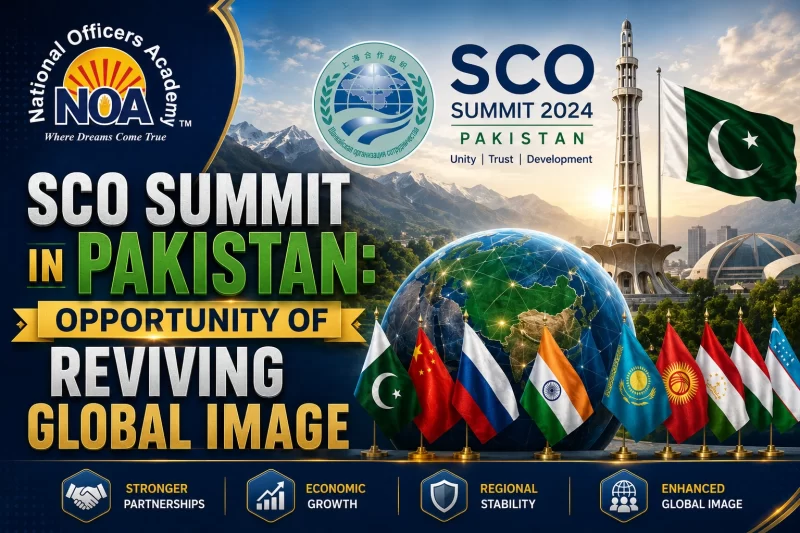
The Shanghai Cooperation Organization was established on 15 June 2001 in Shanghai, China. It later expanded, with India and Pakistan becoming full members in 2017.
Russia supported India’s inclusion as an important strategic partner, while China backed Pakistan’s membership to maintain a regional balance within the organization.
The high-level SCO conference held in Islamabad provided Pakistan with several important opportunities. Despite facing economic and political challenges, Pakistan was able to present itself as a responsible, cooperative and significant regional stakeholder.
Prime Minister Shehbaz Sharif emphasized regional peace, human security and socio-economic development. He also highlighted the China-Pakistan Economic Corridor as evidence of Pakistan’s commitment to regional connectivity.
The summit addressed several major issues, including security, climate change, regional connectivity and economic cooperation. Pakistan also drew attention to the impact of instability in Afghanistan and the long-term consequences of the devastating floods of 2022.
Key Takeaways for Pakistan
Pakistan Successfully Hosted High-Level SCO Delegations
Pakistan became the centre of regional and international attention by hosting senior representatives from SCO member states, observer countries and special guests in Islamabad on 16 October 2024.
The high-level delegates included:
- Chinese Premier Li Qiang
- Russian Prime Minister Mikhail Mishustin
- Indian External Affairs Minister S. Jaishankar
- Belarusian Prime Minister Roman Golovchenko
- Tajik Prime Minister Kokhir Rasulzoda
- Turkmenistan’s Foreign Minister Rashid Meredov
Chinese Premier Li Qiang’s visit was particularly important because it was the first visit to Pakistan by a Chinese premier in 11 years.
The successful participation of senior regional leaders demonstrated Pakistan’s diplomatic relevance and its ability to organize an important multilateral event.
Pakistan Countered the Narrative of Diplomatic Isolation
The successful hosting of approximately 900 high-level delegates gave Pakistan an opportunity to challenge the narrative of its diplomatic isolation.
The summit highlighted Pakistan’s role as a cooperative and responsible regional country capable of bringing together important regional powers.
Despite ongoing economic and political difficulties, Pakistan used the conference to reposition itself as an important stakeholder in regional diplomacy, security and economic cooperation.
Revitalization of Bilateral Relations
The SCO Summit strengthened Pakistan’s bilateral relations with several member states.
Chinese Premier Li Qiang’s visit highlighted the strategic importance of the China-Pakistan Economic Corridor and the long-standing partnership between Pakistan and China.
Similarly, the visit of Russian Prime Minister Mikhail Mishustin was significant because it was the first visit to Pakistan by a Russian premier since 2007.
The Russian prime minister arrived with a large delegation and held bilateral discussions with Prime Minister Shehbaz Sharif. These meetings indicated Russia’s growing interest in strengthening cooperation with Pakistan, particularly in trade, energy and regional connectivity.
Support for China’s Belt and Road Initiative
During the 23rd meeting of the SCO Council of Heads of Government, member states reaffirmed their support for China’s Belt and Road Initiative.
The leaders emphasized the importance of the BRI in improving regional connectivity, promoting economic growth and strengthening cooperation among member countries.
They also discussed the integration of the Eurasian Economic Union with the Belt and Road Initiative.
The meeting prioritized the development of:
- Regional railway networks
- Multimodal transport systems
- Port infrastructure
- Road connectivity
- Energy corridors
- Digital transformation in the transport sector
Regional connectivity was recognized as an important foundation for economic cooperation and shared development.
Pakistan’s Position on Regional Connectivity
Prime Minister Shehbaz Sharif highlighted the importance of expanding regional infrastructure projects such as the Belt and Road Initiative.
He stressed the need for greater investment in transport, energy and digital corridors to improve economic integration among SCO member states.
He referred to several major regional projects, including:
- Belt and Road Initiative
- China-Pakistan Economic Corridor
- International North-South Transport Corridor
- Regional railway networks
- Digital infrastructure projects
- Energy and trade corridors
The prime minister urged member states not to politicize regional development projects. He called for collective efforts to create a peaceful, prosperous and interconnected region that could benefit all participating countries.
Chinese Premier Li Qiang called for better regional trade, easier investment procedures and improved connectivity. He also emphasized the importance of maintaining stable and efficient industrial and supply chains.
Russian Prime Minister Mikhail Mishustin stressed the importance of strengthening transport connectivity among SCO countries.
He highlighted the potential of East-West and North-South transport routes to increase cargo movement and facilitate travel. He also referred to Russia’s cooperation with Iran and Commonwealth of Independent States countries on the International North-South Transport Corridor.
Important examples of Pakistan’s progress in regional connectivity included the inauguration of Gwadar International Airport and the signing of more than 200 memorandums of understanding.
Focus on Regional Security
Security cooperation remained one of the summit’s major priorities due to increasing geopolitical uncertainty.
Member states discussed joint efforts to combat:
- Terrorism
- Extremism
- Separatism
- Organized crime
- Drug trafficking
- Cross-border security threats
Chinese Premier Li Qiang proposed stronger joint action against terrorism, separatism and extremism.
He also recommended the establishment of specialized centres to address security threats, drug control and regional instability.
Prime Minister Shehbaz Sharif highlighted the threat of cross-border terrorism originating from Afghanistan. He urged SCO member states to encourage the Taliban government to prevent Afghan territory from being used for terrorist activities.
He also called for the formation of an inclusive government in Afghanistan.
Indian External Affairs Minister S. Jaishankar indirectly referred to regional security concerns by stating that cross-border terrorism and a lack of trust could obstruct regional cooperation and connectivity.
Highest-Level Indian Visit Since 2016
The participation of Indian External Affairs Minister S. Jaishankar marked the highest-level visit by an Indian official to Pakistan since 2016.
Although India ruled out formal bilateral discussions, Jaishankar’s participation demonstrated India’s continued commitment to the SCO as a multilateral platform.
His presence also reflected international confidence in Pakistan’s ability to successfully host a major regional conference.
Informal interactions, including a shared luncheon with Pakistani officials, suggested the possibility of a gradual improvement in relations.
Subsequent developments, including the issuance of visas to Pakistani pilgrims and the renewal of the Kartarpur Corridor agreement, indicated limited but positive movement between the two countries.
Improved relations could create important regional and economic opportunities, including progress on projects such as:
- Turkmenistan-Afghanistan-Pakistan-India gas pipeline
- Iran-Pakistan-India gas pipeline
- Regional trade agreements
- Climate change cooperation
- Transport and energy connectivity
However, Jaishankar clarified that his visit was strictly in his capacity as an SCO representative.
The summit did not produce a major breakthrough in Pakistan-India relations, but it demonstrated that limited cooperation through multilateral platforms remains possible.
Such cooperation could contribute to regional stability and shared economic development.
Economic and Financial Cooperation
SCO leaders discussed the establishment of new regional financial institutions to reduce dependence on Western financial organizations and international currencies.
Proposed institutions included:
- SCO Development Bank
- SCO Development Fund
- SCO Investment Fund
These institutions could provide financial support for infrastructure projects, promote regional trade and strengthen economic integration among SCO member states.
The summit also discussed increasing the use of national currencies in mutual transactions to reduce dependence on the US dollar.
Pakistan supported these initiatives and endorsed the development of alternative funding mechanisms for stalled infrastructure and development projects.
SCO leaders also criticized unilateral Western sanctions and protectionist trade policies.
They argued that such measures negatively affect international economic relations, particularly for countries such as Russia and Iran, which have experienced significant economic challenges because of sanctions.
Cultural and Environmental Cooperation
SCO leaders acknowledged the importance of cultural diversity and people-to-people diplomacy.
They emphasized that stronger cultural interaction among member states could improve understanding, trust and regional cooperation.
Environmental protection and climate resilience were also identified as major priorities.
Member states supported greater cooperation in areas such as:
- Climate change adaptation
- Disaster-risk reduction
- Environmental protection
- Water-resource management
- Sustainable development
- Climate-resilient infrastructure
Joint action on environmental challenges could help SCO countries respond more effectively to floods, droughts, extreme temperatures and other climate-related disasters.
Impact on Pakistan’s Stock Market
The SCO Summit had a positive impact on investor confidence in Pakistan.
During the summit period, the KSE-100 Index reached an all-time high of approximately 85,500 points.
Investor enthusiasm was supported by expectations of new investment opportunities, regional partnerships and economic cooperation.
However, some sectors, particularly banking, experienced aggressive selling during the same period.
Despite sector-specific pressure, the overall stock market performance reflected increased optimism about Pakistan’s regional economic prospects.
Opportunity to Improve Pakistan’s Global Image
The successful hosting of the SCO Summit gave Pakistan an important opportunity to improve its global image.
The conference demonstrated that Pakistan could provide a secure and organized environment for high-level international diplomacy.
It also allowed Pakistan to present itself as:
- A responsible regional stakeholder
- A supporter of peaceful cooperation
- A major participant in regional connectivity projects
- A bridge between South Asia, Central Asia and the Middle East
- A potential destination for regional investment
- An advocate for economic and security cooperation
The summit helped Pakistan shift international attention towards its diplomatic potential, strategic location and role in regional development.
Conclusion
The SCO Summit in Islamabad was an important diplomatic achievement for Pakistan.
It brought together senior representatives from major regional countries and provided Pakistan with an opportunity to strengthen bilateral relations, support regional connectivity and promote economic cooperation.
The summit also allowed Pakistan to challenge the perception of diplomatic isolation and present itself as an active and responsible regional partner.
Although the conference did not resolve every regional dispute, it created opportunities for dialogue, investment, security cooperation and improved diplomatic relations.
Pakistan must now build upon the momentum created by the summit by ensuring political stability, improving economic policies, strengthening regional partnerships and successfully implementing connectivity projects.
With consistent diplomatic and economic efforts, the SCO platform can help Pakistan improve its global image and strengthen its position within the emerging regional order.