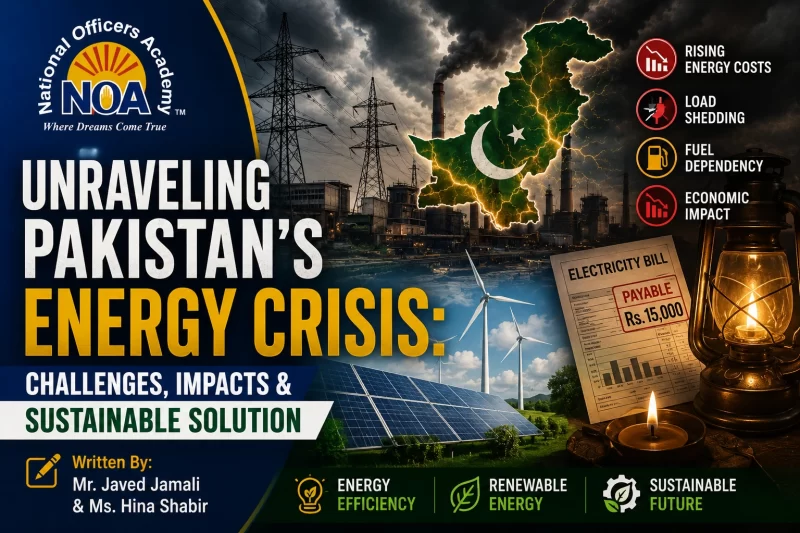
Pakistan’s energy sector stands at a critical crossroads. The crisis, which has deepened since the 1990s, continues despite the country’s considerable reserves of coal and natural gas and its significant renewable energy potential.
The main causes include flawed agreements with Independent Power Producers, excessive dependence on imported hydrocarbons, outdated transmission infrastructure, and the poor performance of electricity distribution companies.
These problems have resulted in electricity shortages, rising tariffs, circular debt, load shedding, and growing pressure on households, businesses, and the national economy.
Resolving the crisis requires major policy reforms, stronger governance, modern transmission systems, efficient distribution companies, and a gradual transition toward indigenous and renewable energy sources.
Root Causes of Pakistan’s Energy Crisis
Pakistan’s energy crisis is the result of interconnected financial, structural, administrative, and geopolitical challenges.
The most important causes include:
- Flawed agreements with Independent Power Producers
- Heavy capacity payments
- Growing circular debt
- Dependence on imported oil, gas, and coal
- Currency depreciation
- Transmission and distribution losses
- Electricity theft and poor recovery of bills
- Weak governance within energy institutions
The Role of Independent Power Producers
Independent Power Producers are privately or publicly owned companies that generate electricity for sale to utilities, governments, or industrial consumers.
They may operate under different ownership and contractual models, including:
- Build-Own-Operate
- Build-Own-Operate-Transfer
- Build-Lease-Transfer
Independent Power Producers have played an important role in increasing Pakistan’s electricity generation capacity, particularly during periods of severe power shortages.
According to the figures cited in the article, approximately 100 IPPs operate in Pakistan. Around 52% are government-owned, while the remaining 48% belong to private entities, including domestic investors and international companies.
Pakistan’s Installed Energy Capacity
According to the Economic Survey of Pakistan 2023–24, the country’s total installed electricity generation capacity stood at approximately 42,131 megawatts.
The energy mix included:
- Approximately 57% thermal power from natural gas, oil, and coal
- Around 25% hydropower
- Nearly 8% nuclear power
- Approximately 10% renewable energy
Despite this considerable installed capacity, Pakistan continues to experience power shortages and high electricity costs.
This indicates that the crisis is not caused only by insufficient generation. Inefficient management, transmission limitations, financial liabilities, and poor distribution also play major roles.
Flawed Agreements With Independent Power Producers
In 1994, when only around 40% of Pakistan’s population had access to electricity, the government introduced a power policy designed to attract private and foreign investment.
The policy offered investors generous incentives, including high returns on investment and relatively low equity requirements.
It also prioritised thermal power plants, resulting in the addition of several furnace-oil and gas-based projects with a combined generation capacity of approximately 4,100 megawatts.
Although these policies rapidly increased generation capacity, they created expensive long-term financial obligations for the government and consumers.
Many contracts guaranteed returns and payments in foreign currency, protecting producers from major financial risks while transferring much of the burden to the state.
Subsequent policies attempted to encourage alternative energy sources and improve contractual terms. However, the financial effects of earlier agreements remain a major burden on Pakistan’s economy.
The Financial Burden of Capacity Payments
Capacity payments are fixed amounts paid to power producers for maintaining generation capacity, regardless of whether the electricity is actually purchased or used.
Under these arrangements, a power plant may receive payment even when it produces little or no electricity.
This system was originally designed to ensure that sufficient power generation capacity remained available. However, it has become one of the largest financial pressures on Pakistan’s electricity sector.
The burden has increased because many payments are linked to the US dollar. When the Pakistani rupee loses value, the cost of these obligations rises.
According to the figures cited in the article, IPPs received approximately Rs8.344 trillion in capacity payments over ten years.
Capacity payments for the 2024–25 financial year were projected to reach approximately Rs2.1 trillion.
These payments are ultimately included in electricity tariffs, increasing costs for households and businesses.
Circular Debt: A Growing Financial Crisis
Circular debt develops when electricity distribution companies fail to recover sufficient revenue from consumers or do not pay power producers on time.
Power producers then become unable to pay fuel suppliers, banks, and other service providers.
This creates a chain of unpaid obligations throughout the energy sector.
The main causes of circular debt include:
- Electricity theft
- Low bill recovery
- Transmission and distribution losses
- Delayed government subsidies
- High generation costs
- Expensive capacity payments
- Poor administrative performance
According to figures from the Power Division cited in the article, electricity-sector circular debt rose to approximately Rs2.636 trillion in January 2024.
This was higher than the government’s stated target of keeping it within Rs2.31 trillion.
The continued rise of circular debt weakens the ability of the entire power sector to function efficiently and discourages further investment.
Dependence on Expensive Imported Hydrocarbons
Pakistan’s strong dependence on imported oil, liquefied natural gas, and coal has significantly contributed to the energy crisis.
These fuels are purchased in international markets and paid for in foreign currency. Their cost therefore rises when global prices increase or the Pakistani rupee depreciates.
This dependence places continuous pressure on Pakistan’s foreign exchange reserves, fiscal balance, and electricity tariffs.
Diesel
Diesel is among the most expensive hydrocarbons used in Pakistan.
It is widely consumed in transportation, agriculture, industrial machinery, and backup electricity generators.
High diesel prices therefore affect the cost of almost every major economic activity.
Liquefied Natural Gas
Liquefied natural gas is less expensive than diesel in some applications, but it remains a costly fuel for power generation and industrial production.
International LNG prices can rise sharply during periods of strong global demand or supply disruption.
Coal
Coal can be less expensive than imported oil and LNG, but imported coal still creates foreign exchange pressure.
It also produces serious environmental and public health concerns unless supported by cleaner technologies and strong emissions controls.
Global Conflicts and Supply Chain Disruptions
International conflicts and supply disruptions have increased global energy prices.
The Russia-Ukraine war and instability in the Middle East have affected oil and gas supply chains and contributed to price volatility.
These disruptions have had a particularly serious impact on energy-importing economies such as Pakistan.
Higher international prices increase Pakistan’s import bill, worsen inflation, create pressure on foreign exchange reserves, and raise the cost of electricity and transportation.
The State Bank of Pakistan has repeatedly highlighted the effect of imported energy costs on the country’s macroeconomic stability.
The Impact of Currency Depreciation
The depreciation of the Pakistani rupee further increases the cost of imported energy.
Oil, LNG, coal, and several power-sector obligations are priced in US dollars or other foreign currencies.
When the rupee loses value, the government and private companies require more rupees to purchase the same quantity of fuel.
Currency depreciation also increases:
- Fuel prices
- Electricity tariffs
- Transportation costs
- Industrial production expenses
- Inflation
- The value of dollar-linked capacity payments
This creates a damaging cycle in which rising energy costs increase inflation, while economic instability causes further depreciation of the currency.
Transmission Inefficiencies and Line Losses
Pakistan’s transmission network is responsible for carrying electricity from generation plants to the national grid and regional distribution systems.
Much of this infrastructure is old, overloaded, and unable to efficiently handle the country’s installed generation capacity.
The article cites transmission and distribution losses ranging from approximately 18% to 20%.
This means that a considerable share of generated electricity is lost before it reaches consumers.
These losses increase the cost of electricity because additional power must be generated to compensate for the energy wasted during transmission and distribution.
Modernising the transmission system is therefore essential for:
- Reducing electricity losses
- Improving grid reliability
- Preventing system breakdowns
- Integrating renewable energy
- Reducing generation costs
Mismanagement of Distribution Companies
Electricity distribution companies are responsible for delivering power to consumers, collecting bills, maintaining local networks, and reducing theft.
Many DISCOs suffer from poor governance, political interference, weak bill recovery, electricity theft, and outdated infrastructure.
In some areas, influential consumers avoid payment while the cost is transferred to those who pay their bills regularly.
The inefficiencies of distribution companies increase the financial losses of the power sector and contribute to circular debt.
According to the tariff figures cited in the article, the average power purchase price was approximately Rs27 per unit.
After including distribution costs and other charges, the average consumer tariff increased to around Rs35.50 per unit.
This rise is influenced by:
- Currency depreciation
- Inflation
- High interest rates
- Capacity payments
- Distribution losses
- Slow electricity sales growth
- Additional generation projects
Socioeconomic Impact of the Energy Crisis
Pakistan’s energy crisis affects industrial production, household finances, employment, economic growth, public services, and social stability.
Industrial Decline and Reduced Competitiveness
High electricity prices have made Pakistani industries less competitive in regional and international markets.
The textile and garment sectors are especially vulnerable because they rely heavily on affordable and uninterrupted electricity.
The article notes that industrial electricity prices in competing countries such as India and Bangladesh are significantly lower than those faced by Pakistani businesses.
Higher energy costs increase the price of locally manufactured goods and make it difficult for Pakistani exporters to compete internationally.
The consequences include:
- Lower industrial production
- Factory closures
- Reduced exports
- Job losses
- Lower foreign exchange earnings
- Movement of investment to other countries
Financial Pressure on Households
Rising electricity and gas bills have placed a severe burden on families across Pakistan.
For many lower- and middle-income households, utility expenses now consume a large share of monthly income.
Some families are forced to reduce spending on food, education, healthcare, and other essential needs in order to pay electricity bills.
Higher natural gas prices and repeated tariff increases have further raised the overall cost of living.
The burden is particularly severe for households that depend on electric cooling during extreme heat or use electricity for small home-based businesses.
Load Shedding and Disruption of National Life
Electricity shortages and load shedding affect industries, commercial activity, education, healthcare, agriculture, and domestic life.
Businesses suffer production delays, equipment damage, and increased expenditure on backup generators.
Students face difficulty studying, hospitals experience pressure on emergency power systems, and households are exposed to extreme temperatures.
The article estimates that energy shortages have caused annual economic losses equivalent to approximately 2% of Pakistan’s GDP.
Persistent shortages can also increase unemployment, inflation, public frustration, and political instability.
A Sustainable Pathway for Pakistan’s Energy Sector
Pakistan’s energy crisis cannot be resolved through a single policy measure.
It requires coordinated financial, institutional, technical, and environmental reforms.
Renegotiate IPP Agreements
The government should review existing power purchase agreements and negotiate fairer terms where legally and financially possible.
Key objectives should include:
- Reducing excessive capacity payments
- Converting foreign currency obligations into local currency where possible
- Linking payments more closely with actual electricity generation
- Improving transparency in power-sector contracts
- Eliminating unjustified guaranteed returns
Reform or Privatise Distribution Companies
Distribution companies require major governance reforms.
Possible approaches include privatisation, public-private partnerships, stronger regulation, or professional management under performance-based contracts.
Any reform programme should focus on:
- Reducing electricity theft
- Improving bill recovery
- Replacing outdated meters
- Introducing smart metering
- Removing political interference
- Improving customer service
- Holding management accountable for losses
Modernise the National Grid
Pakistan must invest in modern transmission lines, grid stations, storage systems, and digital energy-management technologies.
A modern grid would reduce losses, improve reliability, and make it easier to integrate solar and wind power.
Investment should also be directed toward regional transmission networks that can transfer electricity from areas with surplus generation to areas facing shortages.
Expand Indigenous Energy Resources
Pakistan should reduce its dependence on imported energy by responsibly developing domestic resources.
These may include:
- Hydropower
- Domestic natural gas
- Thar coal with environmental safeguards
- Solar energy
- Wind energy
- Biomass
- Waste-to-energy projects
Greater use of domestic resources can reduce pressure on foreign exchange reserves and protect the economy from international price fluctuations.
Accelerate Renewable Energy Development
Pakistan has considerable potential for solar and wind energy.
Solar power is particularly suitable because many parts of the country receive strong sunlight throughout the year.
Wind corridors in Sindh and Balochistan also offer significant generation potential.
The government should support renewable energy through:
- Stable investment policies
- Competitive bidding
- Affordable financing
- Local manufacturing of solar and wind equipment
- Transparent net-metering rules
- Grid-scale battery storage
- Research and technical training
Promote Energy Efficiency
Reducing unnecessary electricity consumption is often less expensive than constructing new power plants.
Energy-efficiency policies should encourage:
- Efficient industrial machinery
- Energy-saving home appliances
- Modern building standards
- LED lighting
- Improved public transportation
- Efficient agricultural pumps
- Public awareness campaigns
Improve Energy-Sector Governance
Pakistan’s energy institutions require clear authority, professional leadership, transparent decision-making, and greater coordination.
Overlapping responsibilities among ministries, regulators, generation companies, transmission authorities, and distribution companies often delay reforms.
Appointments should be based on technical competence and experience rather than political affiliation.
Regulatory institutions must also be empowered to protect consumers, ensure fair competition, and publish accurate information.
Strengthen Regional Energy Cooperation
Regional energy projects can improve Pakistan’s energy security and reduce dependence on costly global markets.
Projects such as the Turkmenistan-Afghanistan-Pakistan-India gas pipeline could provide access to regional energy supplies if political and security challenges are resolved.
Pakistan can also explore electricity trade and energy cooperation with neighbouring and Central Asian countries.
Conclusion
Pakistan’s energy crisis is a multidimensional challenge rooted in costly Independent Power Producer agreements, capacity payments, circular debt, imported fuel dependence, weak distribution companies, and outdated transmission infrastructure.
The crisis has increased electricity prices, weakened industrial competitiveness, disrupted daily life, and placed severe financial pressure on households and businesses.
Comprehensive reforms are essential to break this cycle.
Renegotiating expensive power agreements, improving distribution companies, upgrading the national grid, reducing theft, and strengthening governance can improve financial stability.
At the same time, expanding indigenous and renewable energy can provide a more affordable, reliable, and environmentally sustainable energy future.
Pakistan must combine energy security with efficiency, transparency, environmental responsibility, and long-term economic planning.
Timely implementation of these reforms can reduce energy poverty, support industrial growth, stabilise the economy, and ensure reliable electricity access for future generations.