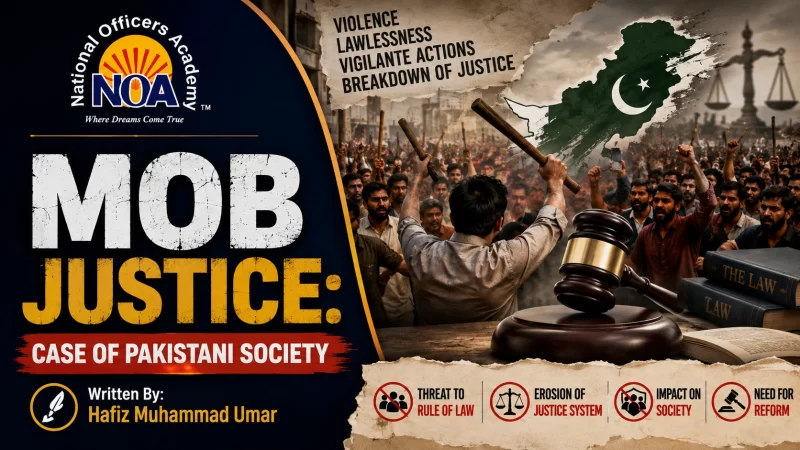
Written by: Hafiz Muhammad Umar
Introduction
Seldom do we hear a term as oxymoronic and counterintuitive as “mob justice.” Justice, one of the cardinal virtues of a functioning society, is a pristine value. By definition, it is orderly and organised. From philosophical theories to legal injunctions, the term justice has remained a subject of intense speculation and arbitration.
Could something as orderly as justice ever be associated with a mob? One would be tempted to say no. Justice requires evidence, impartiality, legal procedure and institutional authority, while a mob is driven by collective emotion, urgency and disorder. What is often described as mob justice is, therefore, not justice at all but violence committed under the illusion of moral legitimacy.
The Homo Sapiens Herd
Understanding the Difference Between a Crowd and a Mob
What is a mob? Most people would loosely define it as a collection of a large number of people. However, that is the definition of a crowd. The two terms are often used interchangeably, but they are not entirely the same.
A mob is a particular kind of crowd with two salient features: it is disorderly and, most importantly, it is intent on causing trouble or violence.
For example, one thousand people walking past Liberty Chowk at 2:00 p.m. on a Wednesday constitute a crowd. The same number of people engaging in vandalism at Liberty Chowk over a religious or socio-political grievance constitute a mob.
The Psychology of Collective Behaviour
Another phenomenon that arouses particular curiosity is the way a mob functions. It is widely believed that people in a mob develop a psychology that is essentially different from the psychology or philosophy of each individual comprising it.
This phenomenon has been described through several concepts, including:
- Groupthink
- Mental unity
- Collective mind
- Collective behaviour
Regardless of the terminology, the key takeaway remains the same: people who would never engage in a particular activity in their individual capacity may do so quite willingly when they become part of a mob.
The Disappearance of Individual Responsibility
The feeling of irresponsibility that permeates crowds is perhaps the most defining characteristic of mob behaviour. An ordinary human being may be susceptible to wicked thoughts or destructive impulses. However, what generally prevents a person from committing such an act is either a sense of personal responsibility or the fear of being held accountable.
In both cases, moral restraint and the possibility of consequences encourage the individual to abandon such ideas and resume normal life.
The presence of a large number of people acting in unison, however, creates a buffer against this sense of responsibility. Within a crowd, an individual begins to lose his or her separate identity. Consequently, personal responsibility no longer remains a powerful barrier against destructive behaviour.
When responsibility is diffused among hundreds or thousands of participants, each person may feel that no single individual can be blamed. This psychological anonymity weakens moral restraint and makes unacceptable behaviour appear permissible.
Suggestibility, Urgency and Impulsiveness
Mobs are also highly suggestible. By their very nature, they are not passive observers. They are active, vibrant and emotionally charged. This atmosphere creates a form of expectant attention among members of the crowd. They become ready for confrontation and prepared to respond to slogans, accusations or commands.
Since a mob cannot remain passive for long, it rarely takes time to contemplate the consequences of its actions. A person within such a group may feel both omnipotent and irresponsible at the same time.
When this perceived power is combined with urgency, the result is a dangerous mixture of:
- Impulsiveness
- Emotional volatility
- Irritability
- Aggression
- Collective irrationality
These conditions encourage individuals to commit acts they would never consider in their private lives.
The Blind Poet of Justice
From separate discussions of mobs and justice, it becomes evident that any attempt to synthesise the two would be farcical. Pristine values such as justice cannot be administered by emotionally charged crowds.
What passes for mob justice is almost invariably mob violence.
It is tempting for people to label their violence as justice. Human beings generally possess a sense of morality, no matter how rudimentary, and most people do not like to perceive themselves as cruel. However, what could be more cruel than participating in a mob that lynches an individual such as Mashal Khan or Priyantha Kumara?
Such acts are unquestionably cruel. The easiest way for participants to avoid guilt and self-blame is to redefine their cruelty as justice.
The false pride of delivering justice is one of the strongest motivating forces behind mob violence.
In the minds of mob members, they are performing something selfless and honourable. They convince themselves that they are providing a service to society and carrying out a responsibility that the state should have fulfilled.
Beneath this façade of justice, however, often lies a primitive thirst for violence waiting to be satisfied.
The Pakistani Context
Pakistan has its own distinct history of mob violence. The country’s position as a resource-stressed developing state, where fiscal mismanagement has repeatedly contributed to deprivation among unemployed and poorly educated segments of society, has played a significant role in the problem.
The state has often failed to provide quality education or cultivate tolerance among the population. It has also remained unable to satisfy many economic and political needs, creating frustration, alienation and resentment.
Additionally, the state machinery has frequently been ill-equipped to deal with challenges of this nature. Pakistan’s police force remains severely understaffed in relation to the country’s population, limiting its capacity to prevent, control and investigate incidents of mass violence.
The Religious Character of Mob Violence
A distinctive feature of mob violence in Pakistan is its frequent association with matters of religion. Although socio-political grievances have also produced violent crowds, religiously motivated mob violence has developed a recurring pattern that distinguishes it from other forms of public disorder.
The 1953 anti-Ahmadi riots in Lahore represent an important turning point. Spearheaded by Majlis-e-Ahrar, the unrest began as peaceful demonstrations in February but soon escalated into citywide incidents of arson, looting and violence.
Around 200 people reportedly lost their lives. The riots also contributed to the dismissal of Prime Minister Khawaja Nazimuddin and resulted in the imposition of limited martial law in Lahore under Lt. Gen. Azam Khan.
This development established an early precedent. It demonstrated that the fledgling state machinery was unable to deal effectively with organised religious mobilisation and mass violence.
More recent examples include:
- Attacks on the Christian community in Jaranwala
- The sacking of police stations in Charsadda
- Numerous violent protests by religiously motivated groups
- Repeated incidents arising from religious allegations
- Persistent persecution of minorities, particularly Ahmadis
These incidents suggest that the problem has worsened while the state’s capacity to address it has not developed proportionately.
Identifying the Causes of Mob Violence
Mob violence, particularly lynching, is a complex problem that cannot be reduced to a single cause or explanation.
Poverty, Unemployment and Lack of Education
Poverty, unemployment and inadequate education can create frustration, anxiety and resentment. These conditions may make individuals more vulnerable to manipulation and more likely to participate in collective violence.
However, these factors alone do not completely explain the phenomenon. They should therefore be understood as enabling conditions rather than the sole causes of mob violence.
Political Instability and Weak Governance
Political instability and weak governance are particularly important in the Pakistani context. Political leaders and organised groups may exploit religious sentiments or public grievances for personal and institutional benefit.
By stoking extremism or manipulating public opinion, such actors can mobilise crowds and advance their political agendas.
When the government is unable or unwilling to regulate inflammatory rhetoric, extremist discourse can develop into direct violence.
The Absence of Rule of Law
The lack of rule of law and the inability of authorities to enforce laws effectively increase the sense of impunity among individuals involved in mob violence.
When perpetrators believe that they will not be identified, prosecuted or convicted, the deterrent effect of law disappears. Each unpunished incident emboldens future offenders and weakens public confidence in state institutions.
The Manipulation of Religion
Religion itself should not be treated as the cause of mob violence. Instead, it is often used as a tool by individuals and groups seeking power, influence or control over the population.
Emotionally charged religious allegations can rapidly mobilise crowds because they create a sense of urgency and moral duty. Once an accusation is presented as an attack on sacred values, the demand for evidence and legal procedure may be dismissed as unnecessary.
The Jury Is Out
Considering the complexity of the issue, it is difficult to place the entire blame upon one actor.
One may be tempted to blame particular religious voices that advocate extremism. However, that approach would be misleading and incomplete. No society in the world is entirely free from extremist propaganda or individuals who preach hatred and violence.
The real problem emerges when extremist discourse creates a pathway towards extremist violence.
The intervention of state machinery should serve as a buffer that prevents mass hatred from transforming into mass violence. In Pakistan, such interventions have often been delayed, inconsistent or entirely absent.
Illiteracy, poverty and unemployment are also closely connected with ineffective state policies. When governments fail to provide quality education, employment, social mobility and equal opportunities, public frustration intensifies.
Similarly, the failure to hold a significant number of participants in mob violence accountable represents a serious challenge to the legitimacy of the state. This lack of punishment has created a sense of impunity among sections of society, allowing the problem to worsen.
The Whiteboard of Policymaking
Does Pakistan possess a solution to this problem? More importantly, even if solutions are available, does the state possess the political and administrative will required to implement them?
These questions remain unanswered. Nevertheless, several possibilities exist, and there is substantial room for improvement.
State Capacity Versus Political Will
The state’s response to major political challenges following May 9 demonstrated that it possesses considerable coercive and administrative capacity when it chooses to exercise it.
This raises an important question: if the state has the institutional muscle to confront organised political forces, why has it struggled to act decisively against actors involved in mob violence?
The challenge may therefore lie less in the absence of capacity and more in selective political will.
Even if the state chooses a direct and forceful approach, another question arises: would such a strategy be sustainable?
Can violence be defeated by violence, and if so, for how long?
The Dilemma of Long-Term Structural Reform
The state can attempt to solve the problem organically by addressing the chronic conditions that allow mob violence to develop.
Illiteracy remains one such factor. Education should not merely increase the number of degree holders; it should improve critical thinking, civic responsibility, tolerance and respect for legal procedures.
Economic mismanagement is another important contributor. When a large proportion of the population is excluded from a fair share of economic resources, poverty, unemployment and resentment become widespread.
Rapid population growth also places severe pressure upon state institutions. When the population grows faster than the capacity of schools, police departments, courts, hospitals and employment markets, governance gaps expand.
Theoretically, the state can reduce mob violence by addressing these structural challenges through:
- Quality education and civic instruction
- Socio-economic uplift programmes
- Employment generation
- Poverty reduction
- Population management
- Community development
- Institutional reform
However, this approach is inherently long-term. Even if these policies are implemented effectively, their results may not become visible for a decade or more.
Pakistan cannot wait for another decade while the fear of mob violence continues to threaten citizens across the country.
The Temptation of Short-Term Coercive Measures
The state may therefore be tempted to shift its focus towards immediate coercive action. Pakistan has often responded to long-term challenges through short-term and improvised measures. This tendency remains one of the most glaring features of national policymaking.
The state could use its monopoly over legitimate force to suppress violent networks and restore public order. Such measures may include:
- Mass prosecution of individuals directly involved in mob violence
- Legal action against those spreading hate speech
- Investigation of organisations repeatedly linked with violent mobilisation
- Prosecution of leaders who incite or facilitate violence
- Stronger preventive policing and intelligence gathering
These actions may appear both necessary and just. However, they do not constitute a complete solution.
Without accompanying social and political reforms, an exclusively coercive approach could appear heavy-handed and may fail to address the conditions that allow extremism to survive.
A Balanced Path Forward
A sustainable response to mob violence requires a balance between immediate law enforcement and long-term structural reform.
The state must ensure that those involved in mob violence are identified, investigated and prosecuted according to law. At the same time, it must address the broader conditions that make collective violence possible.
A balanced policy framework should therefore combine:
- Consistent prosecution of perpetrators
- Strict action against incitement and hate speech
- Improved police capacity
- Better intelligence and preventive policing
- Judicial efficiency
- Quality education and civic awareness
- Socio-economic development
- Political and administrative reform
Force may suppress an incident, but only institutional reform can prevent its recurrence.
Conclusion
Mob justice is neither justice nor a legitimate response to the failures of the state. It is collective violence disguised as moral action.
Its emergence in Pakistan is connected with mob psychology, religious manipulation, weak governance, socio-economic deprivation, ineffective policing and the persistent absence of accountability.
The state cannot eliminate this problem through force alone. Nor can it rely exclusively on long-term reforms while citizens remain exposed to immediate danger.
A sustainable solution requires a coordinated strategy that combines firm law enforcement with education, socio-economic development, institutional reform and consistent accountability.
Justice must remain the responsibility of lawful institutions. Once crowds are permitted to become investigators, judges and executioners, both justice and social order disappear.