Reimagining Pakistan’s Map: The Debate over New Provinces
Written By: Mr. Turhan Khan
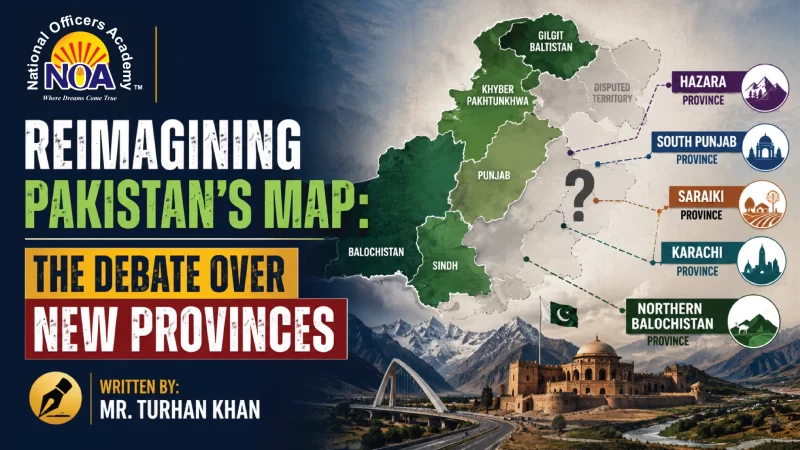
The debate over creating new provinces in Pakistan has intensified since about 2008, as citizens in various regions—from southern Punjab to Hazara and parts of Sindh and Balochistan—demand greater autonomy and development. Proponents argue that the four existing provinces—Punjab, Sindh, Khyber Pakhtunkhwa, and Balochistan—are too large and ethnically diverse to govern effectively, and that carving them into smaller units would bring government closer to the people.
On the flip side, critics counter that splitting provinces could reignite ethnic tensions or create administrative chaos. This article examines the historical context of these demands, their ethnic and linguistic bases, criteria for forming new provinces, the constitutional process required, obstacles faced, and whether stronger local governments might achieve similar goals.
Historical Perspective of Province Creation in Pakistan
From Pakistan’s inception, the question of internal boundaries has been contentious. At independence in 1947, Pakistan inherited provinces from British India—Punjab, Sindh, NWFP and the Balochistan Agency—along with large princely states such as Bahawalpur and Kalat. Shortly afterwards, these territories were merged into the province of West Pakistan under the One Unit scheme in 1955 to create parity with East Pakistan.
One Unit was dissolved in 1970, restoring Punjab, Sindh, NWFP—now Khyber Pakhtunkhwa—and Balochistan. The break-up of East Pakistan in 1971 left Pakistan with four provinces, along with federally administered tribal areas and the federal capital. Since then, the provincial structure has remained largely intact, with notable changes including the renaming of NWFP as Khyber Pakhtunkhwa in 2010 and the merger of FATA into Khyber Pakhtunkhwa in 2018.
Despite these changes, movements for new provinces have periodically emerged. Southern Punjab witnessed demands both for the restoration of Bahawalpur and for a separate Seraiki-speaking province. The Seraiki nationalist movement, which grew from the 1980s onwards, argued that the region was neglected by decision-makers in Lahore. In 2018, the Janoobi Punjab Suba Mahaz revived the demand for a southern Punjab province before merging into PTI.
In Khyber Pakhtunkhwa, the Hazara region has long demanded a separate province, citing its distinct Hindko-speaking identity and concerns over political representation. The renaming of NWFP as Khyber Pakhtunkhwa in 2010 further intensified these grievances. In 2022 and 2023, the KP Assembly passed resolutions supporting the creation of a Hazara Province.
Sindh presents a more complex case. Periodic demands have emerged for separate administrative units centred on Karachi or Hyderabad, particularly because sections of the urban population believe their political and economic interests are inadequately represented. In Balochistan, its vast geography and ethnic diversity have similarly generated occasional proposals for additional administrative units. Parts of northern Punjab have also witnessed discussions concerning a Pothohar-based province.
The 18th Amendment further strengthened provincial authority, increasing the political and financial significance of provincial status. The NFC Award also makes provincial status attractive because provinces receive constitutionally structured shares from the divisible pool. Nevertheless, nationwide consensus on creating any new province remains elusive.
Ethnic and Linguistic Bases of Demand
Most demands for new provinces are framed partly in ethnic or linguistic terms. Pakistan’s existing provinces themselves broadly reflect ethno-linguistic identities, while several smaller communities believe that their identities and interests receive insufficient recognition within these large units.
Seraiki speakers in southern Punjab, for instance, emphasize their distinct language, literature and history while highlighting disparities in education, health and infrastructure. Hindko-speaking communities in Hazara similarly argue that their identity and political interests differ from those of the Pashtun majority in Khyber Pakhtunkhwa.
In urban Sindh, sections of the Mohajir population have historically expressed concerns about political representation and provincial resource distribution. Balochistan’s ethnic and geographical diversity has likewise produced occasional proposals for restructuring the province into more manageable administrative units.
However, scholars caution against creating provinces exclusively on ethno-linguistic grounds. Identity-based territorial restructuring could potentially institutionalize divisions rather than resolve them. The underlying grievances are frequently administrative and economic: distant districts remain underdeveloped, resources tend to concentrate around provincial capitals, and peripheral communities feel excluded from decision-making.
Therefore, while ethnic and linguistic identity is an important driver of provincial demands, administrative efficiency, economic viability and developmental equity should remain central considerations.
Standards for Making New Provinces
If Pakistan decides to create new provinces, their formation should follow objective and transparent criteria. Key considerations include administrative efficiency, population size, geographical accessibility and connectivity, and economic viability.
Administration
A province should be sufficiently manageable to allow effective governance and service delivery. Pakistan’s existing provinces contain enormous populations and, in some cases, vast territories. Punjab alone has a population comparable to that of a major country, while Balochistan’s enormous geographical size makes administrative connectivity particularly difficult.
Smaller administrative units could bring decision-makers closer to citizens, allow governments to focus on region-specific challenges and reduce the concentration of authority in distant provincial capitals. International examples—including the creation of Chhattisgarh, Uttarakhand, Jharkhand and Telangana in India—are frequently cited in support of smaller administrative units.
Population Size
Population is another critical consideration. A province with an extremely small population may lack sufficient fiscal and administrative capacity, while an excessively large population can overwhelm governance structures.
Dividing highly populated provinces could create more balanced units and improve representation. However, new provinces must still have populations large enough to sustain viable institutions, revenue systems and public services.
Area, Accessibility and Connectivity
Geographical coherence should also shape provincial boundaries. Citizens should not have to travel unreasonable distances to access provincial institutions. Mountainous terrain, deserts and inadequate transport networks can make governance especially difficult in geographically expansive provinces.
New provinces should therefore consist of reasonably contiguous and internally connected territories. Administrative boundaries should account for transport networks, geography, economic linkages and accessibility to provincial capitals.
Resource Distribution and Economic Viability
A new province must possess sufficient fiscal capacity to provide essential public services. Natural resources, industries, taxation potential and federal transfers would all influence economic viability.
Resource distribution is already a major source of grievance. Resource-rich but comparatively underdeveloped regions frequently demand greater control over locally generated wealth, while less-developed areas require adequate fiscal transfers to maintain essential services.
New provinces should therefore be designed to ensure both economic sustainability and equitable access to national resources. Administrative restructuring should remedy existing inequalities rather than simply reproduce them on a smaller scale.
Constitutional Procedure for Making New Provinces
Pakistan’s 1973 Constitution establishes a demanding procedure for altering provincial boundaries. Under Article 239, a constitutional amendment affecting the limits of a province requires a two-thirds majority in both Houses of Parliament—the National Assembly and Senate.
Where provincial boundaries are affected, the amendment must additionally secure a two-thirds majority in the assembly of the concerned province. Only after these constitutional requirements have been fulfilled can the amendment proceed for presidential assent.
Consequently, no new province can be created merely through executive action or ordinary legislation. The process requires broad political agreement at both federal and provincial levels, making consensus-building one of the greatest obstacles to territorial restructuring.
Hurdles to Creating New Provinces
Political Consensus and Elite Opposition
Provincial political elites may resist territorial division because it could reduce their political influence, fiscal resources and administrative authority. The constitutional requirement for a two-thirds vote in the affected provincial assembly gives existing provincial stakeholders considerable power over any restructuring proposal.
Administrative and Financial Disruption
Creating a new province requires a new provincial capital, assembly, government departments, judicial institutions, administrative services and infrastructure. Assets, liabilities, personnel and budgets would also have to be divided. Such restructuring could substantially increase public expenditure.
Governance Challenges During Transition
Administrative restructuring could temporarily disrupt public services while jurisdictions, departments and personnel are reorganized. Intergovernmental negotiations over territory, resources and institutional responsibilities could further complicate the transition.
Economic Disadvantages
Multiple new provincial governments could increase regulatory and compliance costs for businesses. Smaller provinces may also lose some economies of scale available to larger administrative units, particularly when financing major infrastructure projects.
Social and Ethnic Tensions
Perhaps the most sensitive challenge is the possibility that territorial restructuring could intensify identity politics. If provincial boundaries are drawn primarily around ethnicity or language, minorities within newly created provinces could develop grievances of their own.
Timing and National Priorities
Critics also argue that Pakistan’s economic, political and security challenges require attention before embarking upon extensive territorial restructuring. Without consensus and careful planning, the debate over new provinces could become another arena for partisan competition rather than administrative reform.
Could Local Government Reform Be an Alternative?
Given the constitutional and political difficulties surrounding new provinces, strengthening local governments offers another route towards improved governance. Article 140-A of the Constitution obliges provinces to establish elected local governments possessing political, administrative and financial authority.
Effective local governments could address many grievances underlying demands for new provinces. Empowered district, tehsil and municipal governments could bring decision-making closer to citizens, improve accountability and reduce dependence on distant provincial capitals.
Former government reform adviser Ishrat Husain has argued for clearer constitutional protection of local government responsibilities and stronger fiscal arrangements. Under such a model, elected mayors and local representatives could exercise meaningful authority over primary education, healthcare, roads, water, sanitation and other essential services.
Pakistan’s experience with local government, however, has been inconsistent. General Pervez Musharraf’s devolution programme expanded district-level authority, but much of the system was subsequently dismantled. Despite Article 140-A, provincial governments have frequently delayed local elections, changed institutional structures or retained substantial financial and administrative control.
A stronger constitutional framework for local government could therefore complement—or in some cases reduce—the need for additional provinces. New provinces address governance at the macro level, while effective local governments address it at the grassroots level.
Conclusion
The demand for new provinces in Pakistan reflects deep concerns about representation, development, administrative accessibility and identity. Although ethnic and linguistic considerations remain powerful, many grievances ultimately stem from administrative neglect, uneven development and inequitable resource distribution.
Creating new provinces could bring government closer to citizens and improve administrative responsiveness. However, constitutional supermajorities, political opposition, fiscal costs and the danger of intensified regionalism make the process exceptionally difficult. Any restructuring should therefore follow objective criteria based on administrative coherence, population, geography, connectivity and economic viability.
Strengthening local government offers a complementary path. If Pakistan combines meaningful implementation of Article 140-A with carefully considered provincial restructuring where genuinely necessary, it could address both dimensions of the problem: giving citizens a stronger provincial stake while ensuring that governance and resources reach communities at the local level.