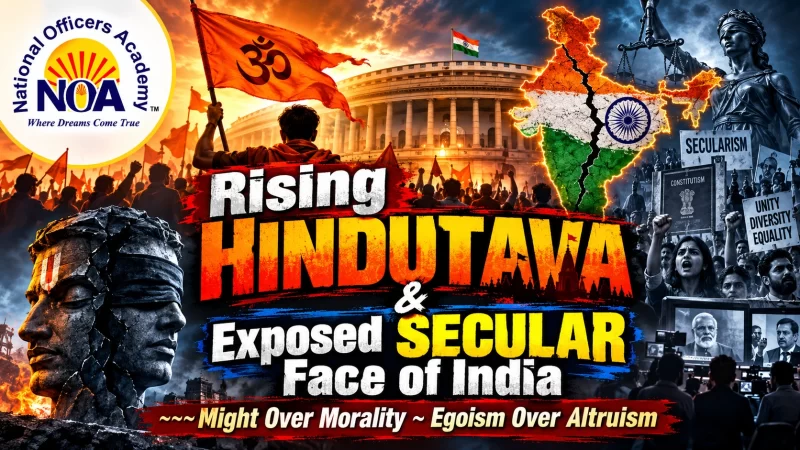
Rising Hindutva & the Exposed Secular Face of India
Might Over Morality – Egoism Over Altruism
Contemporary India has undergone significant political, ideological and socio-cultural transformation. The article argues that the country’s traditional image as a secular and multicultural democracy has increasingly come under pressure from the rise of Hindutva-oriented Hindu nationalism.
Since Narendra Modi and the Bharatiya Janata Party (BJP) rose to national power, debates surrounding the position of religious minorities, secularism, citizenship, religious freedom and majoritarian politics have intensified.
Critics of the BJP government argue that political rhetoric, legislation and social mobilisation associated with Hindutva have contributed to a more difficult environment for Muslims, Christians, Sikhs, Dalits and other communities.
Supporters of the BJP, however, generally present Hindutva as a civilisational and cultural ideology associated with India’s heritage rather than as an inherently anti-minority programme.
The controversy therefore centres on a fundamental question:
Can India’s constitutional commitment to secularism coexist with the increasing political influence of Hindu nationalism?
From Secularism to Hindutva – An Overview
Indian secularism traditionally differs from some Western conceptions of strict separation between religion and the state.
Instead, the Indian state has historically intervened in religious matters while formally recognising equality among different faith communities.
The source article argues that this model has come under increasing strain because of the political rise of Hindutva.
Hindutva is closely associated with organisations such as the Rashtriya Swayamsevak Sangh (RSS) and has exercised considerable influence over the ideological development of the BJP.
The rise of Hindu nationalist politics has generated controversies surrounding:
- Religious identity
- Citizenship
- Interfaith marriage
- Cow protection
- Muslim personal and religious practices
- Kashmir
- Religious conversion
- Minority representation
Modification of India – BJP and Hindutva
The BJP strengthened its national political position after winning parliamentary majorities in the 2014 and 2019 general elections.
Narendra Modi’s political rise also brought renewed attention to the relationship between the BJP and RSS.
The source recalls the communal violence in Gujarat in 2002, when Modi was Chief Minister of the state, as an important episode in debates over communal politics in India.
More than a thousand people were killed in the violence, with Muslims forming a large proportion of the victims.
The BJP has publicly described its Hindutva orientation primarily in terms of culture, civilisation and national heritage. Critics, however, argue that Hindu nationalism has increasingly shaped political discourse in ways that disadvantage minorities.
Minority Treatment in India – Evidence in the Debate Over Secularism
1. Rise of Hindu Nationalist Rhetoric
The source argues that political rhetoric directed against Muslims has intensified during the BJP era.
Statements attributed to several political figures have generated criticism for contributing to communal hostility.
Such rhetoric becomes especially dangerous when political identity is increasingly defined through religious majoritarianism.
The wider consequences can include:
- Communal mistrust
- Political exclusion
- Religious polarisation
- Social hostility
- Mob violence
2. Islamophobia and Communal Mobilisation
The source discusses allegations that anti-Muslim narratives have increasingly entered mainstream political and digital discourse.
It particularly highlights the role of social media in circulating inflammatory content and reinforcing communal stereotypes.
During the COVID-19 pandemic, members of the Tablighi Jamaat became the subject of intense public controversy after a religious gathering was linked to coronavirus transmission.
The source argues that this episode contributed to wider anti-Muslim narratives and calls for economic boycotts in some areas.
3. Cow Protection Laws and Vigilantism
Cows hold religious significance for many Hindus, and several Indian states have introduced or strengthened laws restricting cow slaughter.
The source argues that these policies have also contributed to vigilantism in which individuals suspected of transporting or slaughtering cattle have been attacked.
Muslims and members of other marginalised communities have frequently figured among victims reported in such incidents.
The wider policy challenge is to ensure that religiously motivated legislation does not encourage private individuals or mobs to assume law-enforcement powers.
4. Riots and Mob Violence
Communal violence remains a serious concern in debates about Indian secularism.
The source particularly discusses the violence in northeast Delhi in February 2020.
The unrest occurred against the backdrop of protests concerning citizenship legislation and resulted in dozens of deaths.
Muslims constituted a substantial proportion of those killed, although Hindus and public officials also lost their lives.
The episode intensified debate over:
- Police neutrality
- Political rhetoric
- Majoritarian mobilisation
- Protection of peaceful protesters
- Minority security
5. “Love Jihad” and Religious Conversion Laws
The expression “Love Jihad” has been used by Hindu nationalist groups to allege that Muslim men deliberately enter relationships with Hindu women for the purpose of religious conversion.
Several BJP-governed states have introduced laws addressing allegedly unlawful or coercive religious conversion.
Supporters argue that such laws protect individuals from forced or fraudulent conversion.
Critics contend that they can interfere with interfaith relationships and disproportionately affect Muslim men and Christian communities.
The controversy illustrates the tension between preventing coercion and preserving individual freedom in matters of marriage and religion.
6. Muslim Women and the Hijab Controversy
The treatment of Muslim women has also become a major point of political and social controversy.
The source refers to the Bulli Bai controversy, in which photographs of Muslim women were uploaded online in a degrading manner.
It also discusses the 2022 hijab dispute in Karnataka, where Muslim students faced restrictions relating to wearing hijab in educational institutions.
The issue produced protests and counter-protests and became part of a broader debate over:
- Religious freedom
- Educational discipline
- Women’s autonomy
- Minority identity
- Secularism
7. Citizenship Amendment Act and National Register of Citizens
The Citizenship Amendment Act (CAA), passed in December 2019, became one of the most controversial measures associated with the BJP government.
The legislation created an accelerated pathway to Indian citizenship for specified non-Muslim migrants from Pakistan, Bangladesh and Afghanistan who entered India before a stated cut-off date.
Muslims were excluded from these religious categories.
Supporters of the legislation argued that it was intended to protect religious minorities facing persecution in neighbouring states.
Critics argued that introducing religion into citizenship policy challenged India’s secular constitutional tradition.
The debate became particularly sensitive when linked with discussion of the National Register of Citizens (NRC).
Critics feared that individuals unable to prove citizenship through documentary evidence could face unequal consequences depending on their religious identity.
The CAA-NRC controversy therefore became a major test of India’s constitutional debate over citizenship, religion and equality.
The Jammu and Kashmir Conundrum
Kashmir remains one of the most consequential issues in India-Pakistan relations and a major point of disagreement over Indian constitutional and security policy.
On August 5, 2019, the Indian government altered the constitutional status of Jammu and Kashmir by making Article 370 inoperative and reorganising the former state.
The constitutional changes were accompanied by the removal of the special arrangement associated with Article 35A.
The former state was subsequently reorganised into:
- The Union Territory of Jammu and Kashmir
- The Union Territory of Ladakh
The Indian government presented these measures as necessary for constitutional integration, governance and development.
Critics, including Pakistan and several Kashmiri political groups, argued that the changes weakened Kashmir’s autonomy and altered the constitutional relationship between the territory and New Delhi.
Property and Demographic Concerns
Article 35A had been associated with special rights concerning permanent residents of Jammu and Kashmir.
Its removal generated concerns among critics that changes to residency and property rules could eventually alter the demographic and political character of the region.
These concerns have remained central to Pakistan’s criticism of India’s post-2019 Kashmir policy.
Human Rights Concerns in Kashmir
The source raises concerns regarding:
- Use of pellet-firing shotguns
- Arrests and detention
- Restrictions on political activity
- Press freedom
- Journalist safety
- Allegations of enforced disappearances
The conflict has produced competing narratives over security, separatism, terrorism, human rights and political representation.
Is Indian Secularism Under Pressure?
The cumulative effect of these controversies has produced a wider debate regarding India’s secular identity.
India’s Constitution continues to provide a secular legal framework and guarantees fundamental rights to citizens.
The central criticism presented in the source, however, is that constitutional secularism may be weakened when political rhetoric and state policies are perceived as disproportionately favouring the religious majority.
This distinction between a secular Constitution and the political behaviour of society and institutions lies at the heart of the debate.
Minorities in Pakistan – Constitutional and Institutional Protections
The source contrasts developments in India with constitutional protections available to religious minorities in Pakistan.
However, constitutional guarantees should be distinguished from the actual social experience of minority communities, and Pakistan also continues to face its own challenges involving discrimination, violence and religious intolerance.
1. Constitutional Protection
The Constitution of Pakistan contains provisions relating to equality and minority rights.
These include:
- Article 25: Equality of citizens
- Article 26: Non-discrimination concerning access to public places
- Article 36: Protection of minorities and their legitimate rights and interests
The constitutional framework also provides protections concerning:
- Religious practice
- Educational rights
- Property
- Speech
- Participation in public life
2. Supreme Court Response to the Karak Temple Attack
The source highlights the Supreme Court of Pakistan’s intervention following damage to a Hindu temple in Karak, Khyber Pakhtunkhwa.
The judicial response demonstrated the role courts can play in protecting minority religious sites and enforcing constitutional guarantees.
3. State Response to the Sialkot Lynching
The killing of Sri Lankan factory manager Priyantha Kumara in Sialkot became one of Pakistan’s most widely condemned incidents of mob violence.
The government publicly condemned the killing, arrests were made and criminal proceedings followed.
The case demonstrated both the serious dangers of mob extremism in Pakistan and the importance of prompt state accountability.
4. Removal of a Provincial Minister Over Derogatory Remarks
The source also refers to the removal of Punjab Information Minister Fayyaz-ul-Hassan Chohan following derogatory remarks concerning Hindus.
The decision was presented as an example of political accountability for rhetoric directed against a religious minority.
5. Opening of the Kartarpur Corridor
The Kartarpur Corridor opened in November 2019 and provided Sikh pilgrims from India with direct access to Gurdwara Darbar Sahib Kartarpur.
The initiative was widely viewed as an important gesture of religious facilitation and people-to-people engagement.
Its significance extends beyond religious tourism because it demonstrates the potential of cultural and faith-based diplomacy between Pakistan and India.
6. Representation in Parliament
The constitutional and electoral system provides reserved representation for religious minorities in Pakistan’s legislatures.
The source highlights reserved minority seats in:
- National Assembly
- Provincial assemblies
These arrangements are intended to ensure minority representation within legislative institutions.
7. Employment Quotas
The source also discusses employment quotas established for non-Muslim minorities in public-sector recruitment.
Such mechanisms seek to improve representation and economic participation.
Pakistan Must Also Address Its Own Minority-Rights Challenges
Comparative analysis should not imply that Pakistan has completely resolved the problems facing its own minorities.
Pakistan has also witnessed:
- Mob violence
- Attacks on places of worship
- Religious discrimination
- Social exclusion
- Misuse allegations involving religious laws
The appropriate lesson is therefore not simply to compare one country favourably against another.
Both states must continuously strengthen constitutionalism, rule of law and equal citizenship.
Way Forward for India
1. Reaffirm Constitutional Secularism
India’s constitutional commitment to equality should remain above partisan and religious politics.
2. Protect Religious Minorities
State institutions must provide equal protection to Muslims, Christians, Sikhs, Dalits and all other communities.
3. Prevent Hate Speech
Political leaders should avoid inflammatory rhetoric that can contribute to communal hostility.
4. Act Against Mob Violence
Law-enforcement institutions should act impartially against communal violence and vigilantism.
5. Protect Religious Freedom
Policies involving clothing, dietary practices, religious conversion and worship should be implemented consistently with constitutional protections.
6. Strengthen Media Responsibility
Media institutions should avoid inflammatory communal narratives and distinguish verified reporting from political propaganda.
7. Protect Civil Liberties in Kashmir
Security considerations should be balanced with fundamental rights, political representation and protections for journalists and civilians.
Way Forward for Pakistan
Pakistan should strengthen its own minority-rights framework rather than relying only on comparisons with neighbouring states.
Priority measures include:
- Strict action against mob violence
- Protection of religious sites
- Effective minority employment quotas
- Political representation
- Interfaith dialogue
- Equal educational opportunities
- Rule of law
- Protection against hate speech
Conclusion
The rise of Hindutva has become one of the most important political and ideological developments shaping contemporary India.
The BJP’s electoral dominance, the influence of Hindu nationalist organisations, communal tensions, citizenship debates, cow-protection politics, religious-conversion laws, hijab controversies and constitutional changes in Jammu and Kashmir have collectively intensified debate over the future of Indian secularism.
India remains constitutionally committed to democratic and secular principles, but critics argue that majoritarian political mobilisation is placing those principles under increasing pressure.
For a society as religiously, linguistically and culturally diverse as India, sustainable stability requires equal citizenship regardless of faith, caste or community.
Pakistan’s own constitutional provisions, the Kartarpur Corridor, minority representation and selected state responses provide examples of institutional protection, but Pakistan must simultaneously recognise and address the serious challenges faced by its own minority communities.
Ultimately, the credibility of any democracy is determined not merely by the power of its majority, but by the security, dignity and equal citizenship enjoyed by its minorities.