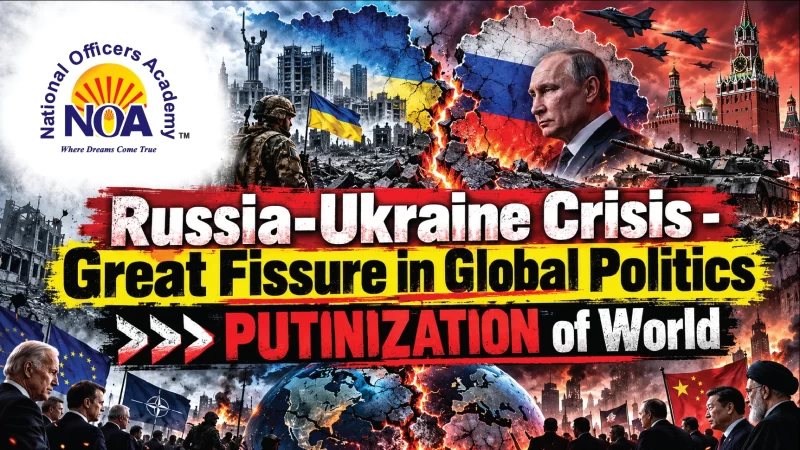
Russia-Ukraine Crisis – Great Fissure in Global Politics
Putinization of the World
Russia’s invasion of Ukraine represents one of the most consequential military and geopolitical crises in Europe since the Second World War.
The conflict has transformed relations between Russia and the West, revived debates over NATO expansion, accelerated great-power competition and produced widespread economic consequences far beyond the immediate battlefield.
The roots of the conflict are connected with several decades of changing European security arrangements following the collapse of the Soviet Union.
After the end of the Cold War, NATO expanded eastward and incorporated several former members of the Soviet sphere, including:
- Poland
- Romania
- Lithuania
- Latvia
- Estonia
- Other Central and Eastern European states
This expansion brought NATO considerably closer to Russia’s borders.
Russia increasingly viewed the prospect of further NATO enlargement, particularly potential Ukrainian membership, as a serious strategic challenge.
President Vladimir Putin repeatedly criticised NATO’s eastward expansion and argued that Russia’s security concerns were being ignored.
Historical Background of the Crisis
The contemporary conflict cannot be understood without examining developments following the dissolution of the Soviet Union.
Russia experienced a dramatic decline in its global influence during the 1990s, while the United States emerged as the dominant international power.
President Putin later sought to restore Russia’s military capability, political influence and position as a major global power.
Ukraine became particularly important because of its:
- Geographical location
- Historical connections with Russia
- Access to the Black Sea
- Economic significance
- Potential strategic alignment with NATO and the European Union
The 2014 Turning Point
Relations between Russia and Ukraine deteriorated sharply in 2014 following political upheaval in Kyiv and the removal of a Ukrainian president who had maintained close relations with Moscow.
Russia subsequently annexed Crimea.
Conflict also intensified in eastern Ukraine, where Russian-backed separatist forces gained control over parts of the Donbas region.
The fighting created a prolonged security crisis and significantly worsened Russia-West relations.
Russian Security Demands Before the 2022 War
In December 2021, Russia presented the United States and NATO with a series of security demands.
Among Moscow’s major concerns were:
- A guarantee that Ukraine would not join NATO
- Restrictions on further NATO military expansion near Russia
- Changes in NATO deployments in Eastern Europe
- Implementation of earlier agreements concerning eastern Ukraine
The United States and its allies rejected several of Russia’s principal demands.
Diplomatic negotiations failed to resolve the growing confrontation.
Russia subsequently launched its full-scale invasion of Ukraine in February 2022.
The Russia-Ukraine War and International Politics
The war has created political, diplomatic, economic, humanitarian, food and energy crises with consequences extending across the international system.
It has also exposed competing interpretations of:
- State sovereignty
- National security
- Alliance politics
- International law
- Great-power influence
Global Strategic Implications of the War
1. Revival of Great-Power Competition
The war has accelerated strategic competition between the United States, Russia and China.
The post-Cold War period of overwhelming American dominance has increasingly given way to a more contested international environment.
Russia has demonstrated that it remains willing to use military power to pursue its strategic objectives, while China continues to expand its economic and geopolitical influence.
The international order is therefore increasingly characterised by competition among major powers.
2. Revival of NATO
The invasion revitalised NATO as a military and political alliance.
European states increased defence spending, strengthened military coordination and renewed their reliance on collective defence arrangements.
Russia’s attempt to prevent greater NATO influence ultimately contributed to stronger Western security cooperation.
3. Russia-China Strategic Convergence
Western sanctions and deteriorating Russia-Europe relations have pushed Moscow towards closer economic and strategic engagement with China.
This creates a potentially important Eurasian alignment.
However, the relationship is characterised by considerable economic asymmetry because China possesses a substantially larger economy and broader technological base.
4. Return of Cold War-Style Bloc Politics
The conflict has contributed to renewed political divisions between Western states and countries maintaining closer ties with Russia.
Although the international environment is more complex than the original Cold War, the conflict has encouraged:
- Strategic bloc formation
- Military alignments
- Economic sanctions
- Competing diplomatic narratives
5. Emergence of a Multipolar World
The Russia-Ukraine war has reinforced the wider transition from a predominantly unipolar international order towards greater multipolarity.
Countries increasingly attempt to preserve strategic flexibility rather than align completely with one major power.
This trend is particularly visible among states in:
- Asia
- Middle East
- Africa
- Latin America
6. Nuclear Flashpoint
The conflict is especially dangerous because Russia possesses one of the world’s largest nuclear arsenals.
Direct military confrontation between Russia and NATO therefore carries potentially catastrophic escalation risks.
The war has renewed debate over:
- Nuclear deterrence
- Strategic stability
- Escalation management
- Nuclear signalling
7. Cyber and Hybrid Warfare
The war has also demonstrated the growing importance of cyber and information warfare.
Modern conflict now involves:
- Cyber attacks
- Satellite intelligence
- Electronic warfare
- Propaganda
- Social-media narratives
- Economic coercion
The battlefield has therefore expanded far beyond conventional military operations.
8. The Taiwan Question
The conflict has also influenced global discussion regarding Taiwan.
Strategists have examined how Western responses to Russia may affect Chinese calculations regarding Taiwan and how economic sanctions could be used in future geopolitical crises.
Global Political Implications
Changing Global Order
The Russia-Ukraine crisis has challenged the existing international system and intensified debate regarding the future distribution of global power.
The United States remains the world’s most powerful military and economic actor in many respects, but Russia’s military assertiveness and China’s economic rise have made the international system increasingly competitive.
Polarisation Within Europe
The conflict created a major security crisis for Europe.
European states faced pressure to balance:
- Military support for Ukraine
- Energy security
- Economic stability
- Domestic inflation
- Relations with Russia
Refugee Crisis
Millions of Ukrainians were displaced by the war.
Large refugee flows created significant humanitarian and administrative challenges for neighbouring European countries.
Global Economic Implications of the Crisis
The economic consequences of the war have extended far beyond Russia and Ukraine.
The conflict disrupted energy markets, agricultural exports, commodity supplies, transportation networks and global supply chains.
The result has been:
- Higher inflation
- Slower economic growth
- Higher energy prices
- Food insecurity
- Supply-chain disruption
- Higher production costs
Economic Sanctions Against Russia
The United States, European Union and other Western partners imposed extensive sanctions on Russia following the invasion.
These measures targeted:
- Russian banks
- Financial institutions
- Individuals
- Technology imports
- International financial transactions
- Selected energy-related activities
The sanctions represented an attempt to impose economic costs on Moscow without entering into direct military conflict.
However, sanctions also contributed to wider economic disruption and encouraged Russia to deepen commercial relationships with non-Western states.
Emerging Global Energy Crisis
Russia has historically been one of the world’s most important exporters of:
- Crude oil
- Natural gas
- Coal
European dependence on Russian energy made the region particularly vulnerable to supply disruption.
Before the war, several European states obtained substantial proportions of their natural gas requirements from Russia.
The conflict forced European governments to search for alternative suppliers.
Liquefied Natural Gas as an Alternative
One of Europe’s major responses has been greater reliance on liquefied natural gas.
Other measures include:
- Increasing renewable energy production
- Improving energy efficiency
- Diversifying suppliers
- Expanding gas storage
The crisis therefore accelerated debate regarding long-term European energy independence.
Russia’s Importance in Global Commodity Markets
Russia is not only an energy exporter.
It also plays an important role in global markets for:
- Nickel
- Fertiliser
- Minerals
- Timber
- Agricultural commodities
Disruption of these supplies affects industrial production and food systems across the world.
Looming Food Insecurity
Russia and Ukraine are important agricultural exporters, particularly of wheat and other grains.
The war disrupted Ukrainian agricultural production, transportation and maritime exports.
Countries heavily dependent on grain imports from the Black Sea region became particularly vulnerable.
The consequences have been especially serious for parts of:
- Middle East
- North Africa
- Developing Asia
Higher food prices have intensified an already difficult situation created by the COVID-19 pandemic and global supply-chain disruption.
Inflationary Pressure
Higher energy and food prices contributed to inflation across Europe and other regions.
For central banks, this created a difficult policy dilemma.
Increasing interest rates can reduce inflationary pressure but may simultaneously weaken economic growth and investment.
Aviation and Airspace Restrictions
The war also disrupted international aviation.
Western countries restricted Russian aircraft from using their airspace, while Russia imposed reciprocal restrictions.
Airlines were consequently required to:
- Reroute flights
- Travel longer distances
- Use more fuel
- Bear higher operational costs
Russia and Ukraine in Global Supply Chains
Both countries occupy important positions in global commodity supply chains.
Disruptions affected sectors such as:
- Automotive manufacturing
- Electronics
- Energy
- Agriculture
- Heavy machinery
- Fertiliser production
Impact on Pakistan’s Strategic Stability
The Russia-Ukraine conflict has important strategic implications for Pakistan.
Pakistan must simultaneously manage relations with:
- United States
- European Union
- China
- Russia
- Ukraine
This requires diplomatic balance in an increasingly polarised international environment.
Pakistan-Russia Relations
Pakistan has gradually attempted to expand relations with Russia beyond their historical Cold War differences.
Potential areas of cooperation include:
- Energy
- Trade
- Regional security
- Afghanistan
- Connectivity
The Ukraine war complicated this engagement because Pakistan also maintains important economic and diplomatic relations with Western states.
Pakistan and Western Powers
The United States and European countries remain important to Pakistan because of:
- Exports
- Financial institutions
- Development partnerships
- Diplomatic relations
- Technology
Pakistan therefore has strong incentives to avoid rigid alignment with either side.
Nuclear Deterrence and Strategic Security
The Ukraine conflict has revived debate regarding the value of nuclear deterrence in international security.
For Pakistan, nuclear capability remains a central component of its deterrence posture in South Asia.
The crisis demonstrates how nuclear weapons can significantly affect calculations surrounding direct military confrontation between major powers.
Impact on Pakistan’s Economic Stability
The economic consequences of the war were particularly difficult for Pakistan because the country was already facing external financing and inflationary pressures.
Food Security
Ukraine had been an important supplier of wheat and other agricultural commodities to Pakistan.
The disruption of supplies increased uncertainty in Pakistan’s food-import market.
The source notes that Ukraine accounted for a substantial proportion of Pakistan’s wheat imports before the conflict.
Energy Security
Higher international oil prices increased Pakistan’s import bill.
As an energy-importing economy, Pakistan is highly vulnerable to sudden increases in global petroleum and gas prices.
The consequences include:
- Higher transport costs
- Greater electricity costs
- Inflation
- Pressure on foreign-exchange reserves
- Larger current-account deficits
Inflation
Rising global food and energy prices contributed to domestic inflation.
Higher production and transportation costs reduced purchasing power and placed greater pressure on households.
Exchange-Rate Pressure
Higher import costs increased demand for foreign currency and contributed to pressure on the Pakistani rupee.
Currency depreciation further increased the local cost of imported fuel, machinery and raw materials.
Employment and Industrial Production
Higher energy and input costs negatively affect domestic industries.
When production becomes more expensive, businesses may reduce:
- Investment
- Production
- Hiring
This can weaken economic growth and employment creation.
Lessons for Pakistan
1. Maintain a Balanced Foreign Policy
Pakistan should avoid unnecessary involvement in great-power bloc politics.
Relations should be guided primarily by long-term national interests.
2. Strengthen Energy Security
Pakistan should diversify energy suppliers and increase domestic and renewable energy production.
Priority areas include:
- Solar energy
- Wind power
- Hydropower
- Energy efficiency
- Diversified oil and gas suppliers
3. Strengthen Food Security
Pakistan should reduce excessive dependence on imported food commodities by improving domestic agricultural productivity.
4. Diversify Trade
Economic relations should be diversified across multiple regions to reduce vulnerability to geopolitical shocks.
5. Protect Strategic Autonomy
A stronger domestic economy is essential for an independent foreign policy.
Excessive economic dependence limits a country’s ability to maintain strategic neutrality during international crises.
Putinization of the World?
The phrase “Putinization of the World” reflects the wider concern that power politics, military coercion and spheres of influence are again becoming increasingly important in international relations.
The Russia-Ukraine war demonstrates that the post-Cold War assumption of steadily expanding cooperative global governance has been severely challenged.
Competition among major powers is increasingly shaping:
- Military alliances
- Economic sanctions
- Energy relationships
- Technology
- Trade
- Regional conflicts
However, military power alone cannot create a stable international order.
Russia’s invasion also raises serious questions under the principles of sovereignty, territorial integrity and the UN Charter.
Conclusion
The Russia-Ukraine war represents a major point of inflection in contemporary global politics.
The conflict was preceded by long-standing disagreements involving NATO expansion, Russia’s security concerns, the political orientation of Ukraine and the wider struggle over the post-Cold War European order.
Nevertheless, Russia’s full-scale invasion of Ukraine constituted a major use of military force with profound consequences for international peace, sovereignty and global stability.
The war has accelerated great-power rivalry, revived NATO, strengthened Russia-China cooperation and contributed to the movement towards an increasingly multipolar world.
Its economic consequences have been equally significant.
Energy shortages, food insecurity, supply-chain disruption, sanctions and global inflation have affected countries far beyond Europe.
Pakistan has also faced significant consequences through rising energy costs, food-import pressures, inflation and difficult diplomatic choices.
The crisis therefore reinforces an important lesson for Islamabad: strategic autonomy requires economic resilience, energy security, food security and balanced relations with competing global powers.
The Russia-Ukraine conflict demonstrates that an international system based only on might over morality risks replacing diplomacy with perpetual confrontation. Sustainable global stability ultimately requires respect for sovereignty, international law, negotiation and responsible great-power behaviour.