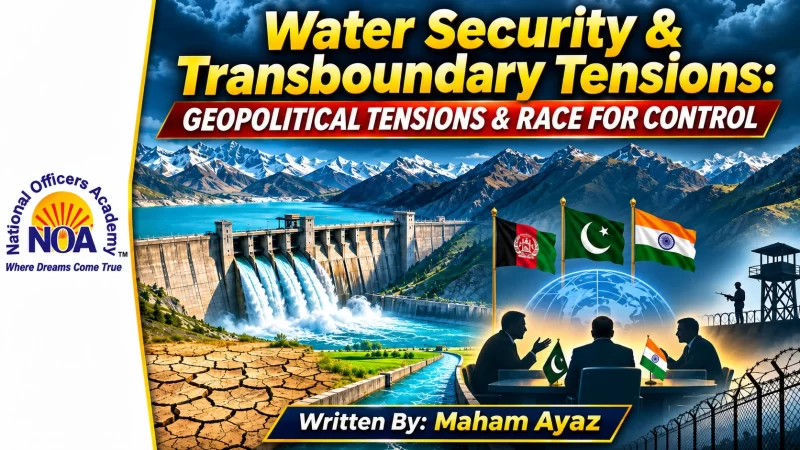
Water Security & Transboundary Tensions
Geopolitical Tensions & Race for Control
Written By: Maham Ayaz
Water is rapidly emerging as one of the most strategic resources in South Asia.
The region depends heavily on snow-fed and glacier-fed rivers originating in the Himalayan and Tibetan highlands and flowing across international borders.
These rivers sustain:
- Agriculture
- Food security
- Hydropower
- Urban populations
- Rural livelihoods
- Natural ecosystems
Two major developments demonstrate how water security is increasingly becoming intertwined with geopolitics.
The first is China’s massive hydropower project on the upper Brahmaputra, known in Tibet as the Yarlung Tsangpo, and its possible consequences for India and Bangladesh.
The second is the growing strain surrounding the Indus Waters Treaty between India and Pakistan.
Together, these cases demonstrate how upstream geographical advantage, weak institutional frameworks and changing state behaviour can transform rivers from shared natural resources into instruments of strategic influence.
The Himalayan Watershed: South Asia’s “Third Pole”
The Himalayan watershed is often called the Third Pole because it contains the world’s largest concentration of freshwater reserves outside the Arctic and Antarctic.
Its river systems support nearly two billion people across:
- China
- India
- Pakistan
- Bangladesh
- Nepal
- Bhutan
Despite this deep hydrological interdependence, South Asia remains one of the least institutionally coordinated regions in the world when it comes to shared-water governance.
As a result, upstream hydropower projects are increasingly viewed not simply as development initiatives but as strategic decisions carrying major transboundary implications.
This securitization of water is particularly visible in the Brahmaputra and Indus basins.
China’s Brahmaputra Mega-Dam and Downstream Impacts
In July 2025, China announced the commencement of what the source describes as the world’s largest hydropower project on the Yarlung Tsangpo in the Tibet Autonomous Region.
The project is estimated at approximately USD 170 billion and is expected to consist of a cascade of five large hydropower stations.
Beijing presents the project as a major initiative aimed at:
- Expanding renewable-energy generation
- Supporting economic growth in western China
- Developing Tibet’s hydropower potential
However, its location at the headwaters of one of South Asia’s most important rivers has generated serious concern in India and Bangladesh.
Why the Brahmaputra Matters
The Brahmaputra is a lifeline for millions of people across northeast India and Bangladesh.
Its waters support:
- Agriculture
- Fisheries
- Drinking-water supply
- Wetlands
- Riverine ecosystems
- Local economies
Any major upstream alteration of its seasonal flow therefore carries both ecological and national-security implications.
Fear of Reduced Dry-Season Flows
One major concern is that large upstream reservoirs could retain substantial quantities of water during lean seasons.
The source cites modelling suggesting that, under worst-case scenarios, dry-season flows could fall dramatically.
For downstream communities, reduced dry-season flows could affect:
- Irrigation
- Groundwater recharge
- Navigation
- Agricultural productivity
- Ecological stability
Risk of Sudden Water Releases
The opposite problem is equally serious.
Sudden upstream releases—whether deliberate, operational or triggered by extreme weather—could increase the risk of severe downstream flooding.
This creates a dual vulnerability:
- Too little water during the dry season
- Too much water during flood periods
In a climate-stressed river system, both scenarios can become destabilising.
Sediment Disruption and Agricultural Losses
The Brahmaputra carries enormous quantities of nutrient-rich sediment downstream.
These sediments are especially important for Bangladesh’s delta.
Large upstream dams can trap sediment within reservoirs and reduce the natural flow of nutrients downstream.
Over time, this may affect:
- Soil fertility
- Agricultural productivity
- River morphology
- Delta stability
- Rural livelihoods
The environmental consequences of mega-dams therefore extend well beyond immediate water quantity.
India’s Response to China’s Dam
India has responded by pursuing its own large-scale hydropower projects on the Brahmaputra, particularly in Arunachal Pradesh.
These projects are intended partly to:
- Expand domestic hydropower capacity
- Strengthen prior-use claims
- Improve India’s strategic position
Indian reactions to China’s project are nevertheless divided.
Some ministers and experts warn that upstream Chinese control could create serious risks through:
- Flow manipulation
- Flooding in Assam
- Dry-season shortages
- Long-term ecological disruption
Others argue that the Brahmaputra is such a large river that much of its total flow comes from monsoon rainfall within India rather than directly from Tibet.
This debate reflects the uncertainty surrounding the actual hydrological consequences of the project.
The Indus Waters Treaty: Legacy and Strain
The Indus Waters Treaty was brokered by the World Bank in 1960 and has long been regarded as one of the most successful transboundary water-sharing agreements in the world.
It allocated:
- Ravi, Beas and Sutlej to India
- Indus, Jhelum and Chenab primarily to Pakistan
For decades, the treaty survived:
- Wars
- Diplomatic crises
- Military confrontation
- Political hostility
This endurance gave the IWT exceptional symbolic and practical importance.
The 2025 Crisis
The source states that this stability was seriously disrupted in 2025 following the Phalgam terrorist attack in India.
New Delhi subsequently announced that the Indus Waters Treaty would be held in “abeyance with immediate effect.”
India justified this move through arguments involving:
- Counter-terrorism concerns
- Demographic change
- Energy demand
- Security requirements
- Changed circumstances
The source argues that the treaty itself contains no provision allowing unilateral suspension, abeyance or withdrawal.
For Pakistan, the implications are particularly serious because its economy and food system are deeply dependent on the western rivers of the Indus basin.
Why the Indus Is Existential for Pakistan
Pakistan is one of the world’s most irrigation-dependent agricultural economies.
The Indus basin supports:
- Crop production
- Food security
- Hydropower
- Rural employment
- Domestic water supply
Any significant uncertainty surrounding river flows therefore has implications far beyond water management.
It can affect:
- National security
- Economic stability
- Agricultural productivity
- Food prices
- Social stability
Brahmaputra and Indus: A Comparative Outlook
Although the two basins are geographically distinct, they demonstrate remarkably similar geopolitical patterns.
Upstream Power Asymmetry
China occupies the dominant upstream position on the Brahmaputra.
India occupies the key upstream position relative to Pakistan on the western Indus rivers.
This gives upstream states structural leverage over downstream countries.
Weak or Strained Institutions
The Brahmaputra lacks a comprehensive multilateral water-sharing treaty involving China, India and Bangladesh.
The Indus basin, by contrast, possesses a detailed legal framework, but that framework is now under significant political strain.
Securitization of Water
Both rivers are increasingly treated as strategic assets rather than merely natural resources.
Hydropower infrastructure, data sharing, storage capacity and water releases now carry geopolitical significance.
Climate Change as a Threat Multiplier
Glacial retreat, unpredictable rainfall, rising temperatures and population growth are making already tense water relations even more difficult.
As hydrological uncertainty grows, states may increasingly interpret water decisions through national-security lenses.
Water as an Instrument of Statecraft
The source argues that rivers that were historically viewed primarily as lifelines for agriculture and human survival are increasingly becoming tools of:
- Statecraft
- Deterrence
- Influence
- Coercive diplomacy
This is particularly dangerous in South Asia because the region already suffers from:
- Border disputes
- Strategic rivalry
- Military competition
- Political mistrust
Water therefore risks becoming another arena of geopolitical confrontation.
China’s Upstream Position and Regional Power Balancing
The article also identifies a deeper strategic dynamic.
China’s upstream control over the Brahmaputra may indirectly act as a counterweight to India’s geographical leverage over Pakistan within the Indus system.
This creates a layered regional hierarchy in which:
- China holds upstream leverage over India
- India holds upstream leverage over Pakistan
- Bangladesh remains highly vulnerable downstream
Water politics therefore intersect directly with wider regional power balances.
International Adjudication: What Are Pakistan’s Options?
Pakistan possesses comparatively stronger legal options because the Indus Waters Treaty contains a detailed dispute-resolution mechanism.
Neutral Expert
Technical disagreements can be referred to a Neutral Expert.
Court of Arbitration
Legal and treaty-interpretation disputes can be taken to a Court of Arbitration.
The source states that Pakistan has already taken treaty-related disputes to the Permanent Court of Arbitration.
According to the article, the PCA confirmed that India could not unilaterally suspend the treaty and that the tribunal retained jurisdiction to hear Pakistan’s case.
Can Pakistan Go to the International Court of Justice?
Pakistan may attempt to approach the International Court of Justice.
However, this route is more complicated.
ICJ jurisdiction generally requires the consent of the states involved.
The source notes that India has historically resisted referring water disputes to the ICJ.
This significantly limits the practical utility of this route.
Role of the World Bank
Because the World Bank brokered the original Indus Waters Treaty, Pakistan can also seek diplomatic engagement through the institution.
The objective would be to:
- Increase political pressure
- Encourage treaty compliance
- Support continued institutional dialogue
Limits of International Law
Even favourable legal decisions may face enforcement challenges.
International tribunals do not possess their own enforcement machinery.
Pakistan’s success would therefore depend on a combination of:
- Legal rulings
- International pressure
- Diplomatic engagement
- Regional cooperation
Nevertheless, the source concludes that Pakistan possesses legally substantial options because the treaty continues to exist under international law.
India and Bangladesh’s Options Against China
The Brahmaputra situation is legally much more difficult because no comprehensive water-sharing treaty exists between China, India and Bangladesh.
General International Water-Law Principles
India and Bangladesh can rely on general principles such as:
- Equitable and reasonable utilisation
- Obligation not to cause significant harm
- Duty to share hydrological information
However, the absence of a binding treaty makes formal legal enforcement difficult.
China is not automatically required to accept external arbitration or adjudication.
Water Diplomacy as the Most Practical Option
The most realistic path for India and Bangladesh is sustained diplomatic engagement.
This can include:
- Regional diplomatic pressure
- Hydrological data-sharing agreements
- Dam-safety protocols
- Joint environmental assessments
- Confidence-building measures
Need for a Formal Brahmaputra Basin Agreement
India and Bangladesh can also press for creation of a formal river-basin framework.
Such an agreement could include:
- Guaranteed data sharing
- Joint monitoring
- Environmental safeguards
- Consultation before major projects
- Binding dispute-resolution mechanisms
The source nevertheless emphasises that China’s dominant upstream position gives it substantial strategic leverage and currently limits incentives for binding cooperation.
Climate Change Is Making Water Diplomacy Harder
Transboundary water disputes cannot be analysed only through geopolitics.
Climate change is altering the physical foundations of South Asia’s river systems.
Major pressures include:
- Glacial retreat
- Erratic monsoon rainfall
- Floods
- Droughts
- Population growth
- Rising agricultural demand
Greater hydrological volatility means historic water-sharing assumptions may become increasingly difficult to maintain.
Why Data Sharing Matters
One of the most important confidence-building measures is timely sharing of hydrological information.
Data regarding:
- Reservoir levels
- Rainfall
- Water releases
- Glacial conditions
- Flood forecasts
can reduce uncertainty and improve disaster preparedness.
In highly securitized environments, absence of data can itself generate strategic mistrust.
From Hydro-Politics to Hydro-Diplomacy
South Asia urgently needs to move away from treating water exclusively as an instrument of leverage.
A sustainable regional approach requires:
- Negotiation
- Transparency
- Scientific cooperation
- Legal predictability
- Joint basin management
Shared rivers should ideally become platforms for regional cooperation rather than sources of strategic confrontation.
Way Forward
1. Preserve the Indus Waters Treaty
India and Pakistan should avoid politicising a treaty that has survived decades of conflict.
2. Strengthen the Permanent Indus Commission
Technical dialogue and continuous communication should remain active even during diplomatic crises.
3. Expand Hydrological Data Sharing
China, India, Pakistan and Bangladesh should improve transparency regarding river flows, reservoir operations and flood risks.
4. Create a Brahmaputra Basin Framework
A formal multilateral arrangement involving China, India and Bangladesh would reduce uncertainty.
5. Institutionalise Prior Consultation
Major upstream projects should involve advance notification and technical consultation with downstream states.
6. Develop Joint Climate Adaptation
States sharing Himalayan river systems should cooperate on glacier monitoring, flood forecasting and drought management.
7. Use International Law as a Stabilising Tool
Treaties and dispute-resolution mechanisms should be insulated from short-term political crises.
8. Avoid Weaponizing Water
Water should not become an instrument of retaliation or coercive diplomacy.
9. Strengthen Regional Water Diplomacy
South Asia needs permanent dialogue mechanisms dedicated specifically to shared water security.
10. Recognise Water Security as Shared Security
Upstream and downstream states ultimately depend on the same ecological systems.
Destabilising those systems eventually harms the entire region.
Conclusion
Water security is becoming one of the defining geopolitical challenges of South Asia.
The Brahmaputra and Indus basins demonstrate how geography, power asymmetry, climate stress and weak institutional cooperation can transform rivers into strategic fault lines.
China’s mega-dam on the Yarlung Tsangpo has heightened concerns in India and Bangladesh regarding flow manipulation, flooding, sediment loss and long-term strategic dependence.
At the same time, India’s decision to place the Indus Waters Treaty in abeyance has raised serious questions about the future of one of the world’s most durable water-sharing arrangements.
Pakistan possesses stronger treaty-based legal options than India and Bangladesh possess against China, but legal victories alone cannot guarantee compliance.
The broader solution lies in rebuilding trust through institutional cooperation, data sharing, international law and sustained water diplomacy.
In an era of glacial retreat, population growth and intensifying geopolitical rivalry, control over water cannot become a substitute for cooperation. South Asia’s rivers cross borders regardless of political hostility; the region’s survival therefore depends on transforming hydro-politics into hydro-diplomacy before shared lifelines become permanent strategic flashpoints.