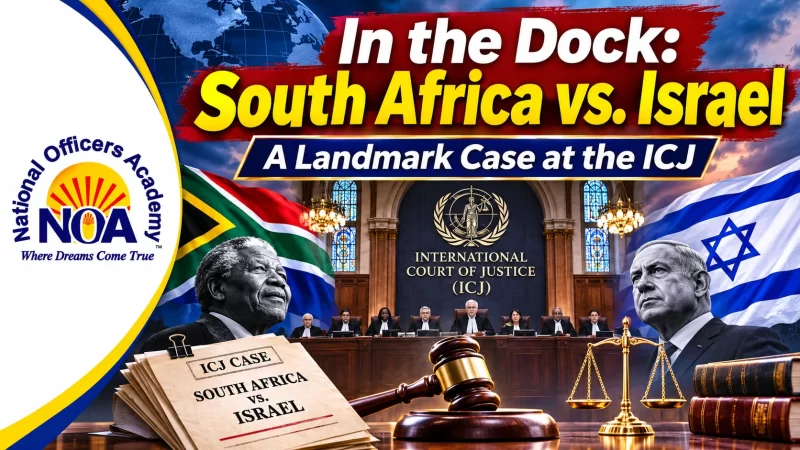
In the Dock: South Africa vs. Israel — A Landmark Case at the ICJ
The International Court of Justice (ICJ) held two days of public hearings in The Hague on January 11 and 12, 2024, concerning South Africa’s landmark case against Israel over alleged violations of the 1948 Convention on the Prevention and Punishment of the Crime of Genocide.
South Africa initiated proceedings on December 29, 2023, alleging that Israel’s actions against Palestinians in the Gaza Strip violated its obligations under the Genocide Convention. It argued that the conduct of Israeli authorities and military forces, considered alongside statements by senior officials, indicated an intention to destroy Palestinians in Gaza, in whole or in part, as a protected group.
Invoking Article IX of the Genocide Convention, which provides for the submission of relevant disputes to the ICJ, South Africa requested urgent provisional measures to protect Palestinians from irreparable harm while the Court considered the substantive allegations.
The case drew comparisons with The Gambia’s 2019 proceedings against Myanmar concerning alleged genocide against the Rohingya population. Both proceedings illustrate how a state party to the Genocide Convention may initiate litigation regarding obligations under the treaty even when it has not itself been directly affected by the alleged atrocities.
Israel rejected South Africa’s allegations and denied possessing genocidal intent, maintaining that its military operations were directed against Hamas following the attacks of October 7, 2023.
The proceedings consequently raised fundamental questions about genocide prevention, state responsibility, civilian protection, and the effectiveness of international law during armed conflicts.
International Legal Battle: South Africa vs. Israel at the ICJ
The International Court of Justice is the principal judicial organ of the United Nations. Established under the UN Charter, it settles legal disputes between states and provides advisory opinions on legal questions referred by authorized international bodies.
Unlike the International Criminal Court (ICC), which concerns individual criminal responsibility, the ICJ adjudicates disputes involving states and their obligations under international law.
Both South Africa and Israel are parties to the 1948 Genocide Convention. South Africa brought its case before the ICJ under Article IX, which provides a jurisdictional basis for disputes concerning the interpretation, application, or fulfilment of the Convention.
Proceedings before the ICJ may take several years to reach a final judgment. Consequently, the Court has the authority to indicate provisional measures intended to preserve relevant rights and prevent irreparable harm while litigation continues.
South Africa’s December 2023 application, accompanied by an urgent request for provisional measures, sought several forms of relief.
These included:
- The immediate suspension of Israel’s military operations in and against Gaza.
- Measures to prevent acts prohibited under the Genocide Convention.
- Prevention and punishment of direct and public incitement to commit genocide.
- Protection of Palestinians from irreparable harm.
- Measures to facilitate humanitarian assistance.
- Preservation of evidence relevant to the allegations.
- Reporting on steps taken to comply with the Court’s orders.
South Africa argued that urgent judicial intervention was necessary because the humanitarian situation in Gaza presented a serious risk to the rights of Palestinians protected under international law.
Genocide Convention’s Legacy: South Africa’s Allegations and Pursuit of Justice
The Convention on the Prevention and Punishment of the Crime of Genocide was adopted by the United Nations General Assembly on December 9, 1948, in response to the atrocities of the Second World War, particularly the Holocaust.
It represented a landmark development in international human rights law by recognizing genocide as an international crime and establishing obligations to prevent and punish it.
Understanding Genocide Under Article II
Article II of the Convention defines genocide through specified acts committed with the intent to destroy, in whole or in part, a national, ethnical, racial, or religious group as such.
These prohibited acts include:
- Killing members of a protected group.
- Causing serious bodily or mental harm to members of the group.
- Deliberately inflicting conditions of life calculated to bring about the group’s physical destruction, in whole or in part.
- Imposing measures intended to prevent births within the group.
- Forcibly transferring children of the group to another group.
A central legal requirement is the existence of specific genocidal intent. Establishing that severe suffering or unlawful acts occurred is not, by itself, sufficient to prove genocide under the Convention.
South Africa’s Allegations Regarding Gaza
South Africa alleged that Israel’s military campaign and restrictions affecting the civilian population had created conditions inconsistent with obligations under the Genocide Convention.
Its arguments concerned several dimensions of the humanitarian crisis.
1. Restrictions on Food, Water, Fuel, and Electricity
South Africa argued that restrictions affecting the availability of food, drinking water, fuel, electricity, and other essential resources endangered the survival of Gaza’s civilian population.
It maintained that the deprivation of basic necessities could be relevant to the prohibition against deliberately inflicting destructive conditions of life upon a protected group.
2. Humanitarian Assistance and Civilian Survival
South Africa emphasized the difficulties faced by humanitarian organizations in delivering adequate assistance to civilians in Gaza.
It argued that shortages of food, medicine, shelter, sanitation, and healthcare aggravated an already catastrophic humanitarian situation.
3. Widespread Displacement
South Africa cited large-scale displacement as another important dimension of the crisis.
The original proceedings referred to approximately 1.9 million internally displaced Palestinians, many of whom faced shortages of suitable shelter, clean water, and sanitation facilities.
4. Civilian Deaths and Destruction
During the January 2024 proceedings, South Africa presented casualty estimates indicating that approximately 23,000 Palestinians had been reported killed since the escalation of hostilities in October 2023.
The source article also refers to estimates suggesting that women and children constituted approximately 70% of those killed.
These were historical figures cited during the early proceedings and should not be interpreted as current casualty totals.
5. Allegations of Genocidal Intent
South Africa argued that statements attributed to senior Israeli political and military officials, considered together with the conduct of military operations, provided evidence relevant to determining genocidal intent.
Its legal representatives maintained that such statements could help establish the purpose behind particular actions affecting Gaza’s civilian population.
Depicting Genocidal Intent: Evidence and Historical Context in South Africa’s Case
One of the most significant features of South Africa’s legal presentation was its reliance on statements attributed to Israeli officials and military leaders.
South Africa argued that these statements, when interpreted alongside military operations and humanitarian conditions, supported its allegation of genocidal intent.
Statements by Israeli Political and Military Officials
South Africa’s legal team drew attention to remarks attributed to senior Israeli officials, including the President, Prime Minister, and Minister of Defence.
The statements were presented as potential evidence concerning the intentions of state authorities during the military campaign.
Particular attention was given to remarks by then-Defence Minister Yoav Gallant concerning a complete siege of Gaza and his use of dehumanizing language.
South Africa argued that such rhetoric was relevant to evaluating the risk of prohibited acts under the Genocide Convention.
Humanitarian Evidence from International Organizations
South Africa also referred to statements and reports from international organizations, including:
- The United Nations (UN).
- The International Committee of the Red Cross (ICRC).
- The World Health Organization (WHO).
These sources described extensive civilian suffering, pressure on hospitals, damage to essential infrastructure, and serious difficulties in providing medical services.
South Africa used this material to emphasize the severity of the humanitarian situation and the risks faced by civilians.
Historical Context: The Nakba, Occupation, and Blockade
South Africa placed the contemporary conflict within the broader history of Palestinian displacement, occupation, and restrictions on Gaza.
Its arguments referred to the Nakba of 1948, the prolonged Israeli occupation of Palestinian territories, and the blockade of Gaza.
The Arabic term Nakba, meaning catastrophe, refers to the mass displacement and dispossession of Palestinians during the 1948 Arab-Israeli conflict.
The legal team argued that historical circumstances were relevant to understanding the broader context in which the alleged violations occurred.
The Biblical Reference to Amalek
South Africa’s presentation also highlighted a biblical reference to Amalek made by Israeli Prime Minister Benjamin Netanyahu.
The Amalekites are portrayed in biblical narratives as adversaries of the Israelites.
South Africa argued that the reference, considered in the context of other statements and military actions, was relevant to assessing the alleged intention to destroy Palestinians in Gaza.
Israel disputed this interpretation and maintained that the reference did not demonstrate genocidal intent.
Israel’s Defence: Challenging Allegations of Genocidal Intent
On January 12, 2024, Israel presented its response before the International Court of Justice.
Israel rejected South Africa’s genocide allegations and argued that its military operations were conducted in response to the October 7, 2023, attacks by Hamas and other armed groups.
1. Invoking the Right to Self-Defence
Israel maintained that its military campaign was intended to protect its population from further attacks and eliminate the military capabilities of Hamas and affiliated armed organizations.
Its legal representatives presented the operations as part of the state’s security response to an armed attack.
2. Denying Genocidal Intent
Israel argued that its military objectives were directed against Hamas rather than the Palestinian population as a protected group.
It maintained that civilian casualties, however severe, did not independently establish the specific intent required for a finding of genocide.
Israel further contended that the statements cited by South Africa had been selectively interpreted or taken out of context.
3. Contesting the Interpretation of Official Statements
Israeli representatives disputed South Africa’s argument that remarks by political and military leaders demonstrated genocidal intent.
They maintained that such statements should be interpreted in the context of the conflict and Israel’s stated security objectives.
4. Allegations Concerning Hamas and Civilian Infrastructure
Israel accused Hamas of operating within civilian areas and using civilians as human shields.
It argued that Hamas’s alleged conduct complicated military operations and contributed to the danger faced by Gaza’s civilian population.
These allegations formed part of Israel’s legal defence and were disputed within the broader international debate over the conflict.
5. Questioning Casualty Evidence
Israel also challenged aspects of the casualty information and supporting evidence submitted by South Africa.
Its representatives questioned the reliability and interpretation of certain figures associated with authorities in Gaza.
Israel maintained that the legal threshold for proving genocide had not been established by South Africa’s submissions.
The competing arguments therefore centered on the relationship between military conduct, humanitarian consequences, and the specific intent required by the Genocide Convention.
Solidarity in Struggle: South Africa’s Historical Alliance with Palestine
South Africa’s support for the Palestinian cause has deep historical and political roots.
The country’s governing African National Congress (ANC) has maintained longstanding relationships with Palestinian political and liberation movements.
These connections developed during South Africa’s struggle against apartheid, when the ANC sought international solidarity in opposing racial segregation and discriminatory minority rule.
The African National Congress and Palestinian Solidarity
The ANC’s historical experience of political exclusion, resistance, and international solidarity has influenced its interpretation of the Palestinian question.
South African leaders have frequently drawn parallels between their country’s former apartheid system and the conditions experienced by Palestinians under occupation.
Although the historical and legal circumstances differ, these comparisons have played a significant role in South Africa’s political approach towards the Israeli-Palestinian conflict.
Nelson Mandela and Yasser Arafat
Former South African President Nelson Mandela and Palestinian leader Yasser Arafat maintained a close political relationship rooted in shared experiences of national liberation struggles.
Mandela repeatedly expressed support for Palestinian self-determination and linked Palestinian freedom with the broader struggle for justice and independence.
South Africa’s decision to bring proceedings against Israel can therefore be understood partly through the historical relationship between the ANC and Palestinian liberation movements.
Its legal action also reflects the belief that international law should provide mechanisms for holding states accountable for alleged violations of fundamental humanitarian obligations.
ICJ’s January 26, 2024 Order: Pursuing Accountability in the Gaza Conflict
On January 26, 2024, the International Court of Justice issued an important order indicating provisional measures in the case brought by South Africa against Israel.
The Court determined that certain rights asserted by South Africa under the Genocide Convention were plausible and required protection against a risk of irreparable harm pending its final decision.
Importantly, the Court did not make a final determination that Israel had committed genocide.
What Did the ICJ Order?
The Court directed Israel, in accordance with its obligations under the Genocide Convention, to take measures addressing several areas of concern.
- Prevention of Prohibited Acts: Israel was required to take all measures within its power to prevent acts falling within Article II of the Genocide Convention in relation to Palestinians in Gaza.
- Military Compliance: Israel was required to ensure, with immediate effect, that its military did not commit the acts covered by the relevant provisional measure.
- Prevention of Incitement: Israel was directed to prevent and punish direct and public incitement to commit genocide against Palestinians in Gaza.
- Humanitarian Assistance: Israel was required to take immediate and effective measures to enable the provision of urgently needed basic services and humanitarian assistance.
- Preservation of Evidence: Israel was required to take effective measures to prevent the destruction of evidence relating to allegations under the Genocide Convention.
- Compliance Reporting: Israel was required to submit a report to the Court within one month on the measures taken to give effect to the order.
Did the ICJ Order an Immediate Ceasefire?
The January 26 order did not grant South Africa’s request for an immediate suspension of all Israeli military operations in Gaza.
Instead, the Court imposed provisional measures directed towards protecting rights under the Genocide Convention and preventing irreparable harm.
This distinction is important because provisional measures are legally binding obligations but do not constitute a final judgment on the merits of the genocide allegations.
Legal Significance of the Provisional Measures
The ICJ’s order was significant because it recognized the need for urgent protection of certain plausible rights under the Genocide Convention.
It also demonstrated the capacity of international judicial institutions to respond to situations involving serious allegations of violations of international law.
However, the Court’s authority to issue legally binding orders does not mean that it possesses an independent enforcement mechanism comparable to a national police or executive authority.
Enforcement Challenges: International Law and the United Nations Security Council
The implementation of ICJ orders raises important questions about international accountability.
Under the UN Charter, member states undertake to comply with decisions of the International Court of Justice in cases to which they are parties.
However, international judicial decisions frequently depend on state compliance and broader diplomatic or institutional mechanisms.
The Role of the UN Security Council
Article 94 of the UN Charter provides a framework through which a party may bring another state’s failure to comply with an ICJ judgment before the Security Council.
The Security Council may consider appropriate recommendations or measures, although its ability to act is affected by political disagreements among its members.
The Challenge of Veto Power
The five permanent members of the UN Security Council possess veto powers over substantive decisions.
Consequently, geopolitical rivalries and strategic alliances may prevent the Council from taking effective action even when significant international legal concerns arise.
The South Africa–Israel proceedings illustrate the tension between the legal authority of international institutions and the political realities of international relations.
Humanitarian Consequences and International Pressure
Despite the January 2024 order, the conflict and humanitarian crisis continued.
The original article cited more than 26,700 reported Palestinian deaths in the period shortly after the Court’s initial decision.
This figure reflects reporting from early 2024 and should not be understood as a current casualty estimate.
South Africa continued to emphasize the need for international action to protect civilians and ensure compliance with the Genocide Convention.
Subsequent ICJ Provisional Measures in 2024
Following the January proceedings, the International Court of Justice issued additional orders as the humanitarian situation in Gaza developed.
March 28, 2024: Additional Humanitarian Measures
On March 28, 2024, the ICJ reaffirmed its earlier provisional measures and directed Israel to ensure, without delay and in cooperation with the United Nations, the unhindered provision at scale of urgently needed basic services and humanitarian assistance.
The order addressed essential supplies and services, including food, water, electricity, fuel, shelter, hygiene, sanitation, and medical care.
May 24, 2024: Further Measures Concerning Rafah
On May 24, 2024, the Court issued another order concerning the worsening humanitarian situation in Rafah.
It directed Israel, in conformity with its obligations under the Genocide Convention and in view of conditions affecting Palestinian civilians, to immediately halt its military offensive and other actions in Rafah that could inflict conditions of life capable of bringing about the physical destruction of the Palestinian group in Gaza, in whole or in part.
The Court also addressed humanitarian access, including the Rafah crossing, and reaffirmed its previously indicated provisional measures.
These subsequent orders demonstrated the continuing judicial attention given to humanitarian conditions and the protection of rights under the Genocide Convention.
They did not, however, constitute a final judgment on whether genocide had occurred.
Shaping International Discourse: Implications of South Africa’s ICJ Case
South Africa’s proceedings against Israel have generated extensive international attention and debate concerning the role of international law in armed conflicts.
1. Strengthening the Relevance of International Law
The case illustrates how states can invoke international legal institutions to raise allegations involving grave violations of treaty obligations.
It highlights the continuing importance of the Genocide Convention as a framework for preventing and addressing atrocities.
2. Expanding International Accountability
South Africa’s application demonstrates that obligations under the Genocide Convention are not confined to disputes involving states that have suffered direct territorial or material injury.
The proceedings therefore carry broader implications for international accountability and the protection of fundamental human rights.
3. Intensifying Scrutiny of Military Operations
The proceedings have drawn attention to the conduct of hostilities, protection of civilians, humanitarian assistance, and the treatment of vulnerable populations.
They have also increased international scrutiny of statements by political and military leaders and their potential relevance under international law.
4. Highlighting the Limits of International Judicial Enforcement
The case reveals the difficulties international courts face when their legally binding decisions depend on state compliance and the cooperation of political institutions.
It emphasizes the need for effective international mechanisms capable of supporting the implementation of judicial orders.
5. Reinforcing the Importance of Humanitarian Protection
Regardless of the final outcome of the proceedings, the humanitarian suffering experienced by civilians underscores the importance of protecting non-combatants and ensuring access to essential services.
International humanitarian law and international human rights law provide important legal standards for evaluating state conduct and protecting civilian populations.
6. Influencing Global Diplomatic Relations
South Africa’s legal action has also affected diplomatic discussions surrounding Israel, Palestine, and the responsibilities of the international community.
The case has encouraged renewed debate over humanitarian obligations, international justice, state sovereignty, and the effectiveness of multilateral institutions.
Conclusion
The South Africa vs. Israel case represents a landmark development in the application of international law to the Gaza conflict.
By invoking the Genocide Convention, South Africa brought serious allegations concerning the treatment of Palestinians before the International Court of Justice, drawing global attention to the obligations of states to prevent genocide and protect vulnerable populations.
Israel rejected the accusations, maintaining that its military actions were directed against Hamas and undertaken for legitimate security objectives.
The ICJ’s provisional measures established legally binding obligations aimed at protecting rights under the Convention while leaving the ultimate legal determination to subsequent proceedings.
Beyond the immediate legal dispute, the case raises broader questions about the effectiveness of international institutions, the enforcement of judicial decisions, and the influence of geopolitical interests on international accountability.
Ultimately, the credibility of international law depends not only on the decisions of judicial institutions but also on the willingness of states and international organizations to respect legal obligations, protect civilians, and uphold fundamental principles of justice.