Counter-Unmanned Aerial Systems
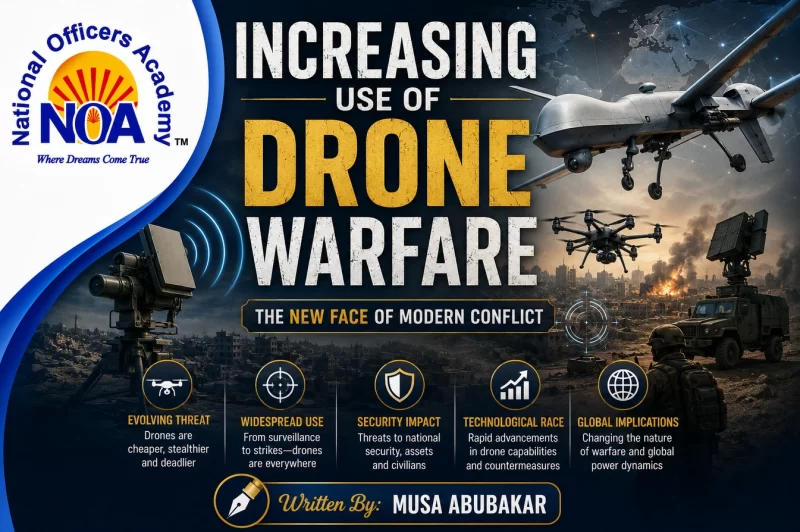
Increasing Use of Drone Warfare
Written By: Musa Abubakar
Introduction
“Change is the only constant in the world” applies not only to human progress but also to the ways mankind continues to find new means of destroying itself.
With the evolution of war, the world is witnessing a record increase in the use of electronic and aerial warfare, particularly unmanned aerial vehicles.
These remotely operated aerial vehicles, commonly known as drones, can carry a wide range of ammunition, conduct intelligence missions, attack in swarms, and overwhelm conventional air defence systems.
They sharply reduce the risk to the aggressor’s life and resources while inflicting psychological, economic, and human losses on the enemy.
As technology improves and more investment flows into drone technologies, the war industry continues to capitalize on this powerful tool.
With this, the world has started to embrace sixth-generation warfare tactics, where technological dominance increasingly decides the course of events.
Azerbaijan-Armenia War
During the 2020 Armenia-Azerbaijan war over Nagorno-Karabakh, Azerbaijan clearly had an upper hand due to its extensive use of drone technology.
Azerbaijan used drones to attack Armenian military personnel, depots, air defence systems, tanks, and other strategic targets.
It extensively used Turkish-made Bayraktar TB2 drones, along with Israeli Harop and Orbiter 1K drones.
According to Azeri sources, Azerbaijan lost around 25 to 30 drones while damaging more than 700 ground targets, including Armenian tanks, air defence systems, and other military assets.
Drones became a significant force multiplier for Azerbaijan. They allowed early suppression of Armenian air defences, deep reconnaissance, precise strikes, and lower Azerbaijani casualties.
The Nagorno-Karabakh war demonstrated that drones were no longer auxiliary tools. They had become central instruments of battlefield success.
Russia-Ukraine War
Russia and Ukraine have extensively used drones in their ongoing war of attrition.
From small quadcopters carrying RPG rounds to highly sophisticated drones such as Shahed systems, this war has used drones for attack, intelligence gathering, interception, and deception.
Drones have also been used as decoys to suppress enemy air defence systems.
Russia is using swarms of Shahed and other drones, launching approximately 7,000 to 8,000 drones per month.
Similarly, Ukraine carried out a successful drone attack on June 1, 2025, targeting multiple Russian airfields. The operation used 117 small FPV quadcopters and reportedly damaged or destroyed more than 20 aircraft, including multiple Tu-95 heavy bombers, Tu-22M3 supersonic bombers, and Tu-160 strategic bombers.
This single attack reportedly inflicted damages worth more than $5 billion on Russia.
The strategic implications of drone usage in the Russia-Ukraine war include deep-penetration strikes, asymmetric warfare, and psychological pressure on both civilians and military personnel.
The conflict has shown that even relatively low-cost drones can challenge expensive and advanced military assets.
Drone Warfare in the Israel-Iran Conflict and Beyond
The Middle East has also witnessed a sharp rise in the use of drone technology.
Since the beginning of Israel’s military onslaught on Gaza, Israel has attacked several neighbouring areas using drones.
Israel has used a variety of drone systems, ranging from small quadcopters to kamikaze drones.
In the recent Mossad drone infiltration in June 2025, under Operation Rising Lion, Israel reportedly used hundreds of small FPV drones to attack Tehran.
Similarly, Israel has used Hermes 450 drones for surveillance purposes and Hermes 900 drones for precision strikes.
It has also used Heron TP and Harop drones to detect radar signals, loiter over targets, and crash into radar or air defence systems. These systems were reportedly used to sabotage Iranian air defence capabilities, particularly the S-300 system.
Iran has claimed to have downed Israeli drones on multiple occasions.
Similarly, more than 1,300 drones have reportedly been fired directly toward Israel from Lebanon, Iran, Syria, Gaza, Yemen, and Iraq. According to The Times of Israel, around 231 of these drones hit their targets.
Almost 80% of the drones were intercepted by different layers of Israel’s air defence system.
During the April 13, 2024 operation, Iran fired around 170 drones, and virtually all of them were successfully intercepted.
Iran used drones from the Shahed series and Mohajer-10. Other models such as Mohajer-6, Ababil, Kaman, and Mirsad/Ayoub have also been used by proxies including Hezbollah, Iraqi militias, and Yemeni militias.
These drones are generally shorter-range systems, often used for reconnaissance or proxy strikes.
Iran reportedly used over 1,000 drones during the June 2025 escalation in a mass barrage. Around 200 entered Israeli airspace, but almost all were intercepted or crashed.
This shows that drone warfare has become a defining feature of Middle Eastern conflict.
Pakistan-India Drone Warfare
The Indian false-flag Pahalgam attack led to serious tensions between Pakistan and India.
This eventually turned into the first-ever large-scale drone warfare episode between the two neighbouring countries.
Both Pakistan and India used drones.
Pakistan used Turkish technology previously tested by Azerbaijan, including Turkish Asisguard Songar, YiHA-III, and Bayker kamikaze drones. Pakistan also used indigenous drones such as Shahpar and Burraq.
India, on the other hand, used Israeli Harop and Heron drones, Polish Warmate drones, and Indian-made SkyStriker and Nagastra-1 drones for intelligence gathering and precision strikes.
Pakistan successfully used drone swarms for:
- Surveillance and reconnaissance missions
- Saturation of enemy defences
- Decoy operations
- Kamikaze strikes on Indian radar systems and airbases
India mostly used drones for suppression of enemy air defence missions, targeting Pakistani air defences, infrastructure, and so-called militant bases with loitering munitions. Later, India also struck airfields in Pakistan.
Both countries are now heavily investing in drone technology for cost-effective precision strikes.
India is tripling UAV funding to $470 million, fast-tracking procurement, and fielding domestic systems to strengthen its counter-drone posture.
Pakistan is accelerating local production through China-Turkey hybrid loitering drones such as YiHA-III, Bayraktar, CH-4, Wing Loong II, and Shahpar/Burraq ISR systems.
Pakistan’s Current Measures and the Need for New Steps
Pakistan’s armed forces, particularly the Pakistan Air Force, understood the imminent threat of drone attacks and invested in electronic warfare along with cyberwarfare capabilities.
This important technological leap made a significant difference in Operation Bunyan ul Marsus.
The Pakistan Air Force actively jammed enemy radar and tracking systems, which misguided many aerial attacks from India.
However, one area that remained missing for Pakistan was advanced drone-jamming technology.
Pakistan needs to invest further in Counter-Unmanned Aerial Systems, also known as C-UAS or anti-drone systems.
These systems are part of soft-kill technology, which is more effective and cost-efficient than hard-kill technology when dealing with drones.
With evolving drone warfare, C-UAS has become an essential antidote that only a handful of countries currently possess.
These countries include:
- United States: Drone Defender, Mjölnir, and Epirus high-power microwave systems
- Russia: Krasukha, Repellent, and Stilet systems
- China: Silent Hunter, Sky Net, and electronic warfare modules for drone swarms
Pakistan must acquire and develop this technology to counter any future drone swarm approaching its borders from either side.
Operation Bunyan ul Marsus also exposed how Israeli drone technology, regarded as one of the best in the world, has actively complemented Indian attacks.
It is high time for Pakistan to leap forward in drone warfare while also investing in air defence systems that can detect, jam, intercept, and destroy any swarm of drones.
Conclusion
Drone warfare has become one of the most transformative features of modern conflict.
From Azerbaijan-Armenia and Russia-Ukraine to the Middle East and Pakistan-India tensions, drones have changed the logic of warfare by making attacks cheaper, more precise, and more difficult to intercept.
They have empowered weaker actors, complicated traditional air defence systems, and created new psychological pressures on both soldiers and civilians.
At the same time, the increasing use of drones has made Counter-Unmanned Aerial Systems a strategic necessity.
For Pakistan, investment in drone warfare must go hand in hand with investment in anti-drone capabilities, electronic warfare, radar integration, and indigenous defence innovation.
The future battlefield will not only be decided by tanks, jets, and missiles. It will also be shaped by drones, jammers, algorithms, and the ability to control the electromagnetic spectrum.
In this new era of warfare, the state that adapts faster will survive stronger.