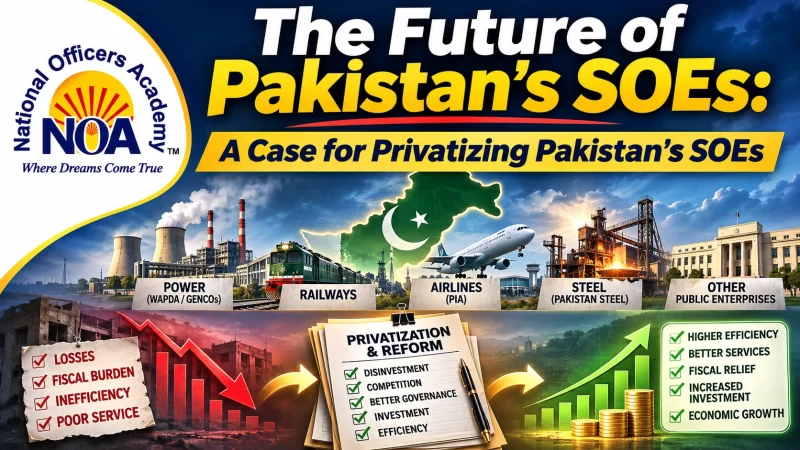
The Future of Pakistan’s SOEs: A Case for Privatizing Pakistan’s SOEs
What Are State-Owned Enterprises (SOEs)?
State-owned enterprises (SOEs) are organizations that are fully or partially owned and controlled by the government to engage in commercial or industrial activities. These enterprises operate to provide public services, generate revenue, or achieve broader socioeconomic objectives.
SOEs exist across various sectors, including energy, transportation, healthcare, banking, and industrial production. While their primary objectives may include public welfare and economic development, their operational and financial performance remains a significant consideration for governments.
Pakistan and State-Owned Enterprises (SOEs)
Pakistan’s state-owned enterprises have remained a major subject of debate because of their financial losses, operational inefficiencies, and impact on the national economy.
According to the figures presented in the original analysis, Pakistan had approximately 113 state-owned enterprises, while its loss-making enterprises collectively incurred annual losses of approximately $4.1 billion, equivalent to around PKR 1,200 billion.
To illustrate the scale of these losses, the original analysis compares them with estimated education spending of $2.8 billion and healthcare spending of $3.3 billion. On an individual basis, the stated annual SOE losses exceed each of these spending figures.
These comparisons highlight the opportunity costs associated with financially distressed public enterprises. Resources allocated to covering operating losses and financial liabilities could otherwise support education, healthcare, infrastructure, and other development priorities.
However, the financial position of SOEs must also be assessed against their public-service responsibilities, strategic importance, and broader socioeconomic contributions.
Comparison of SOEs and Privatized Enterprises
The debate surrounding privatization in Pakistan becomes clearer when the performance of state-owned enterprises is compared with private-sector organizations operating in similar industries.
1. Pakistan International Airlines (PIA)
The COVID-19 pandemic created unprecedented challenges for the global aviation industry. International travel restrictions, border closures, and declining passenger demand severely affected airlines worldwide.
However, the post-pandemic recovery created opportunities for airlines to restore their operations, increase revenues, and benefit from renewed travel demand.
The original analysis argues that several private airlines achieved substantial profitability during the aviation recovery, while Pakistan International Airlines continued to experience financial and operational difficulties.
According to the figures cited in the source, private-sector airlines achieved gross margins of approximately 25–30%, whereas PIA recorded a gross margin of around -0.4% during the period being discussed.
This comparison is intended to highlight differences in operational efficiency and financial management between public and private airlines.
Employee-to-Aircraft Ratio: An Operational Efficiency Indicator
One indicator frequently used to compare airline staffing structures is the employee-to-aircraft ratio.
Employee-to-Aircraft Ratio = Total Number of Employees / Number of Aircraft
This ratio measures the average number of employees associated with each aircraft in an airline’s fleet. Although it provides insight into staffing levels, it should be considered alongside fleet utilization, outsourcing arrangements, business models, and the range of services performed by each airline.
The original analysis presents the following historical comparison:
| Airline | Employees per Aircraft |
|---|---|
| Pakistan International Airlines | 269 |
| Thai Airways | 203 |
| Qatar Airways | 186 |
| Iran Air | 167 |
| Air China | 116 |
| Singapore Airlines | 113 |
| Air India | 86 |
| Turkish Airlines | 23 |
According to these figures, PIA had the highest employee-to-aircraft ratio among the selected airlines, while Turkish Airlines had the lowest.
The comparison suggests that excessive staffing relative to fleet size may contribute to higher administrative and operational costs. Nevertheless, staffing ratios alone cannot establish overall airline efficiency.
The broader argument is that commercial airlines require professional management, effective resource allocation, operational autonomy, and financial accountability to remain competitive.
2. Pakistan Railways
Pakistan Railways has faced persistent challenges involving operational inefficiency, outdated infrastructure, financial deficits, and administrative weaknesses.
Pakistan Railways operates under the Ministry of Railways and maintains an extensive railway network of more than 7,700 kilometres, connecting major cities and regions across the country.
Despite its importance for passenger transportation, freight movement, and national connectivity, the organization has struggled with several structural problems.
Major Challenges Facing Pakistan Railways
- Outdated Infrastructure: Aging tracks, signalling systems, and railway facilities reduce operational efficiency.
- Maintenance Delays: Insufficient maintenance affects reliability, safety, and service quality.
- Financial Deficits: High operating costs and insufficient revenue contribute to financial instability.
- Administrative Inefficiencies: Complex management structures and excessive bureaucratic intervention slow decision-making.
- Manual Systems: Dependence on outdated administrative processes reduces productivity.
- Staffing Challenges: Workforce management and productivity concerns increase operational costs.
- Schedule Disruptions: Delays and cancellations undermine passenger confidence.
- Cybersecurity Concerns: Increasing digitalization creates a need for stronger information security infrastructure.
- Debt Accumulation: Financial liabilities create pressure on public resources.
- Service Quality: Inconsistent service standards discourage passengers and freight customers.
Privatization and Public-Private Partnership Initiatives
Several initiatives involving private-sector participation have been explored to improve the performance of Pakistan Railways.
These initiatives include public-private partnerships (PPPs), private freight operations, outsourcing selected train services, and encouraging private investment in railway infrastructure.
Under the China-Pakistan Economic Corridor (CPEC), the proposed modernization of Main Line 1 (ML-1) has also been considered an important initiative for improving railway infrastructure and connectivity.
International Examples of Railway Privatization
India’s Public-Private Partnership Approach: India has explored private participation in selected railway services, station redevelopment, and related infrastructure while retaining substantial government control over the core railway network.
This approach illustrates how governments can encourage private investment without necessarily transferring ownership of the entire railway system.
Japan’s Regional Railway Model: Japan reorganized and privatized much of its former national railway system through regionally structured companies.
The Japanese experience demonstrates how restructuring, commercial management, and regional accountability can contribute to improved railway performance. However, results vary across regions and services.
These examples suggest that Pakistan could consider a phased approach involving commercial restructuring, private-sector participation, and stronger regulatory oversight.
Why Is Privatization Advisable?
Supporters of privatization argue that transferring commercial enterprises into private ownership can improve operational efficiency, financial discipline, competitiveness, and service delivery.
Pakistan’s experience with privatized banking institutions and electricity distribution provides important examples for evaluating these arguments.
1. Muslim Commercial Bank (MCB)
The privatization of banks during the 1990s represented a major component of Pakistan’s economic reform programme.
These reforms aimed to reduce direct government control over commercial banking, improve financial-sector efficiency, and address operational weaknesses in public institutions.
Pakistan’s banking privatization experience includes institutions such as Muslim Commercial Bank (MCB), Habib Bank Limited (HBL), and United Bank Limited (UBL).
These institutions are frequently compared with the state-owned National Bank of Pakistan (NBP) when discussing commercial performance and public ownership.
The original analysis cites a historical figure of approximately PKR 29 billion in tax contributions by MCB, presenting it as evidence of the potential financial contribution of commercially successful privatized enterprises.
The broader argument is that efficient private-sector institutions can generate profits, expand financial services, increase tax revenues, and contribute to economic development.
However, the performance of privatized banks must also be assessed in light of regulatory reforms, economic conditions, institutional governance, and banking-sector developments.
2. K-Electric (KE)
K-Electric provides another important example in Pakistan’s privatization debate.
Before privatization, the electricity utility faced significant operational and financial challenges, including high transmission and distribution losses, electricity theft, weak revenue recovery, and administrative inefficiencies.
The original analysis states that electricity losses were reduced from approximately 34% to 15% during the period under discussion.
It also highlights workforce restructuring, employee compensation arrangements, and improvements in operational management.
Financial Performance Comparison
According to the figures presented in the original article:
- 2005: The utility reportedly generated approximately PKR 500 million in profit and paid around PKR 200 million in taxes.
- 2022: The source reports profit of approximately PKR 8.4 billion and tax payments of around PKR 2.8 billion.
These historical figures are presented to support the argument that commercial restructuring and improved management can strengthen enterprise performance.
Nevertheless, profitability, tax contributions, distribution losses, service reliability, and consumer satisfaction must be evaluated together when assessing the effectiveness of privatization.
Three Major Arguments Against Privatization
Although privatization may offer financial and operational benefits, critics raise important concerns regarding the valuation of public assets, national security, and employment protection.
1. State-Owned Enterprises Are Often Undervalued
One major criticism of privatization is that financially distressed public enterprises may be sold below their potential market value.
Pakistan Steel Mills provides an important historical example of this controversy.
The original analysis refers to a proposed transaction valued at approximately PKR 17 billion during the 2005–2006 privatization process. The transaction was subsequently set aside by the Supreme Court of Pakistan.
Critics argue that strategic public assets must be valued transparently and fairly before their ownership is transferred.
Pakistan Steel Mills: Financial Losses
The original article presents the following annual loss figures for Pakistan Steel Mills:
| Year | Reported Losses (PKR Billion) |
|---|---|
| 2017 | 14.9 |
| 2018 | 16.0 |
| 2019 | 16.6 |
| 2020 | 20.5 |
| 2021 | 18.7 |
These reported annual losses illustrate the continuing financial burden associated with the enterprise.
Pakistan Steel Mills ceased production operations in 2015 despite possessing a historical production capacity of approximately 1.1 million tonnes of steel annually.
According to the original analysis, accumulated losses exceeded PKR 230 billion by 2020, while outstanding liabilities were reported to exceed PKR 400 billion.
The article also alleges that the enterprise continued to incur avoidable administrative expenses after the suspension of its operations, including expenditure on stationery and other routine items.
From the perspective of privatization supporters, continued financial losses may substantially exceed the immediate proceeds that could have been obtained through an earlier restructuring or sale.
However, the appropriate sale value should be established through independent valuation, transparent bidding, assessment of liabilities, and consideration of public interests.
2. Privatization May Threaten National Interest and Security
Another argument against privatization concerns the strategic importance of public enterprises.
Critics maintain that enterprises operating in sensitive sectors, including transportation, energy, aviation, and infrastructure, may have national-security implications.
However, supporters argue that private ownership does not automatically conflict with national security.
For example, private airlines such as Airblue, SereneAir, and Fly Jinnah have operated in Pakistan under the country’s aviation regulatory framework.
Similarly, private entities participate in the management and operation of airports, seaports, and other infrastructure facilities in different countries.
These arrangements demonstrate that governments can allow private-sector participation while retaining regulatory authority and imposing national-security requirements.
Nevertheless, security-sensitive assets require careful evaluation, and some enterprises may warrant continued public ownership or special safeguards.
3. Privatization May Lead to Job Losses
Employment insecurity is one of the most frequently cited concerns surrounding privatization.
Critics argue that private owners may reduce staffing levels, restructure departments, or eliminate positions to improve profitability.
Such measures can create significant economic hardship for employees and their families.
However, privatization supporters argue that organizational restructuring does not necessarily lead to substantial long-term employment losses.
The original analysis refers to comparisons involving Pakistan Railways and MCB, suggesting that improved profitability can occur without proportionate reductions in employment.
Since the supporting employment figures are not provided in the source text, this claim requires further evidence.
Governments can reduce employment-related risks through voluntary separation schemes, retraining programmes, employee protections, and transparent restructuring arrangements.
Role of Government in Business and Economic Development
Privatization does not eliminate the government’s responsibilities in economic management. Instead, it changes the nature of the state’s involvement from direct commercial operation towards policymaking, regulation, institutional oversight, and public-interest protection.
1. Policy Making
The government plays a crucial role in shaping the business environment through economic policies, regulatory frameworks, and development strategies.
Effective policymaking can encourage competition, promote investment, protect consumers, and support long-term economic growth.
Government policies should balance commercial efficiency with social welfare and national development objectives.
2. Strengthening Regulatory Institutions
Strong regulatory institutions are essential for ensuring that privatization does not create private monopolies or encourage anti-competitive practices.
Institutions such as the Competition Commission of Pakistan (CCP) have an important role in preventing market manipulation, cartels, and abuse of dominant market positions.
Regulatory oversight should focus on:
- Preventing monopolistic practices.
- Discouraging price manipulation and collusion.
- Protecting consumer rights.
- Promoting fair market competition.
- Ensuring transparency and accountability.
- Preventing exploitation through unfair pricing mechanisms.
Effective competition policies can help ensure that consumers receive quality products and services at reasonable prices.
3. Administrative and Regulatory Responsibilities
The government must establish and enforce appropriate standards for product quality, service delivery, public safety, and market conduct.
These responsibilities include preventing adulteration, discouraging hoarding, protecting consumers, and ensuring compliance with relevant laws.
Strong administration and enforcement mechanisms are particularly important when essential public services are delivered by private enterprises.
4. Incentives for Growth and Development
Governments can encourage private investment, innovation, and entrepreneurship through carefully designed incentives.
Such incentives may include tax concessions, targeted subsidies, grants, and research funding for strategically important sectors.
Priority areas may include:
- Technology and digital industries.
- Renewable energy development.
- Small and medium-sized enterprises.
- Industrial innovation.
- Research and development.
- Employment generation.
By supporting productive economic activities, governments can encourage technological progress, industrial expansion, and sustainable development.
5. Trade and Investment Policies
The government should establish policies that facilitate international trade and attract foreign direct investment (FDI).
These policies include tariff regulations, trade agreements, investment protections, and import-export frameworks.
A predictable and competitive business environment can improve investor confidence and expand access to international markets.
Effective trade and investment policies can also encourage technology transfer, industrial modernization, and economic integration.
6. Infrastructure Development
Infrastructure development remains a fundamental responsibility of the state, even when commercial enterprises are privately operated.
The government must support the development of transportation networks, energy infrastructure, communication systems, and digital connectivity.
Public-private partnerships can help mobilize financing and technical expertise for large infrastructure projects.
Improved infrastructure reduces operating costs, increases productivity, and creates favourable conditions for private-sector investment.
Conclusion
The appropriate role of government in commercial activities remains an important subject of economic and political debate.
Supporters of privatization argue that the government should concentrate on policymaking, regulation, administration, and public welfare, while allowing the private sector to manage commercial enterprises more efficiently.
Pakistan’s experience with loss-making state-owned enterprises demonstrates the importance of improving financial discipline, strengthening governance, and reducing unnecessary fiscal burdens.
However, privatization should not be treated as an automatic solution to every problem. Its success depends on transparent asset valuation, competitive bidding, effective regulatory institutions, employee protections, and safeguards for the national interest.
International financial institutions, including the International Monetary Fund (IMF), have advocated reforms aimed at improving the financial sustainability and governance of Pakistan’s public-sector enterprises.
Pakistan must therefore adopt a carefully designed approach that combines privatization where economically justified, restructuring where necessary, and continued public ownership where strategic or social objectives require it.
Ultimately, a transparent privatization framework, effective regulation, and well-designed public-private partnerships can help Pakistan improve economic efficiency, reduce fiscal pressures, attract investment, and promote sustainable development.