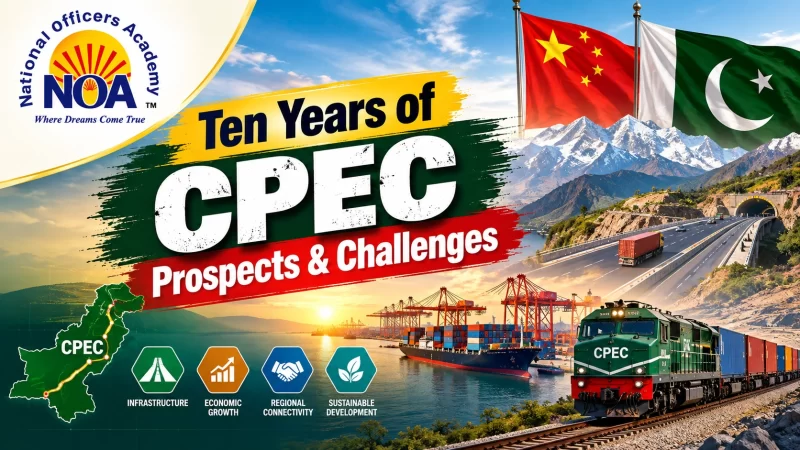
Ten Years of CPEC: Prospects & Challenges
A Historical Perspective of Pakistan-China Relations
Enduring Friendship: The Strong Alliance between Pakistan and China
Pakistan-China relations have developed over several decades into a multidimensional partnership encompassing political, economic and strategic cooperation. Pakistan recognized the People’s Republic of China in 1950, while formal diplomatic relations were established on May 21, 1951. Agreements concluded during subsequent years further strengthened bilateral relations, with the Karakoram Highway becoming one of the most visible symbols of connectivity between the two countries.
Over time, economic cooperation became an increasingly important pillar of this relationship. Growing trade, investment and infrastructure cooperation eventually provided the foundation for the China-Pakistan Economic Corridor.
An Overview of CPEC
The China-Pakistan Economic Corridor (CPEC) is a major component of China’s Belt and Road Initiative (BRI). It seeks to enhance connectivity between China and Pakistan while facilitating wider regional trade and economic integration.
For China, CPEC provides access towards the Arabian Sea and Indian Ocean through Pakistan and offers an alternative route that could reduce reliance on the Strait of Malacca. For Pakistan, it offers opportunities for infrastructure development, energy generation, industrialization, investment and employment.
CPEC gained major momentum during Chinese President Xi Jinping’s visit to Pakistan in April 2015. Projects were initiated in roads, railways, energy, fibre-optic connectivity, Gwadar and Special Economic Zones. The initial planned investment was approximately $46 billion, which was subsequently expanded as additional projects were incorporated.
During its first decade, CPEC projects cited in the article contributed:
Around 6,000 MW of electricity
886 kilometres of transmission infrastructure
Approximately 510 kilometres of highways
Around 800 kilometres of fibre-optic cable
Significant employment generation
More than $25 billion in completed infrastructure and energy projects
The CPEC Long-Term Plan 2017–2030 provides a broader framework for cooperation. Its success depends upon transparency, security, skilled human resources, technology transfer, institutional capacity, a supportive business environment, and sustained trade and investment promotion.
CPEC Phase II: A Critical Success Factor
Moving from Infrastructure towards Socio-Economic Development
The second phase of CPEC expands the corridor beyond conventional infrastructure and energy projects. It places greater emphasis on:
Agriculture
Industrial cooperation
Tourism
Technical and vocational education
Healthcare
Poverty reduction
Climate cooperation
Socio-economic development
A critical requirement is ensuring that CPEC’s benefits reach communities located around its projects. Schools, healthcare facilities, vocational centres and community-development initiatives can be integrated with Special Economic Zones and industrial areas.
CPEC projects can also be aligned with the United Nations Sustainable Development Goals (SDGs), particularly those relating to health, education, employment and poverty reduction. Such an approach could strengthen the connection between large infrastructure investments and improvements in citizens’ everyday lives.
Ten Years of CPEC: Celebration or Introspection?
“CPEC is a testament to the enduring friendship between China and Pakistan, and it represents a shining example of regional cooperation and connectivity.” — Xi Jinping
Over its first decade, CPEC emerged as one of the most prominent manifestations of Pakistan-China economic cooperation. The corridor links China’s Xinjiang region with Pakistan’s Arabian Sea coast through networks of roads, railways and associated infrastructure.
Energy and Infrastructure Development
Energy has remained one of CPEC’s most important areas. According to the article, CPEC-related projects added more than 6,000 MW to Pakistan’s national grid, while transport and connectivity projects expanded road and associated infrastructure.
Gwadar and the Blue Economy
Development of Gwadar Port gives CPEC a maritime dimension. Its location can support Pakistan’s ambitions for greater regional connectivity and development of its blue economy by linking domestic infrastructure with international trade routes.
Special Economic Zones and Industrialization
Special Economic Zones are intended to attract investment, facilitate technology and skills transfer, create employment and deepen industrial cooperation. CPEC therefore has the potential to evolve from an infrastructure corridor into a broader platform for industrial development.
Agriculture and Technology Transfer
Phase II also places increasing emphasis on agriculture. Cooperation can facilitate modern irrigation, improved water management, better farming techniques and higher productivity in major crops such as wheat, cotton and rice.
Employment and Human Development
CPEC has also generated employment and skills-development opportunities. The article highlights projects connected with healthcare, education and vocational training, showing the corridor’s potential to contribute to human development alongside physical infrastructure.
Critical Analysis: Achievements and the Road Ahead
The tenth anniversary of CPEC provided an opportunity both to recognize completed projects and to assess what remains unfinished. According to the article, more than $25 billion in Chinese investment had been attracted since CPEC’s inception, alongside hundreds of kilometres of motorways, substantial power-generation capacity and employment opportunities.
CPEC’s next stage, however, depends increasingly on converting infrastructure into sustainable economic productivity. Pakistan can seek to attract industries, improve exports, strengthen Special Economic Zones and use improved transport connectivity to integrate more effectively with regional markets. The article particularly identifies the relocation of Chinese industries to emerging markets as an opportunity Pakistan could utilize to increase exports and foreign-exchange earnings.
For CPEC to fulfil its long-term potential, attention must therefore extend beyond the completion of physical projects. Effective governance, security, transparency, human-capital development, technology transfer, industrial competitiveness and meaningful participation of local communities will remain crucial.
Conclusion
The first decade of CPEC established a substantial foundation in energy, infrastructure and regional connectivity. Its second phase offers an opportunity to broaden this foundation towards industrialization, agriculture, technology, employment and socio-economic development.
CPEC’s future significance for Pakistan will depend not simply on the scale of investment but on how effectively projects are translated into productivity, exports, employment, skills and improvements in people’s lives. With sustained Pakistan-China cooperation and effective domestic implementation, the corridor can continue to serve as an important platform for economic and regional connectivity through 2030.