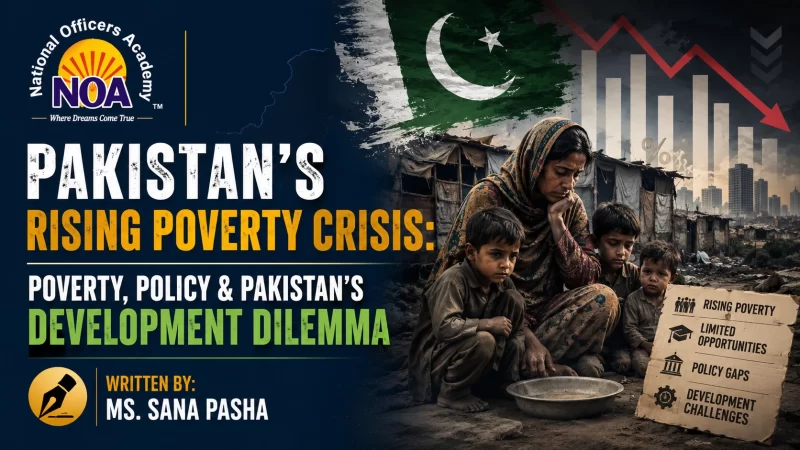
Pakistan’s poverty crisis has re-emerged as one of the country’s most serious socioeconomic challenges. According to the article, poverty has risen sharply amid inflation, weak economic growth, declining real household consumption, unemployment, governance constraints and repeated climate-related shocks. The discussion presents poverty not merely as income deprivation but as a multidimensional development challenge involving education, healthcare, employment, food security and vulnerability.
The article examines the major determinants behind the reversal in Pakistan’s poverty-reduction trajectory, including policy inconsistency, macroeconomic instability, human-capital constraints, COVID-19 and flood shocks. It further assesses the economic, social and environmental consequences of rising poverty and reviews existing government interventions such as BISP, Benazir Kafaalat, Benazir Nashonuma, Taleemi Wazaif and other social-protection initiatives.
It concludes that cash transfers alone cannot provide a sustainable exit from poverty. Pakistan requires inclusive economic growth, employment generation, financial inclusion, stronger human capital, climate-resilient development, population management and better-coordinated social protection to transform short-term relief into long-term socioeconomic mobility.