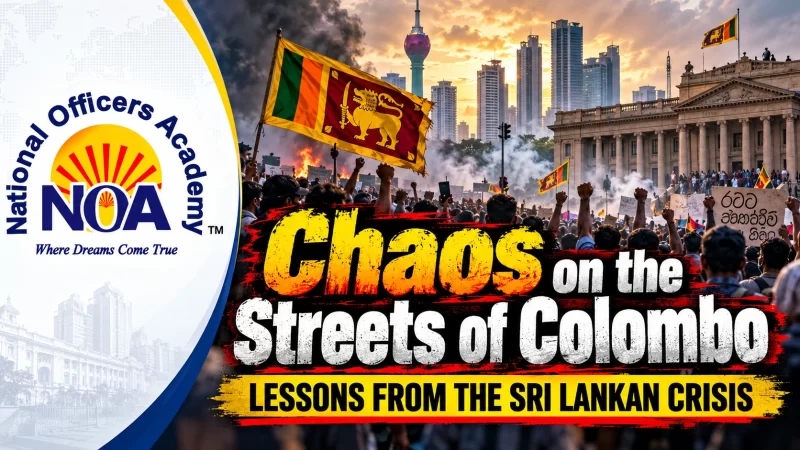
Chaos on the Streets of Colombo
Lessons from the Sri Lankan Crisis
Sri Lanka entered a period of severe national unrest as a deepening economic crisis, unprecedented inflation, fuel shortages and scarcity of essential food items triggered widespread public frustration.
Colombo became the centre of increasingly intense protests as citizens demanded relief from deteriorating living conditions and called for major political change.
Authorities attempted to control demonstrations through measures including water cannons and tear gas, but the underlying economic problems continued to fuel public anger.
The crisis initially emerged from a serious shortage of foreign currency, declining reserves and mounting debt obligations.
The government became increasingly unable to finance essential imports such as fuel, resulting in prolonged power cuts that in some periods lasted for several hours a day.
What began as an economic emergency eventually developed into a wider political crisis.
Protesters demanded the resignation of President Gotabaya Rajapaksa and criticised the concentration of political authority within the Rajapaksa family.
The Sri Lankan experience offers important lessons for other South Asian economies, particularly Pakistan, where analysts have frequently identified comparable vulnerabilities involving debt, inflation, foreign-exchange shortages and political instability.
Sri Lanka’s Flagging Economy Morphed into Political Chaos
Sri Lanka’s political crisis was rooted in a deteriorating economic situation that had been developing for years.
The economic collapse was produced by a combination of structural weaknesses, policy failures and external shocks.
Major contributing factors included:
- Balance-of-payments pressures
- Depleting foreign-exchange reserves
- High external debt
- Weak tax revenues
- Dependence on tourism
- COVID-19
- Policy mismanagement
- Political concentration within the Rajapaksa family
Balance-of-Payments Crisis
Sri Lanka faced a severe balance-of-payments crisis as foreign-currency earnings became insufficient to meet external obligations and finance essential imports.
The country increasingly struggled to service its debt while also paying for:
- Fuel
- Food
- Medicine
- Industrial inputs
- Other essential imports
Weak export performance, declining foreign-currency inflows and mounting debt obligations created enormous pressure on the economy.
The crisis also contributed to falling purchasing power, higher living costs and reduced economic activity.
Depleting Dollar Reserves
Foreign-exchange reserves declined sharply as a result of persistent trade and current-account pressures, external debt repayments and reduced foreign-currency inflows.
As reserves fell, Sri Lanka found it increasingly difficult to pay for basic imports.
The shortage of foreign currency contributed to:
- Fuel shortages
- Power cuts
- Scarcity of imported goods
- Currency depreciation
- Rising inflation
The weakening of the Sri Lankan rupee further increased the domestic cost of imported goods.
As inflation accelerated, ordinary citizens experienced a rapid decline in real incomes and purchasing power.
Unsustainable Debt Burden
Sri Lanka’s external debt became increasingly difficult to manage as foreign-exchange reserves declined.
The country faced the challenge of simultaneously servicing debt and financing essential imports.
This created an unsustainable situation in which increasingly limited foreign currency had to be divided among:
- Debt repayments
- Energy imports
- Food imports
- Medical supplies
The debt crisis eventually became one of the defining characteristics of Sri Lanka’s economic collapse.
Tax Reforms and Weak Revenue Collection
Sri Lanka had long struggled with weaknesses in its taxation system.
One of the most significant problems was the country’s low tax-to-GDP ratio.
The article notes that Sri Lanka’s tax-to-GDP ratio declined substantially from approximately 19 percent in 1990 to 11.5 percent in 2019.
Weak revenue collection limited the government’s ability to finance public expenditure without relying heavily on borrowing.
Dependence on Indirect Taxes
A large share of Sri Lanka’s tax revenue came from indirect taxation.
These included:
- Value Added Tax
- Tariffs
- Taxes imposed on goods and consumption
Indirect taxes are frequently passed on to consumers.
This means that lower-income households can bear a disproportionately heavy burden because they spend a larger share of their income on consumption.
At the same time, low direct-tax rates and tax concessions reduced contributions from higher-income groups.
Impact of COVID-19 on Tourism
Tourism had traditionally been one of Sri Lanka’s most important sources of foreign exchange.
The COVID-19 pandemic severely damaged this sector.
International travel restrictions caused tourism revenues to collapse, depriving the country of an essential source of foreign currency.
This shock intensified existing balance-of-payments and debt problems.
The decline in tourism therefore became one of the major channels through which the pandemic accelerated the economic crisis.
Rajapaksa Dynasty: From War Heroes to Political Villains
The crisis also transformed Sri Lanka’s political landscape.
The Rajapaksa family had dominated Sri Lankan politics for years.
Mahinda Rajapaksa had enjoyed enormous popularity among sections of the Sinhala majority after the defeat of the Tamil Tigers in 2009, which brought an end to nearly three decades of civil war.
He was celebrated by supporters as a leader who had restored national unity and security.
Over time, however, political power became increasingly concentrated within the Rajapaksa family.
Critics accused the family of:
- Dynastic politics
- Concentration of power
- Governance failures
- Human-rights abuses
- Mistreatment of minorities
- Pressure on independent media
The economic collapse dramatically changed public perceptions.
Political leaders once celebrated as national heroes increasingly became symbols of government failure.
Economic Crisis Uniting Previously Divided Groups
One of the important political consequences of the crisis was the emergence of broader social mobilisation.
The rising cost of living affected citizens across ethnic, religious and political divisions.
The protests therefore increasingly brought together groups that had previously experienced political and ethnic tensions.
Economic hardship created a shared grievance that cut across traditional social divisions.
Pakistan: A Story of Economic and Political Crisis
The Sri Lankan crisis generated immediate comparisons with Pakistan because Pakistan was simultaneously experiencing serious political and economic instability.
Pakistan’s political crisis intensified following the vote of no-confidence against Prime Minister Imran Khan.
The motion eventually resulted in his removal from office, making him the first Pakistani Prime Minister to lose office through a successful parliamentary vote of no-confidence.
Although a new government assumed office, political instability continued.
This political uncertainty interacted with existing economic weaknesses and increased concern regarding Pakistan’s financial stability.
Pakistan and Sri Lanka: South Asian Brothers Stuck in Crisis?
Pakistan and Sri Lanka are not identical economies, but both countries have experienced several comparable vulnerabilities.
These include:
- High inflation
- Fuel-price pressures
- Political instability
- Foreign-exchange constraints
- Growing external debt
- Weak fiscal management
- Dependence on imported energy
- Pressure on household incomes
These similarities encouraged analysts to warn that persistent policy inaction could increase the possibility of deeper economic instability in Pakistan.
Soaring Inflation
Inflation became a major source of public dissatisfaction in both Sri Lanka and Pakistan.
Rising prices reduce household purchasing power and disproportionately affect lower- and middle-income groups.
Particularly sensitive increases include:
- Petrol prices
- Electricity tariffs
- Food prices
- Transport costs
When inflation combines with political instability, economic grievances can rapidly develop into broader social discontent.
Fuel Subsidies and Fiscal Pressure
The article highlights fuel subsidies as an important policy dilemma.
Governments often use subsidies to protect consumers from sudden price increases.
However, large and poorly targeted subsidies can create serious fiscal costs.
If governments finance such measures through additional borrowing, they may worsen:
- Budget deficits
- Debt accumulation
- External financing requirements
- Macroeconomic instability
The Sri Lankan experience therefore demonstrates the risks of postponing necessary economic adjustments for short-term political reasons.
Political Instability Magnifies Economic Problems
Economic crises are more difficult to manage when political institutions are unstable.
Governments facing continuous political confrontation may avoid unpopular but necessary reforms.
Investor confidence can also weaken when there is uncertainty regarding:
- Government survival
- Economic policy
- Taxation
- Energy prices
- International financing arrangements
Political stability is therefore an important component of economic recovery.
From Economic Crisis to Political Catastrophe
Sri Lanka demonstrates how rapidly economic problems can become political problems.
Foreign-exchange shortages initially appeared to be primarily a financial issue.
However, as the crisis began affecting electricity, fuel, food and essential services, public frustration intensified.
The resignation of ministers and growing demands for President Gotabaya Rajapaksa’s departure demonstrated how economic mismanagement could directly undermine political legitimacy.
What Comes Ahead?
The major lesson from Sri Lanka is that prolonged economic mismanagement creates consequences extending far beyond financial indicators.
When citizens lose confidence in the government’s capacity to provide basic necessities, the crisis can escalate into:
- Mass demonstrations
- Political paralysis
- Government resignations
- Social unrest
- Institutional instability
Lessons for Pakistan
1. Prevent the Depletion of Foreign-Exchange Reserves
Pakistan needs sufficient reserves to finance essential imports and meet external obligations.
A prolonged decline in reserves increases vulnerability to balance-of-payments crises.
2. Manage External Debt Prudently
Debt should remain sustainable relative to foreign-exchange earnings and government revenue.
Borrowing cannot permanently substitute for structural economic reform.
3. Improve Tax Collection
Pakistan requires a broader and fairer tax base.
Greater reliance on direct taxation can reduce excessive dependence on consumption taxes that disproportionately affect ordinary citizens.
4. Avoid Politically Motivated Economic Decisions
Short-term populist policies may provide temporary relief but create larger fiscal problems if they are not financially sustainable.
Energy subsidies and tax concessions should therefore be:
- Targeted
- Transparent
- Fiscally sustainable
5. Maintain Political Stability
Economic recovery requires predictable governance and policy continuity.
Constant political confrontation discourages investment and delays difficult reforms.
6. Strengthen Foreign-Exchange Earnings
Pakistan needs to improve sustainable sources of foreign currency through:
- Exports
- Foreign direct investment
- Remittances
- Tourism
- Information technology services
7. Reduce Dependence on Imported Energy
Heavy reliance on imported petroleum makes Pakistan extremely vulnerable to global price shocks.
The country should strengthen:
- Renewable energy
- Domestic energy resources
- Energy efficiency
- Long-term supply diversification
8. Control Circular Debt
Pakistan’s energy-sector circular debt places significant pressure on public finances.
Reforms are required to reduce losses, improve collection and establish sustainable pricing.
9. Protect Vulnerable Citizens
Economic adjustment should not impose the greatest burden on low-income households.
Targeted social-protection mechanisms are more sustainable than untargeted universal subsidies.
10. Restore Public Confidence
Economic reform succeeds only when citizens trust the government’s intentions and competence.
Transparency, communication and institutional accountability are therefore essential.
Avoiding a Colombo-Like Scenario in Pakistan
Pakistan’s circumstances differ from Sri Lanka’s, but the comparison remains useful as a warning against complacency.
The most dangerous combination is:
- Economic fragility
- Political instability
- Poor governance
- Delayed reform
- Public frustration
If these pressures reinforce one another, a manageable economic problem can gradually become a broader national crisis.
The government therefore needs carefully planned economic measures rather than temporary political fixes.
Political Stability as an Economic Necessity
Political stability should not be treated separately from economic policy.
Investors, businesses and financial institutions require predictability.
Persistent political confrontation creates uncertainty over future policies and weakens confidence.
A stable political environment allows governments to undertake reforms whose benefits may only become visible over the medium and long term.
Conclusion
The chaos on the streets of Colombo demonstrated how economic mismanagement can evolve into a full-scale political crisis.
Sri Lanka’s experience involved a combination of depleted foreign-exchange reserves, external debt, weak tax revenues, inflation, dependence on tourism, policy errors and declining public confidence.
As shortages of fuel, food and electricity became part of everyday life, citizens increasingly challenged the legitimacy of the political establishment.
The fall of the Rajapaksa family’s political dominance became a powerful example of how quickly public support can collapse when governments fail to deliver economic security.
Pakistan does not face exactly the same circumstances, but several vulnerabilities identified in the Sri Lankan case remain relevant.
Foreign-exchange pressure, debt, inflation, imported energy, political instability and weak fiscal capacity require serious attention.
Pakistan must therefore strengthen its tax system, improve exports, manage debt, reform the energy sector, protect vulnerable households and restore political stability.
The central lesson from Sri Lanka is that economic crises rarely remain purely economic. When governments delay reform and citizens lose access to basic necessities, financial instability can rapidly transform into political and social upheaval.