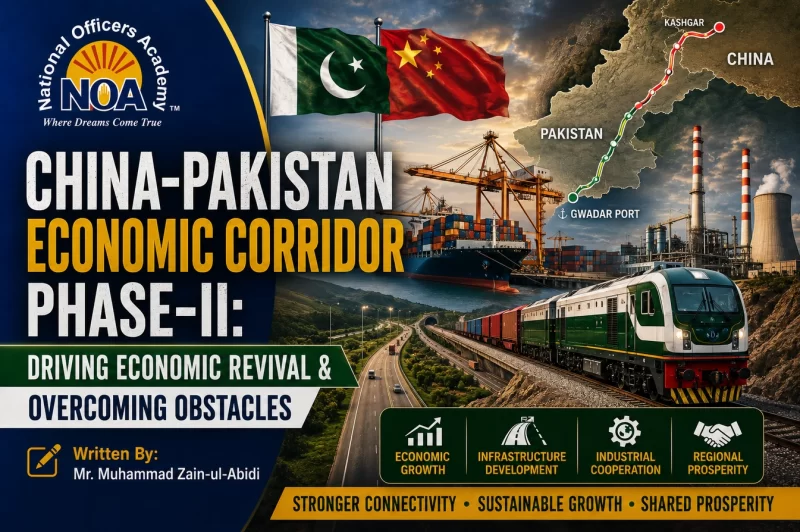
The China-Pakistan Economic Corridor is one of the most significant development projects in recent times, not only for Pakistan but also for the wider region.
Launched in 2015, CPEC is part of China’s ambitious Belt and Road Initiative. It aims to create a vast network of trade routes between China and Pakistan while strengthening regional connectivity, infrastructure, energy cooperation, and economic development.
Phase-I of CPEC witnessed rapid progress. Pakistan’s energy sector received major investment, and infrastructure development moved forward at an extraordinary pace. Around $46 billion was initially committed in the form of investment.
After the completion of major Phase-I projects, CPEC Phase-II began with high expectations of industrialization, trade expansion, foreign direct investment, and broader socio-economic development. The total value of CPEC reached around $65 billion by 2022.
However, Phase-II has not progressed at the same pace as the first phase. Several challenges continue to slow down its implementation. These include security concerns, political instability, regulatory delays, debt-related pressure, and changing regional geopolitics.
CPEC Phase-I: Infrastructure and Energy Development
CPEC Phase-I primarily focused on infrastructure and energy projects.
Under this initial phase, around $46 billion was allocated for different projects, with a major portion directed toward power generation to address Pakistan’s severe energy crisis.
This phase included the construction of coal, hydropower, and wind power plants. It also included major road infrastructure projects designed to connect Gwadar Port with Pakistan’s northern regions and China’s Xinjiang province.
Gwadar Port was also upgraded and operationalized, strengthening Pakistan’s position as a key node in China’s global trade network.
Overall, CPEC Phase-I played an important role in:
- Improving Pakistan’s road networks
- Reducing load shedding
- Expanding power generation capacity
- Creating employment opportunities
- Strengthening regional connectivity
- Upgrading Gwadar Port
CPEC Phase-II: A Shift Toward Industrialization
CPEC Phase-II officially began in 2020. Unlike Phase-I, which focused mainly on energy and infrastructure, the second phase places greater emphasis on industrialization, agriculture, socio-economic development, and human capital growth.
Where Phase-I laid the foundation, Phase-II aims to build on that groundwork by promoting sustainability, productivity, and economic diversification.
CPEC Phase-II includes targeted projects in:
- Education
- Healthcare
- Agriculture innovation
- Industrial development
- Skill development
- Technology transfer
- Human capital formation
This phase offers Pakistan not only infrastructure development but also an opportunity to reshape and diversify its economic profile.
Industrial Growth and Development
Special Economic Zones under CPEC are planned to serve as industrial hubs where local and international investors can establish manufacturing facilities.
With a focus on export-oriented industries, these zones can help Pakistan benefit from technology transfer, skill development, value addition, and job creation.
This industrialization drive can significantly enhance Pakistan’s export capacity, reduce its trade deficit, and support economic growth by creating a skilled workforce.
Special Economic Zones are being established across Pakistan to attract investment, especially in the manufacturing sector.
The main objectives of these zones include:
- Increasing industrial output
- Boosting exports
- Generating employment
- Attracting foreign investment
- Promoting technology transfer
- Supporting value-added production
Allama Iqbal Economic Zone
The Allama Iqbal Economic Zone, located near Faisalabad, is one of the largest Special Economic Zones by area.
It is expected to focus primarily on textile, value-added agricultural production, and general industries linked with the Faisalabad region.
Several industries from Faisalabad and nearby areas have already shifted to this zone, while many industrial units have started operations.
Rashakai Economic Zone
The Rashakai Economic Zone, located near Mardan, is expected to focus on pharmaceutical production, medicinal products, and general industries.
Its location gives it strategic importance for industrial development in Khyber Pakhtunkhwa and access to nearby regional markets.
Gwadar Economic Zone
The Gwadar Economic Zone can become a new industrial hub for Balochistan’s coastal region.
This region has long remained deprived of large-scale industrial and economic development. If managed effectively, Gwadar can support local employment, regional trade, and maritime economic activity.
Agricultural Revolution Under CPEC Phase-II
Pakistan’s agriculture sector employs nearly 40% of the workforce but continues to underperform because of outdated practices, inefficient water use, weak mechanization, and limited value addition.
With China’s expertise, CPEC Phase-II introduces opportunities for modern farming techniques, mechanization, efficient irrigation, seed development, and agricultural processing.
These improvements can help Pakistan:
- Increase crop yields
- Improve food security
- Reduce post-harvest losses
- Promote rural development
- Increase agricultural exports
- Improve farmers’ income
- Strengthen agribusiness value chains
Agribusiness cooperation in food processing, packaging, storage, and export of agricultural products can also open new avenues for economic diversification.
Joint Working Group on Agriculture
A Joint Working Group has already been established under the CPEC framework to promote agricultural cooperation between Pakistan and China.
The group is focusing on several important areas, including:
- Irrigation innovation and water resource management
- Seed research and development
- Introduction of productive breeds and crop varieties
- Post-harvest innovation and processing
- Marketing innovation through public-private partnerships
- Agricultural exports
- Human capital development
Human Capital Development and Skill Training
China has introduced several educational and vocational training initiatives under CPEC to improve the skills of Pakistan’s youth.
These programmes are important because Pakistan needs a competitive workforce capable of working in new sectors such as technology, healthcare, agriculture, logistics, and industrial production.
Confucius Institutes are already operating in various educational institutions across Pakistan, focusing on cultural exchange and language training.
Several educational institutions in Pakistan and China have also signed memorandums of understanding for academic and technical cooperation.
One important example is the cooperation between the University of Agriculture, Faisalabad, and Bailie Vocational College of China.
Both institutions have signed an MoU to offer an advanced joint agriculture diploma, allowing students to study and gain practical experience at both institutions.
Efforts are also underway to bring technological innovation into agriculture through capacity building, institutional exchange, and training in areas such as sowing, harvesting, pest management, and farm mechanization.
Trade Boom and Regional Connectivity
Improved road, railway, and port connectivity under CPEC can help Pakistan position itself as a regional trade and logistics hub.
CPEC routes can allow goods to flow between China, Central Asia, the Middle East, and South Asia.
This can generate revenue through transit trade and strengthen Pakistan’s role as a central player in regional commerce.
Increased agricultural and industrial production will be essential for fully benefiting from this connectivity.
If Pakistan successfully expands exports and improves industrial competitiveness, CPEC can help the country move toward a trade surplus economy.
Energy Efficiency and Sustainability
While CPEC Phase-I helped address Pakistan’s immediate energy shortages, Phase-II places greater attention on energy efficiency and sustainability.
Investments in renewable energy, including solar and wind projects, can help Pakistan reduce its dependence on expensive imported fuels.
This shift is important for lowering energy costs, improving environmental sustainability, and supporting global climate goals.
Pakistan has recently witnessed a major increase in solar energy adoption.
In 2024, the country became one of the largest markets for solar module imports from China after Europe.
During the first half of 2024, Pakistan reportedly imported around 13 gigawatts of solar panels, mostly from China.
This trend reflects growing public interest in sustainable energy sources, especially amid high electricity prices and inflation.
Hurdles Facing CPEC Phase-II
Despite its promise, CPEC Phase-II faces several serious challenges that Pakistan must address to realize its full potential.
Contemporary Security Issues
Security remains one of the most serious concerns for CPEC, particularly in Balochistan and other sensitive areas.
Militant activities directly threaten Chinese investments, workers, and project sites.
Persistent instability delays project timelines and increases costs because additional security measures become necessary.
Recent attacks on Chinese nationals in Besham, Balochistan, and Karachi have further worsened the situation.
Since the launch of CPEC in 2015, several Pakistani and Chinese citizens have lost their lives in security-related incidents.
Ensuring a safe environment is essential for maintaining Chinese confidence and sustaining project momentum.
Diplomatic Tensions
China remains Pakistan’s closest strategic partner, but certain tensions have emerged due to debt obligations, delayed payments, security concerns, and unmet project expectations.
Global geopolitical pressure, especially from the United States and India, also complicates the diplomatic environment surrounding CPEC.
After repeated attacks on Chinese nationals, China expressed serious concern and called for effective remedial measures to prevent future incidents.
Pakistan must therefore manage external pressures while maintaining a strong and stable partnership with China.
Political Instability
Frequent political changes in Pakistan create inconsistencies in CPEC management and long-term planning.
Political instability often leads to delays, project reviews, administrative uncertainty, and a decline in investor confidence.
For CPEC Phase-II to succeed, Pakistan needs policy continuity and institutional stability.
Long-term development projects require consistent implementation regardless of changes in government.
Chinese Demands and Debt Pressure
China’s demand for favourable project conditions and strict repayment terms can place pressure on Pakistan’s already fragile economy.
The debt burden remains a major challenge.
Chinese officials and power producers have reportedly pressured the Pakistani government to clear pending capacity payments, which have reached around $1.98 billion.
Pakistan must carefully negotiate fair terms to avoid excessive dependence and ensure that CPEC remains economically beneficial for both countries.
Recommendations for Making CPEC Phase-II Successful
To ensure that CPEC Phase-II fulfils its potential, Pakistan must take practical and long-term measures.
Strengthen Security Measures
Pakistan must establish stronger security protocols to protect Chinese nationals, local workers, infrastructure, and project sites.
Security planning should include input from Chinese stakeholders, especially in sensitive areas.
Enhanced intelligence sharing, rapid-response systems, and better coordination among federal and provincial authorities can reduce risks.
Improved security will attract foreign investment, reduce project delays, and support local economic activity.
Ensure Consistent Policies
The government should create a stable policy framework with broad political support.
This would prevent CPEC projects from being disrupted by changes in government or shifts in political priorities.
Pakistan can use the Special Investment Facilitation Council to promote policy continuity and provide stable guidelines for investors.
Consistent policies will increase confidence among Chinese investors, domestic businesses, and international partners.
Encourage Domestic Participation
Pakistan should encourage domestic businesses to invest in Special Economic Zones.
Local industries must not remain passive observers in CPEC Phase-II.
Incentives can be provided to motivate domestic participation, including:
- Tax exemptions
- Infrastructure support
- Easy access to industrial land
- Streamlined approval procedures
- Affordable financing
- Training and technical support
Domestic participation will help ensure that CPEC produces broad-based benefits for Pakistan’s economy.
Promote Socio-Economic Uplift in Balochistan
Balochistan is central to CPEC because of Gwadar Port and several major connectivity projects.
However, the province has long faced underdevelopment, unemployment, and a sense of political and economic exclusion.
Investing in education, healthcare, technical training, and local employment is essential for reducing alienation.
Programmes should be launched in collaboration with Chinese companies to equip the local workforce with skills required for CPEC-related industries.
The Special Investment Facilitation Council can also offer tax breaks, land allocations, and flexible leasing terms to attract both domestic and foreign investors to Balochistan.
Improve Regulatory Efficiency
Pakistan must simplify bureaucratic procedures and improve regulatory transparency to attract investment.
Digital platforms for project approvals, clear regulatory frameworks, and single-window facilities can make Pakistan more business-friendly.
The Special Investment Facilitation Council can play an important role by integrating investment facilitation with CPEC-related projects.
Through its one-window operation, SIFC can reduce red tape, speed up approvals, simplify permits, and support timely project implementation.
The Role of SIFC in CPEC Phase-II
The Special Investment Facilitation Council can become a key driver of CPEC Phase-II.
Its specialized role in investment facilitation and regulatory support can help Pakistan address many of the delays that slowed earlier projects.
SIFC can support CPEC by:
- Providing one-window services to investors
- Improving coordination among government departments
- Ensuring policy continuity
- Reducing bureaucratic delays
- Supporting industrial development
- Facilitating investment in Special Economic Zones
- Encouraging development in Balochistan
- Promoting transparency and investor confidence
By making Pakistan a more attractive, stable, and secure investment destination, SIFC can help drive CPEC’s momentum forward.
Conclusion
CPEC represents a major opportunity for Pakistan to achieve economic resilience, industrial development, and regional integration.
Phase-I helped Pakistan improve infrastructure and power generation, while Phase-II offers a broader opportunity to promote industrialization, agriculture modernization, skill development, renewable energy, and trade expansion.
However, the challenges cannot be ignored.
Security threats, political instability, debt pressure, regulatory inefficiency, and diplomatic complexity can slow the progress of CPEC Phase-II if not addressed properly.
Strategic planning, strong leadership, policy continuity, and diplomatic maturity are essential for overcoming these hurdles.
Pakistan must also ensure that CPEC benefits local communities, especially in Balochistan, and creates opportunities for domestic businesses and workers.
If managed carefully, CPEC Phase-II can become a turning point for Pakistan’s economy.
It can strengthen connectivity, support sustainable growth, expand industrial capacity, and open a new chapter of shared prosperity between Pakistan and China.