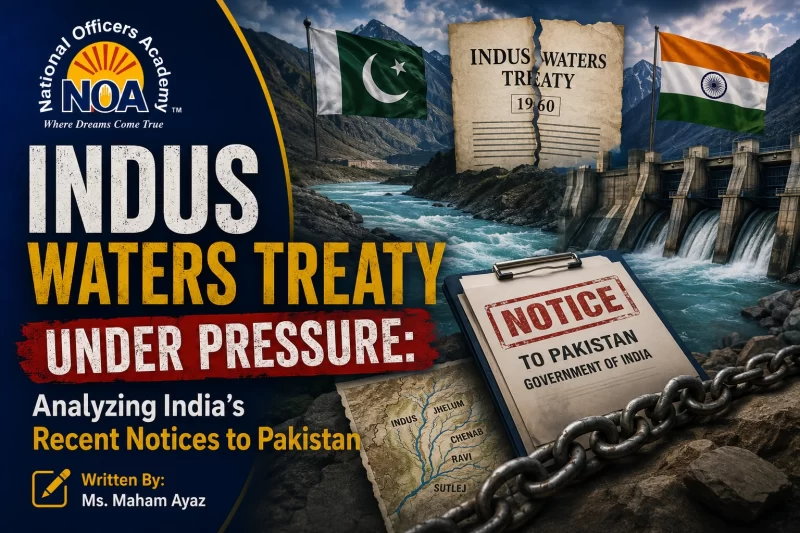
The Indus River System is regarded as a lifeline for Pakistan. It includes the Indus River and its five major tributaries: Jhelum, Chenab, Ravi, Beas, and Sutlej.
For an agrarian country like Pakistan, the Indus River System is the most critical natural resource. As a single-basin country, Pakistan heavily depends on the Indus Basin for domestic, agricultural, and industrial water needs.
However, Pakistan shares this basin with India, one of its major regional rivals. After the partition of British India, the Indus Basin system was divided, turning water into a major fault line between Pakistan and India.
India became the upper riparian state with control over canal headworks that supplied water to large areas that became part of Pakistan. Pakistan, on the other hand, became the lower riparian state.
Origins of the Pakistan-India Water Dispute
The water dispute between Pakistan and India began on 1 April 1948, when India stopped irrigation water in canals crossing the India-Pakistan boundary.
This action affected nearly 1.6 million acres of irrigated land in Pakistan and created an urgent need for a formal agreement between the two countries regarding the future use and distribution of shared waters.
Negotiations began between Pakistan and India, but both sides were initially unable to reach a settlement. The World Bank then used its good offices to facilitate talks, which began in May 1952.
During these negotiations, both countries agreed to work on engineering measures to increase the effective water supplies available to each side.
After eight years of intense negotiations, the two countries finally reached an agreement in the form of the Indus Waters Treaty in 1960.
Salient Features of the Indus Waters Treaty
The Indus Waters Treaty created a detailed framework for the use and management of the Eastern and Western rivers of the Indus Basin.
Provisions Regarding the Eastern Rivers
- All waters of the Eastern rivers, namely Sutlej, Beas, and Ravi, were allocated for India’s unrestricted use.
- Pakistan is required to allow the free flow of the Sutlej Main and Ravi Main in areas where these rivers enter Pakistani territory but have not yet fully crossed into Pakistan.
- Pakistan may use these waters only for domestic and non-consumptive purposes in such areas.
- Once the Eastern rivers fully cross into Pakistan, any tributary joining the Sutlej Main or Ravi Main is reserved for Pakistan’s unrestricted use.
Provisions Regarding the Western Rivers
- Pakistan has unrestricted use of the waters of the Western rivers: Indus, Jhelum, and Chenab.
- India is obligated to allow the waters of the Western rivers to flow undisturbed.
- India cannot interfere with these waters except within the limited uses permitted under the Treaty.
General Provisions for Eastern and Western Rivers
- Pakistan was required to develop and operate replacement systems to meet irrigation needs after the reduction of flows from the Eastern rivers.
- Natural river channels may carry floodwater or excess water without restriction from either side.
- Both countries are required to prevent significant pollution of the rivers.
- Before sewage or industrial waste enters the rivers, necessary treatment must be applied to avoid harmful effects on water usage.
Dispute Resolution Mechanism Under the Treaty
Article IX of the Indus Waters Treaty establishes a structured mechanism for resolving disagreements between India and Pakistan regarding the interpretation or application of the Treaty.
This mechanism clearly distinguishes between technical and legal issues and assigns each type of issue to a specific forum.
Role of the Permanent Indus Commission
Any initial question regarding the interpretation or application of the Treaty is first referred to the Permanent Indus Commission.
The Commission consists of one commissioner from each country. Both commissioners are expected to resolve the question through mutual agreement.
If the Commission succeeds, the matter is settled without further escalation.
Role of the Neutral Expert
If the Permanent Indus Commission cannot resolve a question and the matter is considered a “difference,” it may be referred to a Neutral Expert.
The Neutral Expert is a technical authority responsible for resolving technical matters listed in Annexure F of the Treaty.
Such issues usually relate to specific engineering or design features of water projects.
The Neutral Expert’s decision is binding on technical aspects but does not address broader legal disputes or interpretation of Treaty provisions unless they are directly linked to technical matters.
Role of the Court of Arbitration
If a matter involves interpretation of Treaty provisions beyond technical issues, or if the Neutral Expert determines that the matter should be treated as a dispute, it may be referred to the Court of Arbitration.
Unlike the Neutral Expert, the Court of Arbitration can deal with both legal and technical questions.
This allows the Court to examine broader issues requiring interpretation of Treaty clauses and legal principles.
Flexibility in Escalation
The Permanent Indus Commission has flexibility in determining whether a matter should be referred to a Neutral Expert or escalated directly to the Court of Arbitration.
This flexibility allows the Commission to choose the appropriate forum based on whether the issue is primarily technical or requires legal interpretation.
Timeline of Key Events in the Indus Waters Treaty
- 1960: The Indus Waters Treaty was signed between India and Pakistan with the support of the World Bank.
- 1978–1987: The Salal Hydroelectric Project created initial tensions, which were resolved through bilateral negotiations.
- 1985–1990: The Wullar Barrage dispute emerged after Pakistan raised concerns about India’s construction on the Jhelum River.
- 2005: The Baglihar Dam dispute became the first major case referred to a Neutral Expert under the Treaty.
- 2010: The Kishanganga dispute led Pakistan to approach the Court of Arbitration for the first time under the Treaty.
- 2016: Pakistan requested arbitration regarding the Kishanganga and Ratle projects, while India preferred a Neutral Expert, creating a procedural deadlock.
- 2023: India issued its first notice to Pakistan on 25 January, seeking modification of the Treaty.
- 2024: India issued a second notice on 30 August, citing “fundamental and unforeseen circumstances” as grounds for reviewing the Treaty.
Compliance Issues Under the Indus Waters Treaty
Over time, several compliance issues have arisen under the Treaty, mostly involving Indian hydroelectric projects on rivers covered by the agreement.
Some major projects that have generated controversy include:
- Salal Dam
- Wullar Barrage
- Baglihar Dam
- Kishanganga Project
- Dul Hasti Project
- Uri II Project
- Nimoo Bazgo Project
The main disputes have usually involved technical design features and interpretation of specific Treaty clauses.
Salal Dam
The design-related questions surrounding the Salal Dam were resolved through bilateral negotiations between Pakistan and India.
Baglihar Dam
The Baglihar Dam dispute marked the first instance where a compliance issue was classified as a “difference” under the Treaty.
The matter was referred to a Neutral Expert, who examined the technical design concerns raised by Pakistan.
Kishanganga Project
The Kishanganga dispute went beyond the jurisdiction of the Neutral Expert and became a formal “dispute.”
This led to the establishment of a Court of Arbitration for the first time under the Treaty to address Pakistan’s objections to the project’s design.
India’s Recent Notices to Pakistan
The Indus Waters Treaty has recently come under renewed pressure.
On 25 January 2023, India issued a notice to Pakistan seeking modification of the Treaty. India cited Pakistan’s alleged intransigence as the main reason.
Later, on 30 August 2024, India issued another notice, referring to “fundamental and unforeseen changes in circumstances” as grounds for reviewing and modifying the Treaty.
These notices raise important questions regarding their legal implications and the future of the Treaty.
Kishanganga and Ratle Projects: The Immediate Background
Tensions between India and Pakistan increased over the design features of the Kishanganga and Ratle hydroelectric power projects.
The Kishanganga project has a capacity of 330 megawatts and is located on a tributary of the Jhelum River.
The Ratle project has a capacity of 850 megawatts and is located on a tributary of the Chenab River.
The Treaty permits India to construct hydroelectric projects on the Western rivers, but only within specific design constraints and Treaty obligations.
Pakistan argued that the design of these projects violated the Treaty and therefore required legal and technical examination.
In 2016, Pakistan approached the World Bank and requested the formation of a Court of Arbitration to address its concerns.
India, however, insisted that the matter should be referred to a Neutral Expert.
Disagreement Over the Proper Forum
The Treaty provides a three-level dispute resolution framework:
- Questions are addressed by the Permanent Indus Commission.
- Differences are resolved by a Neutral Expert.
- Disputes are referred to the Court of Arbitration.
Pakistan maintained that the issues relating to Kishanganga and Ratle were not merely technical. According to Pakistan, they required interpretation of the Treaty and should therefore be referred to the Court of Arbitration.
India argued that Pakistan bypassed the Treaty’s graded dispute resolution mechanism and that the matter should have gone to a Neutral Expert.
In response to the disagreement, the World Bank initiated both processes at the same time.
India objected to the parallel proceedings and chose not to participate in the Court of Arbitration process.
India later issued its formal notice to Pakistan in 2023, seeking modification of the Treaty.
India’s Position
India argues that Pakistan’s approach to dispute resolution amounts to a procedural violation of the Treaty.
It claims that Pakistan bypassed the graded mechanism by seeking arbitration instead of allowing the matter to proceed before a Neutral Expert.
India also contends that the World Bank’s decision to initiate both the Court of Arbitration and Neutral Expert processes could lead to conflicting outcomes.
According to India, this situation complicates the resolution of the dispute and creates uncertainty in the Treaty’s functioning.
Pakistan’s Position
Pakistan argues that the hydroelectric projects being constructed by India raise questions that go beyond technical design.
Pakistan maintains that the matter involves interpretation of Treaty provisions and therefore qualifies as a “dispute” rather than a mere “difference.”
For this reason, Pakistan considers the Court of Arbitration to be the appropriate forum.
Pakistan also argues that the Neutral Expert is limited to technical assessments, whereas the Court of Arbitration can address both legal and technical issues.
Pakistan’s Response to India’s Notices
In response to India’s first notice, Pakistan’s Attorney General’s office confirmed that Pakistan formally replied on 5 April 2023.
Pakistan expressed willingness to address India’s concerns within the framework of the Permanent Indus Commission.
This response demonstrated Pakistan’s position that the Treaty remains valid and that any concerns should be handled through its existing mechanisms.
After India’s second notice on 30 August 2024, Pakistan again expressed willingness to engage in discussions.
Pakistan’s Foreign Office clarified that it wanted to address India’s concerns within the framework of the Indus Waters Treaty.
Legal Implications of India’s Notices
It is important to understand that India’s notices do not automatically annul, suspend, or modify the Treaty.
A notice or request for modification is only the beginning of a possible negotiation process.
The Treaty itself provides a clear framework for modification under Article XII.
Article XII states that any modification or alteration of the Treaty requires agreement between both parties.
Therefore, any change to the Indus Waters Treaty must be negotiated, drafted, and ratified by both Pakistan and India.
The Treaty does not allow unilateral modification by one party.
Can the Treaty Be Unilaterally Terminated?
The Indus Waters Treaty is an agreement of indefinite duration.
Under customary international law, treaties of this nature cannot be unilaterally terminated by one party without violating international law.
Any unilateral withdrawal would breach the terms of the Treaty and undermine the binding nature of international agreements.
Such action would also weaken the principle that treaties must be respected unless both parties agree to amend or terminate them.
Material Breach Argument Under International Law
India’s claim that Pakistan has materially breached the Treaty can be examined under Article 60(3) of the Vienna Convention on the Law of Treaties.
Article 60(3) defines a material breach as:
- A repudiation of the Treaty not permitted by the Convention; or
- A violation of a provision essential to achieving the object and purpose of the Treaty.
Pakistan’s decision to pursue the Court of Arbitration instead of a Neutral Expert does not appear to meet this definition.
The disagreement concerns the proper dispute resolution forum. It does not amount to repudiation of the Treaty or violation of a provision essential to the Treaty’s purpose.
Therefore, the matter appears to be a procedural disagreement rather than a material breach of the Treaty.
Fundamental Change in Circumstances
India’s second notice referred to fundamental and unforeseen changes in circumstances.
These included demographic shifts, environmental challenges, and the continuing impact of cross-border terrorism.
Such concerns may be discussed within the Permanent Indus Commission or other Treaty mechanisms.
However, they cannot automatically justify unilateral withdrawal from the Treaty.
Under Article 62 of the Vienna Convention on the Law of Treaties, the principle of pacta sunt servanda, meaning that treaties must be honoured, remains central.
A fundamental change in circumstances can only be invoked under strict conditions.
There is no clear evidence that the circumstances cited by India have made the Treaty impossible or excessively burdensome for either party to perform.
Therefore, these arguments do not appear sufficient to justify unilateral modification or withdrawal.
Why the Treaty Framework Still Matters
The Indus Waters Treaty has survived wars, military tensions, diplomatic breakdowns, and repeated political crises.
Its durability lies in its structured approach to water sharing, technical cooperation, and dispute resolution.
Weakening the Treaty could create uncertainty for both countries and increase the risk of conflict over shared rivers.
For Pakistan, the Treaty is especially important because the Western rivers are central to its agriculture, food security, hydropower generation, and economic stability.
For India, the Treaty provides a recognised framework for limited use of the Western rivers and reduces the risk of uncontrolled water disputes.
Both countries therefore have an interest in preserving the Treaty’s integrity.
Conclusion
India’s recent notices to Pakistan are only a precursor to possible negotiations. They do not automatically modify, suspend, or terminate the Indus Waters Treaty.
Any amendment to the Treaty must be mutually agreed upon, formally drafted, and ratified by both countries.
The legal framework of the Treaty, along with international law, does not support unilateral modification or withdrawal.
Pakistan and India must uphold their international responsibilities and resolve their concerns within the existing Treaty mechanisms.
The Indus Waters Treaty remains one of the most significant agreements on transboundary river management in the world.
Its resilience over several decades shows its importance for regional stability and water cooperation.
The Treaty should not be altered or weakened because of political shifts or short-term tensions.
As both countries navigate current challenges, they must honour their commitments and use the Permanent Indus Commission, Neutral Expert, and Court of Arbitration mechanisms where appropriate.
Preserving the Treaty’s integrity will help protect regional peace, water security, and the cooperative spirit that the agreement was designed to maintain.