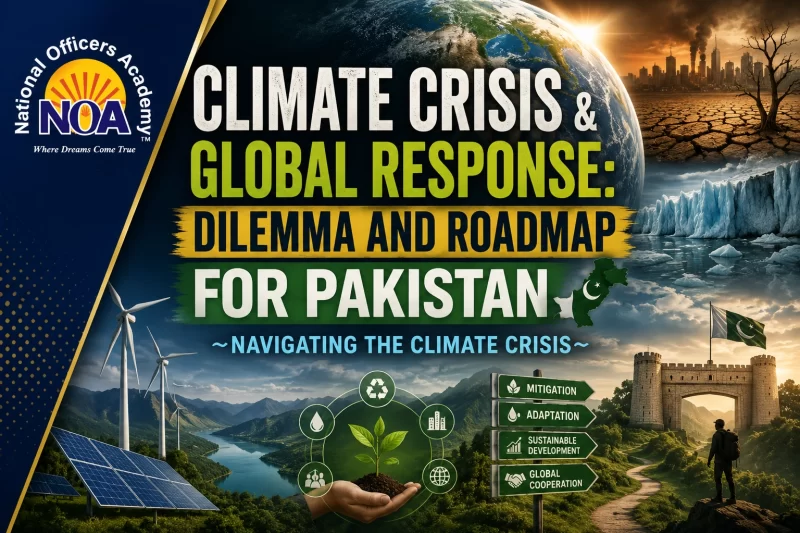
Introduction: The Global Climate Crisis
The climate crisis is no longer a distant warning. It is a present-day reality with severe consequences, particularly for vulnerable countries such as Pakistan.
Rising global temperatures, melting ice caps, increasingly frequent extreme weather events and widespread biodiversity loss have created a global environmental emergency.
The Intergovernmental Panel on Climate Change has repeatedly warned about the devastating consequences of allowing the average global temperature to rise beyond 1.5°C.
These warnings emphasize the need for countries to take immediate, coordinated and decisive action.
For Pakistan, the risks are particularly serious. The country must simultaneously meet its development requirements while adapting to and mitigating the effects of the climate crisis.
This article examines:
- The global response to climate change
- Pakistan’s unique climate vulnerabilities
- The climate-finance dilemma
- The country’s climate-policy framework
- A practical roadmap for climate resilience
The Climate Challenge: Pakistan on the Frontlines
Pakistan contributes less than 1% of global greenhouse gas emissions, yet it is frequently ranked among the countries most vulnerable to climate change.
A combination of geographical, socio-economic and governance-related factors increases the country’s exposure to climate risks.
Pakistan is already experiencing more frequent and intense:
- Heatwaves
- Floods
- Droughts
- Cyclones
- Glacial lake outburst floods
- Water shortages
- Climate-related agricultural losses
During the last decade, Pakistan experienced some of the most destructive environmental disasters in its history.
The 2022 super floods affected and displaced more than 33 million people and caused economic losses estimated between $20 billion and $30 billion.
Melting glaciers in northern Pakistan have also become a growing annual threat.
Glacial lake outburst floods can destroy settlements, infrastructure and agricultural land while placing millions of people at risk.
Climate-induced food and water shortages are expected to increase further, affecting:
- Economic stability
- Public health
- Food security
- Employment
- Internal migration
- National security
Global Response: COP Conferences and International Agreements
The international response to climate change has primarily developed through global frameworks and agreements.
Major international climate mechanisms include:
- The United Nations Framework Convention on Climate Change
- The Kyoto Protocol
- The Paris Agreement
- The annual Conference of the Parties meetings
Pakistan is a signatory to the major international climate agreements, including the Kyoto Protocol and the Paris Agreement.
These agreements aim to limit the rise in global temperatures and provide a framework through which individual countries can develop their national climate policies.
The Role of COP Conferences
The annual Conference of the Parties meetings play an important role in establishing international climate targets and reviewing global progress.
COP29 in Baku was viewed as an important opportunity for the international community to address post-2025 climate-finance objectives and strategies for achieving Nationally Determined Contributions.
However, a considerable gap remains between international promises and their practical implementation.
This gap is particularly visible in the limited financing and technological assistance provided to developing countries such as Pakistan.
The Financial Dilemma: The Global South and the Global North
Climate finance remains one of the most disputed issues in international climate negotiations.
Developed countries pledged to provide $100 billion annually to help developing countries mitigate and adapt to climate change.
However, these commitments were not fulfilled consistently or within the promised timeframe.
According to the Organisation for Economic Co-operation and Development, developed countries mobilized approximately $89.6 billion in climate finance in 2021.
For Pakistan, access to international climate finance is essential for implementing large-scale adaptation and resilience projects.
Pakistan’s Financial Constraints
Pakistan’s fiscal deficit and dependence on international financial assistance increase its climate vulnerability.
The international financial system often remains reluctant to:
- Restructure the debt of climate-vulnerable countries
- Provide long-term financing
- Offer low-interest climate loans
- Prioritize grants over debt-based assistance
- Simplify access to climate funds
Many developing countries require substantial resources for climate adaptation but remain trapped in debt.
In several cases, governments spend more on debt repayments than on development, healthcare, education or environmental protection.
This creates a serious climate-finance dilemma for the Global South.
Pakistan’s Climate Policy Framework
Pakistan has developed several laws, policies and institutions in response to the growing threat of climate change.
The Pakistan Climate Change Act of 2017 established the Pakistan Climate Change Authority.
The authority was created to coordinate national climate action and support the implementation of climate policies.
However, it has remained underfunded and insufficiently resourced.
Governance and Institutional Challenges
Pakistan’s climate response is weakened by:
- Limited institutional capacity
- Insufficient funding
- Overlapping administrative responsibilities
- Weak coordination between federal and provincial institutions
- Limited implementation of environmental laws
- Changes in political priorities
These weaknesses prevent climate policies from being translated into effective action at the national and local levels.
Pakistan’s Nationally Determined Contributions
Pakistan has made several ambitious commitments under its Nationally Determined Contributions.
These commitments include:
- Transitioning to 30% renewable energy by 2030
- Converting 30% of transportation to electric vehicles by 2035
- Producing 70% of energy from renewable sources by 2035
These targets are important but require substantial financial investment, technological assistance, institutional capacity and political commitment.
The Heatwave Threat: Impacts on Public Health and Livelihoods
Pakistan is highly vulnerable to extreme heat, with several areas recording some of the highest temperatures in the world.
In 2024, Mohenjo-daro recorded a temperature of approximately 52.2°C.
Extreme temperatures affect both humans and animals and can cause serious health complications.
Prolonged exposure to heat can result in:
- Heat exhaustion
- Heatstroke
- Dehydration
- Cardiovascular complications
- Kidney-related illnesses
- Worsening of existing medical conditions
The most vulnerable groups include:
- Children
- Older people
- Outdoor labourers
- People with chronic illnesses
- Low-income communities
- People living without reliable electricity or clean water
Heatwave Response Measures
The government has introduced cooling centres and water-distribution programmes in some areas.
However, these initiatives remain limited in scale and geographical coverage.
Pakistan should expand heatwave-response measures, particularly in major urban heat islands such as Karachi and Lahore.
Necessary actions include:
- Establishing more cooling centres
- Providing clean drinking water
- Introducing early-warning systems
- Adjusting working hours during extreme heat
- Expanding emergency medical services
- Increasing urban green spaces
- Promoting heat-resilient building designs
Water Scarcity and Agricultural Impact
Pakistan depends heavily on the Indus River system for agriculture, drinking water, industry and electricity generation.
Climate change is altering river flows and increasing the risks of floods and droughts.
Severe water shortages are becoming increasingly common in Sindh and Balochistan.
Coastal areas are also experiencing rising salinity, making agricultural production more difficult.
The Glacier Paradox
The melting of northern glaciers may initially increase flooding.
However, as glacial reserves decline over time, Pakistan may experience prolonged water shortages and droughts.
This creates a long-term threat to the Indus River system and the communities that depend upon it.
Impact on Agriculture
Agriculture employs a substantial proportion of Pakistan’s labour force and remains highly exposed to climate-related disruption.
Erratic rainfall, extreme heat, droughts and floods reduce crop yields and create serious economic losses for farmers.
Climate change threatens the production of:
- Wheat
- Rice
- Cotton
- Maize
- Sugarcane
- Fruits and vegetables
Solutions for Water and Agricultural Resilience
Pakistan should adopt modern and water-efficient agricultural practices.
Priority measures include:
- Drip irrigation
- Sprinkler irrigation
- Rainwater harvesting
- Groundwater regulation
- Climate-resilient crop varieties
- Improved weather forecasting
- Crop diversification
- Reforestation
- Soil conservation
These interventions can reduce agricultural losses and improve food and water security.
The Role of Renewable Energy
Transitioning towards renewable energy is a central part of Pakistan’s climate strategy.
The country possesses considerable potential for:
- Solar energy
- Wind energy
- Hydropower
- Biomass
- Other clean-energy technologies
Despite this potential, progress remains slow, and Pakistan continues to depend significantly on fossil fuels, including coal.
Expanding Solar and Wind Energy
Developing solar and wind projects, particularly in rural and underserved areas, can help reduce Pakistan’s energy deficit.
Renewable-energy expansion can also:
- Create employment
- Reduce electricity costs
- Improve rural electrification
- Reduce dependence on imported fuels
- Lower greenhouse gas emissions
- Strengthen national energy security
Energy Storage and Grid Modernization
Renewable-energy development must be supported by investment in energy-storage technologies.
Pakistan must also modernize its national electricity grid so that it can manage variable solar and wind generation.
A modern and reliable grid is essential for achieving long-term energy sustainability.
Climate Justice and the Path Forward
Climate justice has become an increasingly important principle in global climate negotiations.
Pakistan and other developing countries argue that they should not be forced to carry an unequal share of climate-mitigation costs when their historical contribution to global emissions remains limited.
This argument highlights the need for fair and accessible climate-finance mechanisms.
Vulnerable countries require greater support through:
- Climate grants
- Debt relief
- Concessional financing
- Technology transfer
- Capacity-building programmes
- Loss and damage funding
Balancing Development and Climate Adaptation
Pakistan must balance its economic-development needs with climate adaptation and environmental protection.
International assistance will remain important, but domestic reforms are equally necessary.
Pakistan should prioritize:
- Strengthening climate institutions
- Implementing environmental laws
- Improving federal and provincial coordination
- Increasing public awareness
- Improving climate education
- Expanding disaster preparedness
- Integrating climate risks into development planning
Community Participation
Local communities should be actively involved in climate-adaptation projects.
Community participation can produce solutions that are more sustainable, practical and appropriate for local conditions.
Farmers, women, young people, local governments and civil-society organizations should all be included in climate planning.
A Roadmap for Pakistan
Pakistan requires a comprehensive national roadmap that combines climate mitigation, adaptation, sustainable development and disaster resilience.
Strengthen Climate Governance
- Fully operationalize the Pakistan Climate Change Authority
- Clarify the responsibilities of federal and provincial institutions
- Provide adequate funding and trained personnel
- Improve transparency and accountability
- Integrate climate action into national development planning
Expand Climate-Resilient Infrastructure
- Develop flood-resistant roads and bridges
- Strengthen urban drainage systems
- Improve river and watershed management
- Expand glacier-monitoring systems
- Protect vulnerable coastal communities
Transform Agriculture and Water Management
- Introduce water-efficient irrigation
- Promote climate-resilient seeds
- Regulate groundwater extraction
- Increase rainwater harvesting
- Support farmers through credit and climate insurance
Accelerate the Renewable-Energy Transition
- Expand solar and wind farms
- Modernize the national electricity grid
- Invest in battery-storage systems
- Promote electric public transport
- Reduce dependence on imported fossil fuels
Improve Disaster Preparedness
- Strengthen early-warning systems
- Improve evacuation planning
- Train local disaster-response teams
- Develop emergency shelters
- Protect hospitals, schools and critical infrastructure
Secure International Climate Finance
- Develop transparent and bankable climate projects
- Improve access to international climate funds
- Advocate for grant-based support
- Seek debt restructuring linked to climate resilience
- Strengthen regional and international partnerships
Conclusion: The Urgency of Action
The climate crisis is not simply an environmental problem.
It is also a development, health, economic and national-security challenge.
For Pakistan, the stakes are exceptionally high, and the available time for effective action is rapidly decreasing.
The international community must fulfil its climate-finance commitments and support vulnerable developing countries through grants, technology and capacity building.
At the same time, Pakistan must develop and implement a strong internal climate framework.
The country must embrace renewable energy, sustainable agriculture, effective water management, stronger institutions and climate justice.
Although the path forward is difficult, coordinated and timely action can help Pakistan build a more resilient and sustainable future.
The time to act is now, because the social, environmental and economic cost of inaction will be far greater.