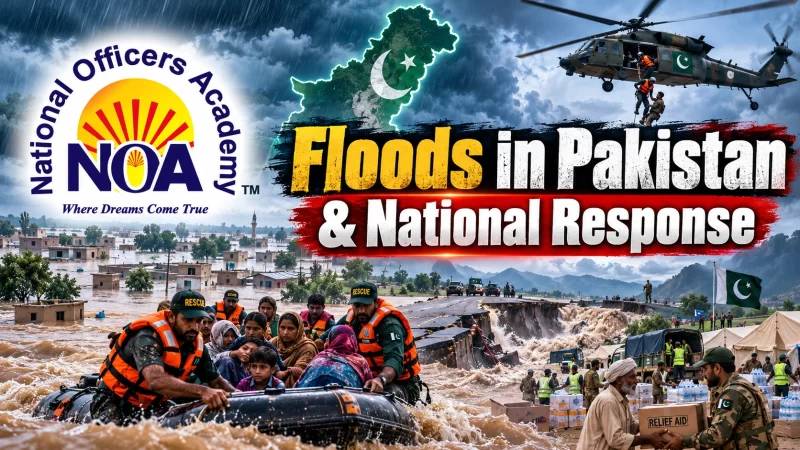
Floods in Pakistan & National Response
Validating the Reality of Climate Change
After experiencing exceptionally hot conditions during April and May 2022, Pakistan was struck by one of the most devastating flood disasters in its recent history.
Between June and August 2022, torrential monsoon rains combined with riverine, urban and flash flooding to create an unprecedented humanitarian and environmental crisis.
On August 25, 2022, the Government of Pakistan declared a state of emergency because of the scale of the flooding.
August 2022 became one of the wettest months recorded in Pakistan in decades, with rainfall far above normal levels in several regions.
Sindh and Balochistan were particularly badly affected, receiving several times their usual monthly rainfall.
The Indus River and its associated waterways overflowed across vast areas, submerging settlements, destroying agricultural land and damaging critical infrastructure.
Around 33 million people were affected, while millions were displaced from their homes.
The floods caused more than 1,700 deaths, with children accounting for a significant share of the fatalities.
The disaster destroyed or damaged:
- Homes
- Schools
- Hospitals
- Roads
- Bridges
- Agricultural land
- Livestock
- Water and sanitation systems
Rain-induced flooding, glacial melt and landslides collectively destroyed livelihoods and exposed major weaknesses in Pakistan’s disaster-preparedness system.
Humanitarian and Health Consequences
Flooding created a major public-health emergency in affected areas.
According to the source, millions of flood-affected people required health assistance by late 2022.
Stagnant water, damaged sanitation systems and overcrowded displacement sites increased the risk of:
- Cholera
- Dengue fever
- Malaria
- Diarrhoeal diseases
- Skin infections
- Malnutrition
Women and children faced particular risks.
Millions of women of reproductive age were living in affected areas, including hundreds of thousands of pregnant women requiring maternal-health services.
The crisis demonstrated that climate disasters are not merely environmental events. They rapidly become crises of:
- Health
- Food security
- Housing
- Education
- Livelihoods
- Gender protection
- Public administration
Climate Change – The Threat is Real
The global climate is changing, with increasingly visible effects on weather patterns, ecosystems and human societies.
Scientific evidence has shown long-term increases in global temperatures, melting glaciers, rising sea levels and changing patterns of extreme weather.
Pakistan’s flood disaster must therefore be understood within the broader context of increasing climate vulnerability.
Rising Global Temperatures
The Earth has experienced a sustained rise in average temperatures since the industrial era.
Recent decades have repeatedly produced some of the warmest years ever recorded.
Higher temperatures increase the probability and severity of:
- Heatwaves
- Glacial melting
- Extreme rainfall
- Drought
- Wildfires
- Sea-level rise
Melting Glaciers and Rising Sea Levels
Global warming is accelerating the melting of glaciers and ice sheets.
Pakistan is particularly vulnerable because of its large northern glacial system.
Rapid glacial melting increases the risk of Glacial Lake Outburst Floods (GLOFs), which can destroy infrastructure and settlements in mountainous areas.
At the same time, sea-level rise threatens Pakistan’s coastal communities and ecosystems, particularly around the Indus Delta.
Ocean Warming and Ecosystem Damage
The world’s oceans absorb significant quantities of heat and carbon dioxide.
This contributes to ocean warming and acidification, placing marine ecosystems under pressure.
Climate change therefore threatens both terrestrial and marine biodiversity.
Pakistan – Measuring Climate Vulnerabilities
Pakistan is highly vulnerable to climate-related disasters because of its geography, socioeconomic conditions, rapid urbanisation and dependence on climate-sensitive sectors.
The country faces multiple natural hazards, including:
- Floods
- Droughts
- Cyclones
- Heatwaves
- Earthquakes
- Glacial lake outburst floods
These disasters cause loss of life, economic damage and reversal of development gains.
Flood Vulnerability
Pakistan has experienced repeated large-scale flooding over the past several decades.
Floods affect agriculture, infrastructure, housing, health, water supplies and economic productivity.
Frequent floods also increase poverty by destroying livelihoods and forcing households to use savings for reconstruction.
Glacial Vulnerability
Rising temperatures are accelerating the melting of northern glaciers.
Thousands of glacial lakes exist across Pakistan’s mountainous regions, with a number of them considered potentially dangerous.
GLOFs can occur suddenly and produce devastating downstream impacts.
Drought and Water Scarcity
Sindh and Balochistan are particularly exposed to water scarcity and drought.
Climate variability can create a paradoxical situation in which Pakistan experiences devastating floods in one period and severe water shortages in another.
Sea-Level Rise
Pakistan’s coastal regions face risks from rising sea levels, saline intrusion and degradation of the Indus Delta.
These impacts threaten:
- Coastal communities
- Agriculture
- Mangroves
- Freshwater supplies
- Livelihoods
Agricultural Vulnerability
Agriculture remains one of Pakistan’s most climate-sensitive sectors.
Floods and droughts can reduce crop yields, damage livestock and undermine national food security.
Climate change therefore poses both an environmental and an economic challenge.
Urbanisation and Climate Risk
Pakistan is one of the fastest-urbanising countries in South Asia.
Rapid and poorly planned urbanisation increases vulnerability by putting greater pressure on:
- Drainage systems
- Waste management
- Water supply
- Housing
- Transport infrastructure
Unplanned settlements in flood-prone areas further increase disaster risk.
Pakistan’s Climate Commitments
Pakistan has committed to reducing projected greenhouse-gas emissions, subject in part to international climate finance and support.
The country also faces significant annual adaptation costs because of its vulnerability to floods, droughts, water scarcity and extreme weather.
Water-resource management, disaster preparedness and food security therefore remain central adaptation priorities.
Pakistan’s Disaster Preparedness – An Overview
The 2022 floods exposed major shortcomings in Pakistan’s disaster-preparedness system.
Natural hazards cannot always be prevented, but effective policies can substantially reduce their transformation into human disasters.
Pakistan has experienced several major floods and other disasters, yet institutional learning and implementation have remained weak.
Weak Monitoring and Early-Warning Systems
Pakistan still lacks sufficiently integrated monitoring and forecasting capacity across vulnerable regions.
Early warning is useful only when information reaches communities in time and local authorities possess the capacity to act upon it.
Violation of Land-Use Zoning
Construction in river catchments, floodplains and hill-torrent channels has increased exposure to flooding.
Unregulated development and encroachment can block natural drainage routes and worsen flood damage.
Failure to Implement Floodplain Regulation
After earlier flood disasters, stronger regulation of construction in river catchments was proposed.
However, implementation remained inadequate.
Weak enforcement allowed continued construction in hazardous areas.
Poor Maintenance of Hill-Torrent Channels
Channels carrying hill-torrent water require regular maintenance.
Encroachment and weak maintenance increase the probability that heavy rainfall will result in devastating flooding.
National Flood Protection Plan
Following earlier flood disasters, the Federal Flood Commission developed a long-term National Flood Protection Plan (NFPP).
The plan sought to reduce flood vulnerability through both structural and non-structural measures.
Non-Structural Measures
- Watershed management
- Flood forecasting and warning systems
- Floodplain mapping
- Floodplain zoning
- Environmental management
- Community preparedness
- Institutional capacity building
- Improved reservoir operating procedures
Structural Measures
- Flood-protection works
- Structures across hill torrents
- Capacity enhancement of barrages and bridges
- Breaching sections where required
The Council of Common Interests approved the plan, but financing and implementation delays meant that many proposed measures had not been fully operationalised before the 2022 floods.
Assessment of Pakistan’s Planning Capabilities
Pakistan’s disaster vulnerability is partly the result of deficiencies in long-term planning.
Major Planning Weaknesses
- Lack of specialised planning capacity
- Weak city master plans
- Political polarisation
- Lack of long-term leadership vision
- Weak environmental impact assessments
- Centre-province coordination gaps
- Poor risk-assessment frameworks
- Absence of an integrated response ecosystem
Assessment of Administrative Capabilities
Administrative weaknesses also reduce Pakistan’s ability to respond effectively to disasters.
Major Administrative Challenges
- Insufficient funding
- Poor urban and town planning
- Weak coordination between federal and provincial authorities
- Fragmented communication systems
- Poor databases and data integration
- Limited public awareness
- Weak institutional preparedness
- Capacity limitations of disaster-management institutions
Assessment of Financial Capabilities
Disaster management requires substantial financial resources.
Pakistan’s fiscal constraints and foreign-debt burden reduce the amount of funding available for prevention and preparedness.
Reliance on development budgets after disasters can also disrupt long-term development planning.
A dedicated disaster-financing mechanism is therefore essential.
Assessment of Infrastructure
Pakistan’s physical infrastructure is often insufficiently resilient to climate disasters.
Major vulnerabilities include:
- Weak drainage systems
- Poor sanitation infrastructure
- Inadequate urban planning
- Insufficient rescue infrastructure
- Energy-system vulnerabilities
- Weak transport networks
Recommendations to Address the Challenge
Pakistan has developed various disaster-risk-reduction policies and institutions, but implementation remains a major weakness.
The country needs a comprehensive approach integrating policy, financing, implementation, regulation and institutional capacity.
1. Strengthen Disaster Risk Reduction Governance
Pakistan’s disaster-management institutions need greater funding, political support and institutional coordination.
Provincial Disaster Management Authorities should be strengthened, while district-level disaster-management structures should become fully operational.
2. Conduct Nationwide Risk Assessments
Risk identification should be undertaken across the country.
Authorities need detailed information on:
- Flood-prone areas
- Glacial hazards
- Drought-prone districts
- Urban drainage risks
- Coastal vulnerabilities
This information should guide land-use planning and infrastructure investment.
3. Improve Urban Planning
Urban development should incorporate climate and disaster risks.
Authorities should:
- Prevent construction on floodplains
- Remove dangerous encroachments
- Improve drainage
- Implement city master plans
- Use GIS-based land mapping
4. Take Action Against Encroachments
Encroachment on natural waterways and drainage channels can turn heavy rainfall into urban disasters.
Land-use laws must therefore be enforced consistently.
5. Strengthen NDMA, PDMAs and District Authorities
National and provincial institutions require:
- Greater funding
- Trained personnel
- Better equipment
- Improved data systems
- Clear institutional roles
- Effective coordination mechanisms
6. Adopt Data and Knowledge-Based Disaster Response
Disaster policy should be based on accurate data rather than emergency improvisation.
Digital mapping, satellite information, weather forecasting and integrated databases can improve both preparedness and response.
7. Establish Disaster Contingency Funds
Pakistan should create dedicated financial reserves for major disasters.
This would reduce the need to divert development expenditure or depend entirely on emergency international financing.
8. Prioritise Health, Education and Agriculture During Reconstruction
Reconstruction should focus on sectors most essential to human development.
Health facilities, schools and agricultural livelihoods should receive priority because their destruction creates long-term socioeconomic consequences.
9. Address Gender-Specific Disaster Risks
Women and girls face particular risks during displacement and disaster response.
Disaster planning should therefore include:
- Maternal healthcare
- Safe shelters
- Sanitation
- Protection mechanisms
- Access to relief supplies
10. Recognise Mental Health as a Disaster Issue
Loss of homes, relatives and livelihoods creates psychological trauma.
Mental-health support should become part of national disaster-response planning.
11. Improve Aid Transparency
Domestic and international aid must reach vulnerable communities efficiently.
Transparent tracking systems are necessary to prevent misuse and ensure social protection.
12. Launch Climate-Justice Diplomacy
Pakistan contributes comparatively little to global greenhouse-gas emissions but suffers significant climate impacts.
The country should therefore continue advocating internationally for:
- Climate finance
- Adaptation funding
- Loss and damage support
- Technology transfer
- Climate justice
13. Establish an Ecological Restoration Fund
Pakistan should develop dedicated financing mechanisms for ecosystem restoration, watershed management, reforestation and climate adaptation.
14. Encourage Environmental Entrepreneurship
The private sector can contribute to climate resilience through innovation in:
- Renewable energy
- Water conservation
- Waste management
- Climate-smart agriculture
- Green construction
15. Promote Public-Private Partnerships
Public-sector resources alone are insufficient to finance Pakistan’s enormous climate-adaptation requirements.
Public-private partnerships can help mobilise investment for resilient infrastructure.
Infrastructure Enhancement
Expand Rescue Services
Pakistan needs both vertical and horizontal expansion of rescue services.
Emergency-response capacity should extend beyond major cities into vulnerable rural and mountainous districts.
Develop Resilient Infrastructure
Roads, bridges, schools, hospitals and housing should be designed according to climate-resilient standards.
Expand Renewable Energy
Greater reliance on solar, wind and other renewable resources can reduce emissions and improve energy security.
Launch Large-Scale Forestation Campaigns
Forestation and ecosystem restoration can reduce erosion, strengthen watersheds and improve long-term climate resilience.
Improve Dams and Water Storage
Improved water-storage infrastructure can help manage both floods and droughts.
However, large infrastructure projects should be combined with watershed management and environmental safeguards.
Improve Canal and Irrigation Systems
Pakistan’s irrigation infrastructure must become more efficient and climate-resilient.
Water losses should be reduced while infrastructure is upgraded to cope with extreme events.
Promote Electric Vehicles and Clean Transport
Cleaner transport systems can contribute to emissions reduction while improving urban air quality.
A Comprehensive Framework for Climate Resilience
Pakistan’s response should integrate four major dimensions.
Planning
- National disaster-management policy
- Updated disaster-management frameworks
- Climate-sensitive city master plans
- Risk mapping
- Stronger environmental assessments
Administration
- Institutional capacity building
- Better centre-province coordination
- Stronger district-level institutions
- GIS-based land management
- Public-awareness campaigns
Finance
- Dedicated disaster funds
- Climate finance
- Ecological restoration funds
- Public-private partnerships
- International climate-justice initiatives
Infrastructure
- Resilient roads and bridges
- Flood-resistant housing
- Modern drainage systems
- Renewable energy
- Forestation
- Improved water storage
- Expanded rescue services
Conclusion
The 2022 floods were a wake-up call for Pakistan.
They demonstrated that climate change is not a distant environmental concern but an immediate national-development and security challenge.
Pakistan’s vulnerability is intensified by weak governance, poor urban planning, inadequate disaster financing, institutional coordination gaps and insufficient implementation of existing frameworks.
The country cannot eliminate natural hazards, but it can substantially reduce their human and economic consequences.
Pakistan must move from a reactive disaster-relief model towards a system centred on prevention, preparedness, adaptation and resilience.
This requires coordinated action across planning, administration, finance, infrastructure and climate diplomacy.
The central lesson of the floods is clear: natural hazards become national disasters when vulnerability, poor planning and weak institutions are allowed to accumulate.