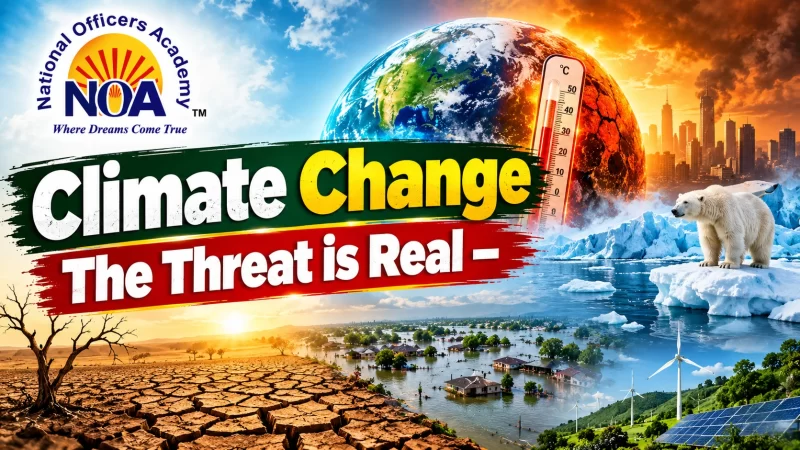
Climate Change – The Threat is Real
Critical Appraisal of Pakistan’s Readiness & Response
Climate change refers to long-term shifts in average weather conditions, including temperature, humidity, rainfall, cloud cover and wind patterns, as well as changes in the frequency and intensity of extreme events.
The Earth’s climate has always changed over long periods of time, but the rapid changes observed in recent decades are primarily associated with global warming and human activities.
Climate change has profound consequences for both people and the natural environment.
Among its major effects are:
- More frequent and intense heatwaves
- Heavier rainfall and flooding
- Melting glaciers and ice sheets
- Sea-level rise
- Changing agricultural productivity
- Pressure on biodiversity
- Disruption of ecosystems
Warmer air can hold more moisture, increasing the possibility of heavy rainfall and extreme precipitation.
At the same time, rising temperatures accelerate the melting of glaciers and ice sheets, contributing to sea-level rise and increasing the risk of glacial lake outburst floods.
Climate Change: A Threat to Pakistan
Pakistan is a prominent example of a developing country that is highly vulnerable to climate change despite contributing only a small share of global greenhouse-gas emissions.
The country increasingly experiences:
- Floods
- Heatwaves
- Droughts
- Glacial melting
- Water scarcity
- Changing monsoon patterns
These events demonstrate that climate change is no longer a distant possibility for Pakistan; it is already affecting the country’s economy, environment and society.
Extreme Heatwaves
Pakistan regularly experiences some of the highest temperatures in the world.
April and May 2022 were exceptionally hot months, with temperatures in several areas rising above normal levels.
Jacobabad in Sindh reportedly reached around 51°C during the May 2022 heatwave.
Such heatwaves pose serious risks to:
- Human health
- Agriculture
- Water availability
- Energy demand
- Outdoor labour
Unprecedented Flooding
Pakistan has repeatedly experienced severe flooding in recent years.
The 2022 floods affected more than 33 million people and caused widespread destruction across several provinces.
The disaster reflected a combination of intense monsoon rainfall, changing precipitation patterns and wider climatic pressures.
Flooding damaged:
- Homes
- Agricultural land
- Roads
- Bridges
- Schools
- Health facilities
Glacial Melting
Pakistan possesses one of the largest concentrations of glaciers outside the polar regions.
Rising temperatures are accelerating glacial melting and increasing the risk of glacial lake outburst floods.
This has serious implications for settlements, infrastructure and water systems in northern Pakistan.
Changing Water Cycle
Climate change is disrupting Pakistan’s hydrological cycle.
Changes in rainfall patterns, glacier melt and river flows create both flood risks and long-term water scarcity.
This dual challenge makes water management one of Pakistan’s most important climate-policy priorities.
Food Insecurity and Agricultural Losses
Pakistan’s agriculture-based economy is highly dependent on stable weather patterns and reliable water supplies.
Climate change affects:
- Crop yields
- Availability of farmland
- Livestock
- Irrigation
- Food prices
Extreme heat, floods and changing rainfall patterns therefore threaten national food security.
Water Scarcity
Pakistan’s per-capita water availability has declined significantly over time.
The source notes that per-capita water availability stood at around 908 cubic metres in 2021, compared with approximately 1,500 cubic metres in 2009.
This growing water stress creates major challenges for agriculture, cities and households.
Climate Change as a Cornerstone of Pakistan’s National Agenda
Recognising its vulnerability, Pakistan has gradually integrated climate change into national policy.
Several initiatives have been introduced to address both climate adaptation and mitigation.
Assessment of National Climate Initiatives
National Climate Change Policy 2012
Pakistan introduced its first National Climate Change Policy in 2012.
The policy primarily focused on climate-resilient development and adaptation because of Pakistan’s vulnerability to extreme climatic events.
National Climate Change Policy 2021
Following developments in global climate governance, including the Paris Agreement, Pakistan updated its National Climate Change Policy in 2021.
The revised framework places greater emphasis on both adaptation and mitigation while also promoting nature-based solutions.
Pakistan’s Nationally Determined Contribution
Pakistan has also announced ambitious climate targets through its updated Nationally Determined Contribution.
The source states that Pakistan aimed for a cumulative 50 percent reduction in projected emissions by 2030, divided into:
- 15 percent from domestic resources
- 35 percent subject to international grant finance
The updated climate targets also included ambitions to:
- Shift towards 60 percent renewable energy
- Increase electric vehicles to 30 percent by 2030
- Restrict coal imports
- Expand nature-based solutions
National Forest Policy
Pakistan approved its National Forest Policy in 2017 to strengthen plantation efforts and improve coordination among federal and provincial authorities.
The policy seeks to:
- Increase forest cover
- Promote afforestation
- Support provincial forestry targets
- Strengthen institutional coordination
- Fulfil international climate obligations
National Biodiversity Strategy and Action Plan
The National Biodiversity Strategy and Action Plan was approved in 2018 to conserve Pakistan’s natural resources and biodiversity.
The initiative aimed to protect ecosystems and improve the management of natural habitats.
Protected Areas Initiative
Pakistan launched initiatives to improve the management of protected areas and natural habitats.
The source notes that the country aimed to expand protected areas from around 12 percent in 2018 to 15 percent by 2023.
Forest Reference Emission Level
Pakistan also developed a Forest Reference Emission Level with the participation of provinces.
This framework was intended to estimate emissions from the forestry sector and support climate reporting obligations.
Green Pakistan Programme
The Green Pakistan Programme has been another important initiative aimed at environmental restoration and green employment.
The programme also provided employment opportunities during the COVID-19 period.
Ten Billion Tree Tsunami Programme
The Ten Billion Tree Tsunami Programme became one of Pakistan’s most visible environmental initiatives.
The programme was launched as a nationwide afforestation and ecosystem-restoration project involving federal, provincial and territorial institutions.
Its broader objectives included:
- Increasing forest cover
- Restoring degraded ecosystems
- Creating green jobs
- Improving biodiversity
- Supporting climate mitigation
Urban Forest Project
Pakistan also launched urban forestry initiatives to improve green spaces in cities.
Urban forests can help reduce:
- Air pollution
- Urban heat
- Carbon emissions
- Loss of biodiversity
Clean Green Pakistan Movement
The Clean Green Pakistan Movement aimed to improve sanitation, waste management, plantation and environmental awareness.
Such programmes seek to integrate environmental responsibility into everyday governance and public behaviour.
Climate Change and National Security
Climate change increasingly affects national security because it influences:
- Water availability
- Food security
- Migration
- Energy security
- Economic stability
- Disaster vulnerability
Climate risks therefore need to be incorporated into Pakistan’s broader national-security and development planning.
Pakistan’s Role in COP26
The 26th Conference of the Parties to the United Nations Framework Convention on Climate Change was held in Glasgow from October 31 to November 13, 2021.
Pakistan participated actively in several climate-related initiatives.
Global Methane Pledge
Pakistan joined the Global Methane Pledge alongside numerous other countries seeking to reduce methane emissions.
Pakistan-Germany Climate and Energy Initiative
Pakistan and Germany launched a climate and energy initiative aimed at strengthening bilateral cooperation in environmental and energy-related sectors.
Pakistan-UAE Green Cooperation
Pakistan and the United Arab Emirates also signed a memorandum of understanding focused on green cooperation.
Pakistan Stands for Youth
Pakistan organised an event titled “Pakistan Stands for Youth” at its COP26 pavilion, highlighting the role of young people in climate action.
Ecosystem Restoration Initiative
Pakistan showcased its ecosystem-restoration initiatives as part of its broader nature-based climate strategy.
Recharge Pakistan
The Recharge Pakistan initiative was introduced as a major climate-adaptation programme.
Its broader objective is to strengthen ecosystem-based adaptation and improve resilience to floods and water-related climate risks.
Pakistan’s Role in COP27
The 27th Conference of the Parties was held in Sharm el-Sheikh, Egypt, in November 2022.
COP27 produced a historic decision to establish funding arrangements addressing loss and damage suffered by climate-vulnerable developing countries.
Pakistan played an important diplomatic role in advancing this agenda.
Loss and Damage Fund – A Climate Justice Initiative
The concept of loss and damage refers to climate impacts that cannot be fully prevented through mitigation or adaptation.
These may include:
- Destroyed infrastructure
- Loss of livelihoods
- Permanent ecosystem damage
- Displacement
- Loss of agricultural land
Pakistan’s experience during the 2022 floods strengthened its argument that vulnerable developing states require dedicated international financial support.
The COP27 decision represented an important step towards climate justice.
Critical Appraisal of Pakistan’s Climate Response
Pakistan has introduced several important climate policies and initiatives, but implementation remains the central challenge.
The country has strong policy ambitions, yet institutional, financial and governance constraints limit their effectiveness.
Major Strengths
- National Climate Change Policy
- Updated NDC targets
- Afforestation programmes
- Climate diplomacy at COP forums
- Nature-based solutions
- Growing recognition of climate-security links
Major Weaknesses
- Weak implementation
- Insufficient climate finance
- Poor governance
- Limited institutional coordination
- Inadequate public awareness
- Weak disaster preparedness
- Slow transition towards clean energy
Way Forward
1. Strengthen Public Awareness
Climate change cannot be addressed only through government institutions.
Public awareness is essential to create behavioural change and build political support for climate policies.
Media campaigns should explain the risks associated with a “do nothing” approach.
2. Improve Governance
Good governance lies at the centre of effective climate action.
Policies must be realistic, properly designed and effectively implemented.
3. Prioritise Adaptation and Mitigation
Pakistan must simultaneously reduce future emissions and adapt to unavoidable climate impacts.
Adaptation should receive particular emphasis because Pakistan is already experiencing severe climatic consequences.
4. Reduce Toxic Emissions
Transport and energy policies should encourage lower-emission technologies.
Cleaner transport can help improve both climate outcomes and urban air quality.
5. Expand Renewable Energy
Pakistan should accelerate investment in:
- Solar energy
- Wind energy
- Hydropower
- Other low-carbon technologies
6. Promote Electric Vehicles
Implementation of electric-vehicle policies can reduce dependence on imported fuel and lower transport emissions.
7. Strengthen Water Storage
Pakistan requires additional water-storage capacity to manage both floods and water scarcity.
New infrastructure should be accompanied by efforts to improve the efficiency and lifespan of existing storage facilities.
8. Improve Disaster Preparedness
Climate adaptation must include stronger:
- Early-warning systems
- Emergency response
- Flood protection
- Urban drainage
- Risk mapping
Conclusion
Climate change is one of the most serious challenges confronting Pakistan in the contemporary era.
The country contributes only a small share of global greenhouse-gas emissions yet remains highly exposed to floods, heatwaves, water scarcity, glacial melting and agricultural disruption.
Pakistan has taken several significant steps, including the National Climate Change Policy, updated NDC commitments, afforestation programmes and active participation in COP26 and COP27.
Its role in advancing the Loss and Damage agenda also strengthened its position in global climate diplomacy.
However, policies and international recognition will have limited value without effective domestic implementation.
Pakistan needs stronger governance, public awareness, climate finance, renewable energy, water management and disaster preparedness.
The central challenge is no longer proving that climate change is real. The challenge is building institutions and policies capable of responding to a threat that is already reshaping Pakistan’s environment, economy and society.