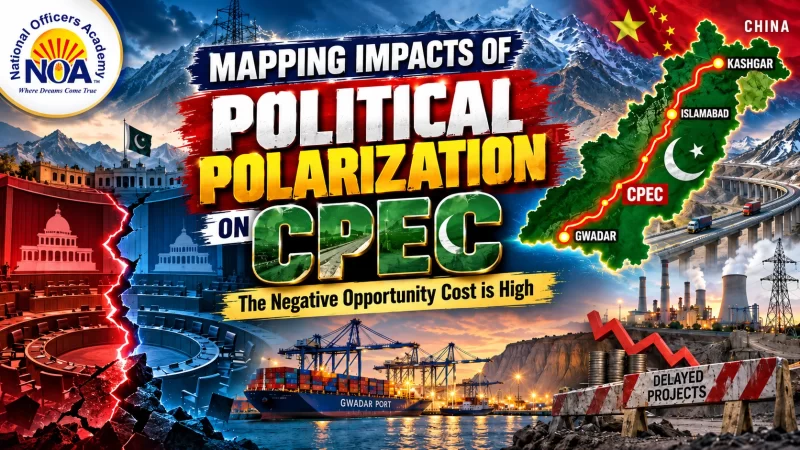
Mapping Impacts of Political Polarization on CPEC
The Negative Opportunity Cost is High
Pakistan occupies an important position in China’s Belt and Road Initiative (BRI) and hosts its flagship project, the China-Pakistan Economic Corridor (CPEC).
CPEC was launched at a time when Pakistan was facing serious security challenges and attracting large-scale foreign investment was difficult.
The corridor includes projects covering:
- Power generation
- Road infrastructure
- Digital connectivity
- Gwadar Port
- Industrial development
- Special Economic Zones
- Agriculture
- Science and technology
Its broader objective is to convert Pakistan’s strategic geographical position into geo-economic opportunities.
However, Pakistan has not fully utilised the opportunities associated with CPEC.
The first phase contributed significantly to addressing energy shortages and improving road connectivity. Thousands of kilometres of highways were constructed, connecting remote regions with major economic centres.
Pakistan was also expected to develop nine Special Economic Zones under CPEC. Progress, however, did not fully materialise according to initial expectations.
Delays in Special Economic Zones, the COVID-19 pandemic, political instability, policy uncertainty and difficulties in doing business collectively slowed the momentum of the corridor.
The central question is whether CPEC can regain the momentum it enjoyed during its early years after its launch in 2015.
CPEC Projects and Pakistan-China Relations
CPEC has become one of the most important dimensions of Pakistan-China relations.
The launch of the corridor placed economic cooperation, connectivity and infrastructure development at the centre of the bilateral relationship.
As the flagship project of the Belt and Road Initiative, CPEC seeks to improve connectivity between Pakistan, China and the wider region through:
- Road networks
- Railways
- Energy infrastructure
- Fibre-optic connectivity
- Industrial clusters
- Special Economic Zones
- Gwadar Port
CPEC Phase I
The first phase of CPEC primarily focused on addressing Pakistan’s immediate infrastructure and energy needs.
Major components included:
Energy Projects
Several energy projects involving hydro, wind, solar and other sources were developed under CPEC.
These projects contributed to increasing electricity-generation capacity and reducing the severity of prolonged power shortages.
Road and Transport Infrastructure
Highways, bridges and other infrastructure projects improved road connectivity between different parts of Pakistan.
Improved transportation infrastructure was intended to reduce travel time, improve trade flows and connect previously underdeveloped regions.
Digital Connectivity
A fibre-optic link connecting Pakistan with China was another important component of CPEC’s communication infrastructure.
Gwadar Port
Development of Gwadar Port has remained a central element of CPEC.
The port is envisioned as a major hub for regional trade, maritime connectivity and economic activity.
CPEC Phase II – From Infrastructure to Industrialisation
The second phase of CPEC is broader in scope than the first.
While Phase I focused mainly on energy and infrastructure, Phase II emphasises:
- Industrial relocation
- Special Economic Zones
- Agricultural modernisation
- Science and technology cooperation
- Job creation
- Socioeconomic development
The success of Phase II is therefore closely linked with Pakistan’s ability to provide a stable political, economic and regulatory environment for investors.
Employment and Socioeconomic Impact of CPEC
CPEC projects have generated employment opportunities for Pakistani workers.
The source notes that around 46,500 Pakistanis had been employed in completed and under-construction energy projects under the CPEC framework.
These projects also provided opportunities for:
- Technical training
- Skill development
- Local employment
- Improvement in household incomes
Development of Gwadar Port and the Free Trade Zone also carries potential for strengthening regional connectivity and economic integration.
CPEC – A Boost to Pakistan’s Dwindling Economy
CPEC is intended to strengthen Pakistan’s economy through investment in transportation, energy, industrial development and connectivity.
Its projects can potentially support economic activity by improving:
- Road infrastructure
- Rail connectivity
- Energy availability
- Ports
- Industrial zones
- Regional trade
Gwadar is expected to benefit from the development of:
- Port infrastructure
- Airport facilities
- Healthcare
- Education
- Communities
- Transport networks
Pakistan-China bilateral trade has also increased significantly over the years.
China remains one of Pakistan’s most important trading and investment partners.
The second phase of the Pakistan-China Free Trade Agreement was also expected to provide greater opportunities for Pakistani exports to the Chinese market.
Prime Minister’s Visit to China – Bringing Hope
During Prime Minister Shehbaz Sharif’s visit to China, both sides reiterated their commitment to reviving and accelerating CPEC projects.
The joint statement reflected political support for:
- CPEC revival
- Gwadar Port development
- Khunjerab border connectivity
- Industrial cooperation
- Export-oriented investment
However, questions remained regarding major pending projects such as the ML-1 railway project.
The source notes that although both sides expressed support for early implementation, no major new project announcement accompanied the visit.
This highlights an important distinction between political consensus at the leadership level and actual implementation at the working level.
The Planning Commission and other relevant institutions therefore have an important responsibility to convert political goodwill into measurable outcomes.
Security of Chinese Personnel and Projects
The security of Chinese workers, officials and projects remains one of the most important challenges facing CPEC.
Concerns regarding attacks on Chinese nationals can negatively affect:
- Investor confidence
- Project implementation
- Future Chinese investment
- Operational costs
- Pakistan-China economic cooperation
Unless security concerns are adequately addressed, attempts to reinvigorate CPEC may face serious difficulties.
CPEC as an Open and Inclusive Platform
An important development highlighted in recent discussions is the description of CPEC as an “open and inclusive” platform.
This approach potentially allows third countries and external investors to participate in selected CPEC projects.
Opening the corridor to additional investors could:
- Increase foreign direct investment
- Expand industrial cooperation
- Reduce excessive reliance on bilateral financing
- Strengthen regional connectivity
- Improve project viability
This development represents a shift from viewing CPEC exclusively as a bilateral Pakistan-China initiative towards a potentially wider regional economic platform.
Pakistan-China Trade and Export Potential
Trade between Pakistan and China has expanded significantly since the signing of their first Free Trade Agreement.
However, the trade balance remains heavily tilted in China’s favour.
China has expressed willingness to encourage investment in export-oriented industries in Pakistan.
Pakistan therefore needs to integrate more domestic products into Chinese supply chains.
Potential sectors include:
- Textiles
- Agriculture
- Pharmaceuticals
- Information technology
- Automotive products
- Footwear
- Furniture
Learning from China’s Poverty Reduction Experience
The source highlights China’s large-scale success in poverty reduction and suggests that Pakistan should learn from aspects of China’s governance and local-development experience.
Pakistan has traditionally relied on measures such as:
- Subsidies
- Income-support programmes
- Shelter initiatives
- Food-support programmes
While such programmes can provide short-term relief, sustainable poverty reduction requires productive employment, economic growth and effective local governance.
Yuan Clearing and Alternative Payment Systems
The central banks of Pakistan and China signed a memorandum concerning yuan clearing arrangements in Pakistan.
If fully operationalised, such arrangements could facilitate cross-border transactions between Pakistani and Chinese businesses.
They may also create greater flexibility in transactions involving countries willing to use alternative settlement currencies.
CPEC and Politico-Economic Instability in Pakistan
Pakistan’s political and economic instability has directly affected progress on the second phase of CPEC.
The source notes that Chinese firms interested in investing in Phase II became cautious because of political uncertainty.
The impact is particularly serious because the second phase depends much more heavily on private and industrial investment than the infrastructure-focused first phase.
Impacts of Political Polarization on CPEC
1. Policy Inconsistency Creates a Trust Vacuum
Frequent changes in government and policy direction create uncertainty for long-term investors.
Large infrastructure and industrial projects require predictable policies lasting many years.
When political parties adopt conflicting positions on major economic initiatives, investors become uncertain about future regulations, agreements and project priorities.
2. Decline in Investor Confidence
Political unrest reduces confidence among foreign investors.
Chinese companies may postpone investment decisions until greater clarity emerges regarding Pakistan’s political and economic direction.
This delays industrialisation and reduces potential foreign direct investment.
3. Terrorism and Security Threats
Security threats against Chinese workers and engineers represent a direct challenge to CPEC.
Such incidents can:
- Delay projects
- Increase security costs
- Discourage technical personnel
- Reduce investor confidence
- Damage Pakistan-China economic cooperation
4. Bureaucratic Hurdles
Slow approvals, complicated regulations and administrative delays can significantly increase project costs.
Such bureaucratic obstacles are particularly damaging during periods of political instability because institutions become reluctant to make major decisions.
5. Weak Ease of Doing Business
Investors require predictable regulations, efficient taxation, contract enforcement and transparent administrative procedures.
Weaknesses in Pakistan’s business environment can encourage companies to invest in competing regional economies instead.
6. Declining Foreign Direct Investment
Political uncertainty and security concerns can reduce FDI inflows.
This is especially damaging for CPEC Phase II because industrial development requires sustained private-sector investment.
7. Corruption and Lack of Transparency
Corruption and a lack of transparency in project agreements can generate public controversy and reduce investor confidence.
The source argues that greater transparency regarding deals, costs and project terms is necessary to prevent CPEC from becoming politically controversial.
8. Weak Institutional Structure
CPEC implementation requires coordination among multiple federal and provincial departments.
Weak institutional capacity and overlapping responsibilities can slow implementation and create unnecessary delays.
9. Economic Crisis and External Debt
Pakistan’s wider economic crisis affects its ability to meet financial obligations and maintain investor confidence.
Foreign-exchange shortages, high debt obligations and concerns regarding repayment capacity can directly affect CPEC-related financing.
10. IMF Dependence and Financial Constraints
Pakistan’s dependence on external financial support limits fiscal space for major infrastructure projects.
Economic uncertainty can also complicate long-term investment planning.
11. Social Non-Inclusion in Gwadar
The success of CPEC depends on local populations benefiting from economic development.
If communities in Gwadar and other project areas perceive that they are excluded from employment, services or decision-making, social resentment can increase.
Local inclusion is therefore essential for the long-term sustainability of the corridor.
12. Political Populism and Unsustainable Projects
Political governments may sometimes prioritise projects for short-term political benefits instead of long-term economic viability.
CPEC projects should therefore be selected on the basis of:
- Economic feasibility
- Commercial sustainability
- National development priorities
- Long-term socioeconomic impact
The Negative Opportunity Cost of Political Polarization
The greatest cost of political polarization is not limited to projects that have already been delayed.
The larger cost lies in opportunities Pakistan may never receive.
When investors postpone or redirect investment to other countries, Pakistan loses potential:
- Industrial development
- Jobs
- Technology transfer
- Exports
- Tax revenues
- Infrastructure
- Regional connectivity
This represents the negative opportunity cost of political instability.
Pakistan does not merely lose time; it may lose entire investment cycles as businesses relocate to competing markets.
Implications for Future Islamabad-Beijing Relations
Pakistan-China relations have traditionally remained strong despite political changes within Pakistan.
However, continued delays, security concerns and economic instability can place increasing pressure on the economic dimension of the relationship.
The future of bilateral relations therefore depends increasingly on Pakistan’s ability to deliver projects efficiently and provide a secure investment environment.
Political declarations of friendship must be accompanied by:
- Effective project implementation
- Reliable security
- Policy continuity
- Transparent regulation
- Commercial viability
Way Forward
1. Create Political Consensus on CPEC
All major political parties should treat CPEC as a long-term national economic project rather than a partisan initiative.
A broad political consensus would provide greater confidence to investors and reduce uncertainty during changes of government.
2. Ensure Policy Continuity
Agreements, industrial policies and investment incentives should remain predictable across political transitions.
3. Accelerate Special Economic Zones
SEZs are central to the industrialisation objectives of CPEC Phase II.
Pakistan should prioritise:
- Infrastructure development
- Electricity supply
- Regulatory facilitation
- Investor services
- Customs efficiency
- Tax clarity
4. Strengthen Security for Chinese Personnel
Protection of Chinese workers and projects should remain a major national-security priority.
Security arrangements should combine intelligence, policing and local community cooperation.
5. Improve Ease of Doing Business
Administrative procedures should be simplified through:
- One-window investment facilities
- Digital approvals
- Transparent regulations
- Faster dispute resolution
- Predictable taxation
6. Increase Local Participation
Communities in Gwadar and other CPEC regions should receive visible socioeconomic benefits.
This requires investment in:
- Employment
- Education
- Healthcare
- Water
- Skills development
- Local businesses
7. Improve Transparency
Greater transparency regarding project costs, financing and agreements can reduce political controversy and strengthen public ownership of CPEC.
8. Promote Export-Oriented Chinese Investment
Pakistan should encourage Chinese companies to establish manufacturing facilities focused on international markets.
This can increase exports, create employment and integrate Pakistani firms into regional supply chains.
9. Diversify CPEC Through Third-Party Investment
Opening CPEC to suitable third-country investors can increase capital, strengthen regional ownership and diversify economic partnerships.
Conclusion
China remains one of Pakistan’s most important economic and strategic partners.
CPEC has already contributed to infrastructure development, energy generation and connectivity, while its second phase carries the potential to support industrialisation, agriculture, technology and employment.
However, political polarization, security threats, bureaucratic delays, weak investor confidence and economic instability have reduced the pace of implementation.
The greatest loss is therefore not simply the delay of existing projects.
It is the opportunity cost of investment, jobs, exports, industrialisation and technology transfer that Pakistan risks losing to competing economies.
Pakistan’s leadership must therefore ensure that CPEC remains insulated from domestic political confrontation.
Policy continuity, transparency, local inclusion, investor facilitation and security must become central elements of the next phase.
If Pakistan can sustain political and economic stability, an invigorated CPEC can help bridge infrastructure gaps, attract investment and strengthen the country’s transition from geostrategic importance towards genuine geo-economic relevance.