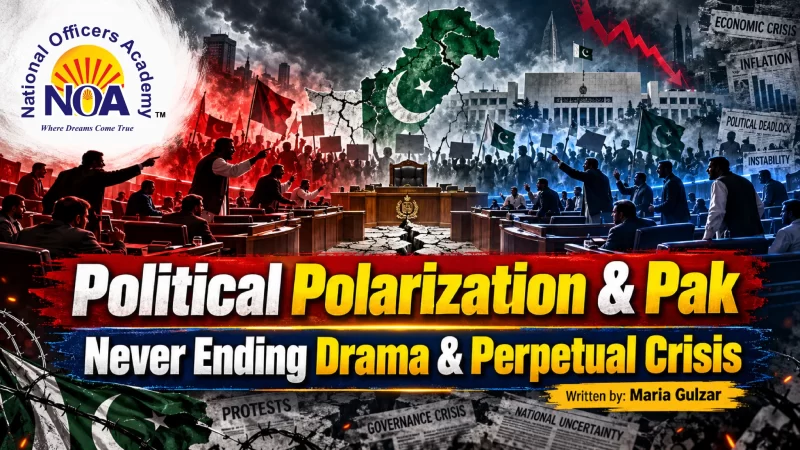
Political Polarization in Pakistan
Never-Ending Drama & Perpetual Crisis
Written by: Maria Gulzar
The exploitation of Pakistan’s diversity for political gains has become increasingly visible. A country founded around shared cultural, religious and social aspirations has gradually witnessed the rise of an intense “us versus them” political culture.
Sectarianism, provincialism, populism, political polarization, religious extremism and widening inequality have weakened social cohesion and encouraged the pursuit of narrow political interests.
The result has been growing mistrust among citizens and between the public and major state institutions.
At a time when Pakistan faces serious economic, governance, environmental and institutional challenges, political polarization has emerged as a force that intensifies nearly every national crisis.
Failure of Political Elites: A Classic Zero-Sum Game
One of the central causes of polarization is the unwillingness of political elites to engage meaningfully with their opponents.
Instead of treating parliamentary politics as a process of negotiation, compromise and democratic contestation, political confrontation often shifts to the streets.
This creates a zero-sum political environment in which one side’s gain is viewed as the other side’s total defeat.
The May 2022 political confrontation surrounding the Azadi March reflected this pattern.
The protest movement was centred on demands for fresh elections and rejection of the political transition following the vote of no confidence.
However, confrontation on the streets led to:
- Violence
- Arrests
- Tear-gas shelling
- Damage to public infrastructure
- Further political fragmentation
Such politics weakens democratic institutions by shifting political conflict away from Parliament and towards agitation, confrontation and street power.
Consistent Undermining of the Supreme Law: A Constitutional Crisis
The Constitution is the supreme legal framework of a democratic state.
It defines the rules of political competition, institutional authority and peaceful transfer of power.
When political actors manipulate constitutional mechanisms for partisan advantage, the legitimacy of the entire democratic system suffers.
The political crisis surrounding the vote of no confidence against former Prime Minister Imran Khan raised major constitutional questions.
The opposition secured the required parliamentary support for the motion, while the Deputy Speaker initially dismissed it.
The resulting constitutional confrontation created:
- Political uncertainty
- Governmental paralysis
- Institutional conflict
- Economic anxiety
Political polarization becomes especially dangerous when constitutional provisions are treated as instruments of partisan survival rather than neutral rules binding all political actors.
State Institutions and the Political Vacuum
Pakistan’s political history has repeatedly demonstrated that weak political parties and unstable civilian institutions create space for stronger state institutions to influence political affairs.
From the early years of independence, weak party structures and limited democratic institutionalisation contributed to an imbalance between political and non-political institutions.
Pakistan has experienced long periods of military rule, which shaped the country’s political culture and institutional development.
In contemporary political discourse, allegations regarding institutional involvement in political engineering further deepen polarization.
When major parties accuse state institutions of favouring their rivals, public confidence in institutions deteriorates.
The long-term solution is not institutional confrontation but stronger democratic institutions capable of managing political competition independently and constitutionally.
The Age of Misinformation: Political Debate in Harsher Tones
The rise of social media has transformed political communication in Pakistan.
Digital platforms have increased political participation, but they have also created new opportunities for:
- Misinformation
- Disinformation
- Propaganda
- Abusive political discourse
- Emotional manipulation
- Coordinated online campaigns
Fake trends, hostile hashtags and manipulated narratives have increasingly replaced substantive policy debate.
The source refers to concerns over hundreds of fake accounts being reported daily during the period discussed.
Political narratives are frequently designed to strengthen group loyalty rather than encourage critical analysis.
As a result, political disagreement increasingly becomes personalised and hostile.
The Cost Pakistan Incurs Due to Political Polarization
Political polarization is not merely an argument between political parties.
Its effects extend across national integration, governance, the economy, institutional legitimacy and foreign relations.
1. National Integration: A Disoriented Youth
National integration depends on social justice, economic equality, political inclusion and democratic pluralism.
It cannot be created solely through top-down political rhetoric.
Polarized political narratives can divide young citizens into competing political and institutional camps.
The source highlights hostile social-media reactions following the death of military personnel in a helicopter crash as evidence of the intensity of political division.
Such behaviour reflects deeper distrust between citizens and institutions.
If political identity becomes stronger than national identity, social cohesion weakens.
2. A Crumbling Economy
Political instability significantly affects economic performance.
When governments and opposition parties remain locked in confrontation, difficult economic decisions become harder to implement.
Investors become cautious, markets become uncertain and long-term economic planning suffers.
Pakistan has simultaneously faced:
- External debt pressures
- Circular debt
- Inflation
- Foreign-exchange shortages
- Dependence on external financing
Short-term measures may temporarily prevent crisis, but persistent political confrontation reduces the possibility of structural reform.
3. Issue-less Politics and Bad Governance
Political polarization shifts attention from governance problems towards constant political confrontation.
Public-health systems, infrastructure, climate adaptation, education and development receive less attention when political energy is consumed by power struggles.
The 2022 floods highlighted this governance problem.
Millions of citizens were affected while questions were raised about:
- Climate-resilient infrastructure
- Evacuation planning
- Disaster preparedness
- Institutional coordination
- Public investment priorities
Climate change contributed heavily to the disaster, but governance weaknesses intensified its human and economic impact.
4. Deteriorating International Reputation
Internal political instability also affects Pakistan’s diplomatic image.
Political leaders increasingly internationalise domestic political conflicts by accusing foreign states or external actors of influencing domestic politics.
Such narratives may generate domestic political support, but they can create unnecessary diplomatic tensions.
Pakistan’s broader democratic performance has also faced criticism in international indices.
Weaknesses in electoral pluralism, government functioning, political participation, political culture and civil liberties affect the country’s international democratic reputation.
Political Polarization and Governance Crisis
Polarization makes governance more difficult because political actors begin to reject policies primarily on the basis of who proposes them.
This produces:
- Policy discontinuity
- Legislative paralysis
- Weak implementation
- Institutional confrontation
- Short-term policymaking
National problems requiring long-term consensus therefore remain unresolved.
Economic reform, climate adaptation, education, population management and national security cannot be addressed through policies that change with every government.
Polarization and the Politics of Populism
Populist politics often divides society between a supposedly virtuous “people” and a corrupt or illegitimate political establishment.
This style of politics can mobilise supporters quickly but often intensifies political hostility.
Political opponents are no longer treated as legitimate competitors; instead, they are presented as enemies, traitors or threats to national survival.
This destroys the possibility of compromise and makes democratic coexistence increasingly difficult.
What’s the Way Out?
1. Political Will for Parliamentary Discourse
Pakistan needs to prioritise parliamentary democracy over confrontational street politics.
Political parties should use:
- Parliament
- Standing committees
- Negotiations
- Legislative debate
- Constitutional mechanisms
to resolve political disagreements.
Political objectives and personal rivalries must remain subordinate to national interests.
2. National Consensus on Major Economic Decisions
Pakistan’s economic challenges require continuity beyond individual governments.
Major political parties should develop consensus on:
- Tax reforms
- Energy policy
- Debt management
- IMF programmes
- Social protection
- Export policy
- Long-term fiscal stability
Short-term political decisions designed merely to gain popularity can create serious costs for future governments.
Economic policy must therefore be insulated, as far as possible, from political cycles.
3. Hold the Constitution Supreme
The Constitution must remain the central rulebook governing political competition.
No political party, institution or individual should be allowed to selectively interpret constitutional provisions for partisan purposes.
A constitutional political culture requires:
- Respect for parliamentary processes
- Acceptance of lawful transitions of power
- Institutional restraint
- Independent courts
- Compliance with judicial decisions
4. Strengthen Institutional Independence
Institutions should perform their constitutionally assigned roles without partisan interference.
Political parties should avoid drawing non-political institutions into political conflicts.
Similarly, state institutions should maintain neutrality and avoid actions that undermine democratic legitimacy.
5. Devolution of Power
Decentralisation can reduce polarization by giving citizens a greater role in political and administrative decision-making.
Strong local governments can improve:
- Political inclusion
- Service delivery
- Citizen participation
- Accountability
- Local development
People who feel represented and included are less likely to view politics as a permanent struggle between competing elites.
6. Strengthen National Integration
National cohesion requires more than political slogans.
It depends on equal rights, fair resource distribution and inclusive development.
Important measures include:
- Strengthening federating units
- Fair resource distribution
- Educational equality
- Interfaith harmony
- Protection of minority rights
- Institutional harmony
- Citizen participation
7. Counter Misinformation and Political Propaganda
Pakistan needs greater digital and media literacy.
Citizens should be encouraged to verify political claims rather than accepting partisan narratives without evidence.
Political parties should also develop internal codes of conduct governing online campaigning and political communication.
8. Promote Accountability and Transparency
Accountability must be applied across the political spectrum rather than used selectively against political opponents.
A transparent and impartial accountability system would help rebuild public trust in democratic institutions.
9. Encourage Political Tolerance
Democracy requires political actors to accept that opponents have a legitimate right to participate in the political system.
Political disagreement should not automatically lead to:
- Delegitimisation
- Personal abuse
- Political victimisation
- Violence
A functioning democratic system requires tolerance of competing political ideas.
Political Polarization and Pakistan’s Future
Political polarization creates a self-reinforcing cycle.
Distrust produces confrontation. Confrontation weakens institutions. Weak institutions generate poor governance. Poor governance creates further public frustration and distrust.
Breaking this cycle requires political maturity and institutional reform.
Pakistan’s political system must evolve from personality-driven politics towards institution-based democratic competition.
Political parties also need stronger internal democracy, policy expertise and issue-based programmes.
Conclusion
Political polarization has become one of Pakistan’s most serious governance challenges.
It has contributed to institutional mistrust, economic instability, weak governance, social division and declining political tolerance.
The problem cannot be solved by the victory of one political party over another.
It requires a change in Pakistan’s political culture.
Parliamentary dialogue, constitutional supremacy, institutional neutrality, decentralisation, transparency and economic consensus must replace zero-sum confrontation.
National integration requires inclusive economic policies and equal access to rights, resources and services across provinces and communities.
Pakistan can overcome political polarization only when political actors begin to see democratic opponents as legitimate competitors rather than enemies whose complete defeat is necessary for political survival.