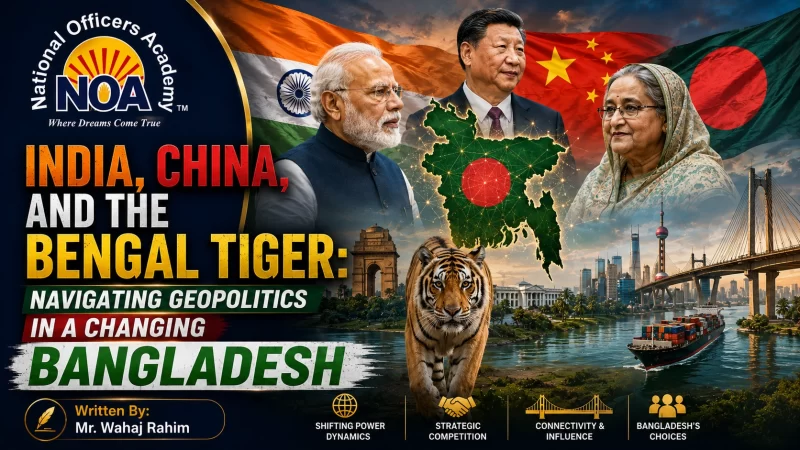
Written by: Mr. Wahaj Rahim
“Bangladesh, since its inception, has witnessed considerable political turmoil. From repeated military interventions to the increasingly authoritarian politics associated with Sheikh Hasina, the people of Bangladesh have experienced nearly every shade of political uncertainty in Dhaka.”
Introduction
Since emerging as an independent state in 1971, Bangladesh has experienced repeated political instability, military interventions and intense competition among political parties.
The country witnessed the assassination of its founding leader, Sheikh Mujibur Rahman, followed by periods of military rule extending from the mid-1970s into the 1990s.
Out of this politically unstable environment emerged Sheikh Hasina, the daughter of Sheikh Mujibur Rahman and leader of the Awami League.
Her long tenure was associated with strong economic growth, infrastructure development and greater regional connectivity. However, it was also criticized for political victimization, restrictions on opposition parties, control over the media and an increasingly authoritarian style of governance.
Some view Sheikh Hasina as the leader who transformed Bangladesh into one of South Asia’s fastest-growing economies. Others remember her as a ruler who weakened democratic institutions and dealt harshly with political opponents.
Following her removal, Bangladesh entered a new political phase in which the interim government must manage domestic instability while balancing relations with India, China and the United States.
Background: From Quota Protests to Political Upheaval
Student protests began over Bangladesh’s public-sector quota system, which reserved a significant number of government positions for the descendants of those recognized as freedom fighters.
The demonstrators demanded the replacement of the quota system with a merit-based recruitment process.
The protests intensified after Sheikh Hasina referred to demonstrators using the politically charged term “Razakars,” historically associated with those accused of supporting Pakistan during Bangladesh’s independence struggle.
Although the Supreme Court later reduced or scrapped major elements of the quota system, the unrest had already expanded beyond the original demand.
The protests became a wider movement against Sheikh Hasina’s government and its handling of political opposition.
According to the article, more than 300 people were killed during the unrest. Mounting public pressure eventually forced Sheikh Hasina to resign and leave Bangladesh for India, which had been her government’s closest regional partner.
What began as a student campaign against employment quotas ultimately resulted in the fall of one of the world’s longest-serving female heads of government.
The interim administration led by Muhammad Yunus now faces the difficult task of preparing for elections, restoring stability and balancing Bangladesh’s relations with competing regional powers.
Sheikh Hasina: A Caped Warrior for the Bengalis?
“Come to Bangladesh to witness what we have done and what we plan to do.” — Sheikh Hasina
Despite criticism of her political conduct, Sheikh Hasina is widely credited with strengthening Bangladesh’s economy and expanding its regional importance.
During her tenure, Bangladesh signed agreements with India on water, land boundaries, energy and regional cooperation.
Her government also reached a peace agreement with tribal insurgents, contributing to greater internal stability.
Sheikh Hasina survived several assassination attempts, including an attack that reportedly affected her hearing. These incidents did not prevent her from continuing her political and economic agenda.
Economic Growth
During much of Sheikh Hasina’s tenure, Bangladesh became one of the fastest-growing economies in South Asia.
The article attributes this progress to an average GDP growth rate of approximately 6.3% over the preceding decade, with particularly strong growth recorded during certain years.
The World Bank estimated that millions of people were lifted out of poverty as Bangladesh’s economy expanded.
The ready-made garments industry played a central role in this transformation by connecting Bangladesh with markets in:
- Europe
- North America
- Asia
- Other major global markets
This industrial expansion attracted foreign investors and helped Bangladesh become one of the world’s leading garment exporters.
Major Infrastructure Projects
Sheikh Hasina’s government invested heavily in infrastructure and connectivity.
Major projects associated with her tenure included:
- The Padma Bridge
- The Teesta water-management initiative
- Energy-sharing projects
- Road and transport infrastructure
- Industrial and economic zones
The Padma Bridge was widely presented as a transformative project capable of improving domestic trade and connectivity.
Social and Agricultural Progress
The article credits Sheikh Hasina’s government with progress in primary-school enrolment, poverty reduction, agricultural production and disaster management.
Bangladesh maintained a strong global position in vegetable production and developed agricultural economic zones to support rural growth.
The government also maintained strategic food reserves during the Russia-Ukraine war to reduce the impact of international supply disruptions.
Improved disaster-management planning contributed to lower casualty rates during monsoon-related emergencies.
Keeping the Military Away from Politics
One of Sheikh Hasina’s major achievements was keeping the military outside the political power structure during her long tenure.
This was particularly significant considering Bangladesh’s history of coups and military rule.
Her government carefully managed senior military appointments to ensure that the armed forces remained subordinate to civilian authority.
Points of Failure and Historical Constructivism
Sheikh Hasina’s political legacy is also marked by serious allegations of authoritarianism and suppression of dissent.
Critics accused her government of using state institutions to weaken opposition parties, particularly the Bangladesh Nationalist Party and Jamaat-e-Islami.
Pressure on Opposition Parties
Her administration was accused of supporting legal proceedings against major opposition figures.
Former Prime Minister Khaleda Zia was imprisoned in 2018 on corruption-related charges, while a senior Jamaat-e-Islami leader was executed in 2016.
Supporters of Sheikh Hasina argued that these actions were part of legal accountability. Critics described them as politically motivated attempts to eliminate opposition.
Weakening of Judicial Independence
The article argues that the judiciary became increasingly vulnerable to political pressure during Sheikh Hasina’s tenure.
One prominent chief justice reportedly left Bangladesh after issuing a ruling that conflicted with the government’s position.
Such incidents contributed to concerns about the separation of powers and judicial independence.
Control of the Media
Sheikh Hasina’s government was also accused of exercising strong influence over mainstream media.
Many major outlets were reportedly owned or controlled by businesses connected with the Awami League.
This allowed the government to promote its preferred national narrative while presenting opposition parties as hostile to Bangladesh’s independence legacy.
Use of Security Forces
The government faced allegations that security institutions, including the Rapid Action Battalion, were used against political opponents and critics.
Human-rights groups accused state agencies of involvement in:
- Arbitrary detention
- Enforced disappearances
- Extrajudicial killings
- Political intimidation
- Suppression of protests
The government was also accused of manipulating elections and restricting meaningful political competition.
The Quota System as a Symbol of Political Favouritism
The continuation of the employment quota system became a major source of dissatisfaction among students.
Many young Bangladeshis viewed it as a political mechanism that benefited groups connected with the ruling party while reducing opportunities based on merit.
When the protests expanded, opposition parties and groups previously targeted by Sheikh Hasina’s government joined the student movement.
Her description of demonstrators as “Razakars” intensified public anger and became a decisive turning point.
Historical Comparisons
The article compares Sheikh Hasina’s political methods with earlier authoritarian leaders who attempted to maintain power through:
- Suppression of opposition
- Control of the media
- Influence over state institutions
- Use of security forces
- Manipulation of electoral processes
History demonstrates that governments relying heavily on coercion and political exclusion often create the conditions for their own downfall.
Sheikh Hasina’s removal therefore reflected both immediate public anger and long-term dissatisfaction with the concentration of political power.
Sheikh Hasina and Delhi: A Close Strategic Partnership
Bangladesh’s political and strategic relationship with India remained particularly close during Sheikh Hasina’s tenure.
India supported Bangladesh’s independence movement in 1971 and maintained strong historical ties with Sheikh Mujibur Rahman and the Awami League.
As the daughter of Bangladesh’s founding leader, Sheikh Hasina viewed India as an important political, economic and security partner.
Major India-Bangladesh Agreements
During her administration, India and Bangladesh signed several important agreements covering:
- Land boundaries
- Energy sharing
- Fuel supplies
- Trade
- Connectivity
- Security cooperation
India also became an important source of investment and political support for Sheikh Hasina’s government.
Delhi was frequently described as a first responder to Bangladesh’s economic and security needs.
The Teesta Project
The Teesta River project became a major point of strategic competition between India and China.
Both countries expressed interest in supporting the project, which was estimated to cost approximately $1 billion.
Despite China’s experience in large infrastructure development, the project was reportedly awarded to India because of the close political relationship between Delhi and Dhaka.
This decision was regarded by some analysts as a strategic victory for India.
The project is located near India’s strategically sensitive Siliguri Corridor, commonly known as the “Chicken’s Neck,” which connects northeastern India with the rest of the country.
India remained concerned that greater Chinese involvement near this corridor could create long-term security risks.
India’s Strategic Objectives
India’s major objectives in Bangladesh included:
- Maintaining a friendly government in Dhaka
- Supporting secular political forces
- Restricting Chinese strategic influence
- Protecting its northeastern region
- Expanding trade and transport connectivity
- Preventing hostile groups from using Bangladeshi territory
India therefore continued supporting Sheikh Hasina despite criticism of her treatment of opposition parties and Jamaat-e-Islami.
A Post-Hasina Bangladesh for India
Sheikh Hasina’s removal created a serious strategic setback for India.
Analyst Michael Kugelman described the development as nearly the worst possible scenario for Delhi, while other observers called it a major geopolitical shift in South Asia.
India strengthened security along its border with Bangladesh and closely monitored political developments in Dhaka.
Delhi’s immediate priorities included protecting existing investments, maintaining regional influence and preventing China from filling the political space created by Sheikh Hasina’s departure.
The political transition weakened India’s ability to rely on a trusted partner in Dhaka.
It also complicated New Delhi’s long-term objective of supporting a secular and India-friendly political order in Bangladesh.
Foreign Powers at Play?
Some observers have argued that foreign powers may have indirectly benefited from Sheikh Hasina’s removal.
From a neorealist perspective, major powers often seek to influence political developments in strategically important countries to protect their interests.
China’s Possible Interests
China was reportedly dissatisfied after the Teesta project was awarded to India.
Greater Chinese involvement in the project could have strengthened Beijing’s strategic and economic position in Bangladesh.
Sheikh Hasina’s close alignment with Delhi limited China’s ability to expand its influence in areas considered sensitive by India.
Her removal therefore created an opportunity for Beijing to rebuild its position in Dhaka.
US Strategic Concerns
The article also suggests that Washington had concerns regarding Sheikh Hasina’s government and India’s growing strategic influence in Bangladesh.
The United States had publicly criticized aspects of Bangladesh’s electoral system, human-rights record and political restrictions.
However, the source article does not provide direct evidence proving that the United States or China organized Sheikh Hasina’s removal.
Claims about external involvement therefore remain matters of interpretation and geopolitical speculation.
“Leading a secular government that Islamists detested, Hasina gave Bangladesh rapid economic growth. But powerful external forces were aligned against her. Her decision to award the Teesta project to India angered China. And sadly, Biden went after her.” — Brahma Chellaney
The Strategic Choices Facing Bangladesh
Bangladesh’s interim government must now manage a complex regional environment.
Its major challenge is to maintain productive relations with India, China and the United States without becoming excessively dependent on any one power.
Relations with India
India remains Bangladesh’s closest geographical neighbour and an important economic and security partner.
Both countries share:
- A long international border
- Rivers and water resources
- Trade routes
- Historical and cultural connections
- Security concerns
- Energy and transport projects
However, growing anti-India sentiment among sections of the Bangladeshi public may make the relationship more difficult to manage.
Relations with China
China is a major investor in Bangladeshi infrastructure and an important source of technology, trade and development financing.
Beijing may seek to expand its role in:
- Ports
- Transport infrastructure
- Energy projects
- Defence cooperation
- Water-management projects
- Industrial development
Bangladesh can benefit from Chinese investment, but excessive dependence may expose it to strategic pressure.
Relations with the United States
The United States remains an important destination for Bangladeshi exports and a major source of diplomatic influence.
Washington is likely to focus on:
- Democratic elections
- Human rights
- Labour standards
- Regional security
- Indo-Pacific strategy
- Limiting Chinese influence
The interim government must therefore maintain balanced relations with Washington while protecting Bangladesh’s political independence.
Protecting Bangladesh’s Economic Progress
Political instability must not be allowed to undermine the economic progress achieved over the previous two decades.
Bangladesh’s next government should prioritize:
- Protection of the garment industry
- Investor confidence
- Political stability
- Independent institutions
- Transparent elections
- Infrastructure development
- Employment generation
- Poverty reduction
The country must also prevent political conflict from disrupting international supply chains and export markets.
Continued economic growth will depend on whether Bangladesh can combine democratic reform with stable governance.
Conclusion
The removal of Sheikh Hasina was the result of both immediate unrest and accumulated dissatisfaction with her government’s treatment of opposition parties, students and critics.
Her political legacy remains deeply contested.
Supporters will remember her for economic growth, infrastructure development, poverty reduction and keeping the military outside politics.
Critics will remember allegations of authoritarianism, electoral manipulation, media control and the suppression of dissent.
Bangladesh’s interim leadership must now prevent political revenge from replacing meaningful reform.
It must organize credible elections, strengthen democratic institutions and protect the economic achievements of recent years.
At the international level, Bangladesh must carefully balance its relations with India, China and the United States.
The country should avoid becoming a battleground for competing powers and ensure that all foreign partnerships serve its national interests.
The future of the Bengal Tiger will depend on whether its leaders can combine political stability, democratic accountability and strategic independence in a rapidly changing regional order.