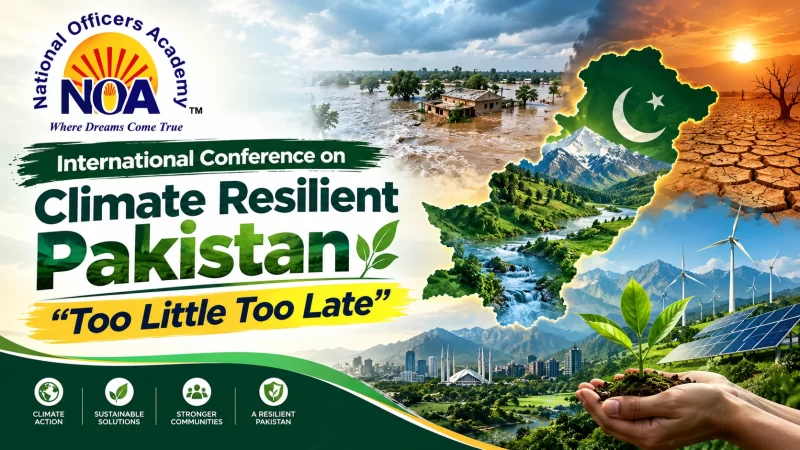
International Conference on Climate Resilient Pakistan
“Too Little, Too Late”
Pakistan has long been regarded as one of the countries highly vulnerable to the impacts of climate change despite contributing comparatively little to global greenhouse-gas emissions.
The devastating floods of 2022 exposed this vulnerability on an extraordinary scale. Beginning in June 2022, torrential monsoon rains combined with riverine, urban and flash flooding to create one of the worst climate-related disasters in Pakistan’s history.
More than 33 million people were affected, over 1,730 people lost their lives, around two million housing units were damaged or destroyed, and thousands of schools and health facilities were affected.
The disaster also worsened existing problems of poverty, food insecurity, health vulnerability and economic instability.
The provinces suffering the greatest damage included:
- Sindh
- Balochistan
- Khyber Pakhtunkhwa
- Punjab
Housing, agriculture and livestock, and transport and communications were among the sectors suffering the most extensive damage.
The Geneva Conference on Climate Resilient Pakistan
On January 9, 2023, the Government of Pakistan and the United Nations jointly hosted the International Conference on Climate Resilient Pakistan in Geneva.
The conference was organised in response to the unprecedented devastation caused by the 2022 floods and sought to mobilise international support for Pakistan’s recovery, rehabilitation and reconstruction.
The conference brought together governments, international financial institutions, development agencies and other stakeholders.
Its central objective was not merely to reconstruct damaged infrastructure, but to ensure that reconstruction itself would make Pakistan more resilient to future climate shocks.
Post-Disaster Needs Assessment
The Government of Pakistan, with support from international development partners, conducted a Post-Disaster Needs Assessment to estimate the scale of the destruction and determine the resources required for reconstruction.
The assessment estimated:
- More than $14.9 billion in physical damages
- Approximately $15.2 billion in economic losses
- At least $16.3 billion required for resilient rehabilitation and reconstruction
The combined impact demonstrated that Pakistan’s recovery challenge extended far beyond immediate humanitarian relief.
Long-term reconstruction required a framework capable of rebuilding infrastructure, restoring livelihoods and strengthening resilience against future climate disasters.
What is the 4RF?
The Resilient Recovery, Rehabilitation and Reconstruction Framework, commonly referred to as the 4RF, was developed as the strategic policy framework for Pakistan’s post-flood recovery.
The framework was prepared following the Post-Disaster Needs Assessment and was designed to guide the reconstruction process in a way that reduces future vulnerability.
The 4RF provides a comprehensive structure for:
- Recovery
- Rehabilitation
- Reconstruction
- Climate resilience
- Institutional coordination
- Financing
- Monitoring and evaluation
The framework represents an attempt to move beyond simply rebuilding what was destroyed.
Instead, it promotes a “build back better” approach in which reconstructed infrastructure, communities and institutions are better prepared to withstand future climate shocks.
Purpose of the 4RF
The framework aims to provide a foundation for long-term resilience to natural hazards and climate change.
Its broader objectives include:
- Restoring damaged infrastructure
- Rehabilitating flood-affected communities
- Protecting vulnerable populations
- Strengthening disaster preparedness
- Improving institutional capacity
- Supporting climate-resilient development
- Preventing long-term developmental losses
Pakistan proposed financing a significant portion of the reconstruction requirements domestically while seeking international assistance for the remaining needs.
Goals of the Conference
The Geneva conference had two major objectives.
1. Present the 4RF to the International Community
The first objective was to formally present Pakistan’s Resilient Recovery, Rehabilitation and Reconstruction Framework.
The framework outlined a multi-sectoral strategy for rebuilding affected areas in an inclusive and climate-resilient manner.
2. Mobilise International Financial Support
The second major objective was to secure financial commitments and establish long-term international partnerships for Pakistan’s recovery and climate adaptation.
The conference therefore served as both a reconstruction platform and a climate-finance initiative.
UN Support for Pakistan
UN Secretary-General António Guterres strongly appealed to the international community to support Pakistan’s reconstruction and climate-resilience efforts.
He emphasised the need for large-scale investment in:
- Rebuilding homes
- Restoring infrastructure
- Reviving agriculture
- Creating employment
- Improving access to technology
- Strengthening resilience against future disasters
The UN also highlighted the wider issue of climate justice, noting that countries facing some of the gravest climate impacts often have comparatively limited responsibility for global emissions.
Pakistan’s Position at the Conference
Pakistan’s leadership used the conference to highlight the extraordinary humanitarian and economic consequences of the floods.
The government presented the 4RF as its central strategy for rebuilding affected areas while increasing long-term climate resilience.
Pakistan also emphasised that climate-vulnerable developing countries require greater access to international financial support to address disasters that exceed their domestic fiscal capacity.
Outcomes of the Conference
The conference marked the beginning of a structured international process to support Pakistan’s recovery.
Participants announced financial commitments exceeding $9 billion from bilateral and multilateral partners for Pakistan’s recovery, rehabilitation and reconstruction efforts.
The commitments demonstrated substantial international support, although an important distinction remained between grants, concessional financing and project loans.
The conference therefore provided Pakistan with significant financial commitments, but the effectiveness of this support depended on how quickly funds were operationalised and how effectively projects were implemented.
Major Action Points
The conference identified several important areas for future action.
1. Develop Detailed Recovery Plans
Pakistan was expected to translate the broad priorities of the 4RF into specific reconstruction projects and implementation plans.
This included identifying projects, financing requirements, timelines and responsible institutions.
2. Link Immediate Recovery with Long-Term Reconstruction
The recovery process was intended to move gradually from emergency humanitarian assistance towards sustainable reconstruction.
This required ensuring that short-term relief measures supported, rather than undermined, long-term climate resilience.
3. Adopt an Inclusive Whole-of-Pakistan Approach
Recovery efforts were expected to involve:
- Federal institutions
- Provincial governments
- Local communities
- International development partners
- Civil society
- Private-sector stakeholders
Such participation is important because climate resilience cannot be developed through central government action alone.
4. Develop a Long-Term Resilience Framework
Pakistan needs to move beyond disaster response towards long-term climate adaptation.
This requires investment in:
- Flood protection
- Climate-resilient agriculture
- Water management
- Early-warning systems
- Resilient infrastructure
- Urban planning
- Disaster preparedness
5. Improve Institutional Capacity
Effective climate financing requires strong institutions capable of preparing viable projects and efficiently managing international resources.
Institutional capacity is therefore essential to turn financial pledges into actual reconstruction projects.
6. Strengthen Monitoring and Transparency
Effective monitoring and evaluation mechanisms are necessary to ensure that funds reach intended projects and communities.
Transparency is particularly important because large-scale reconstruction involves substantial domestic and international financing.
Monitoring mechanisms should track:
- Funding commitments
- Disbursement
- Project implementation
- Geographical distribution
- Benefits to affected communities
- Long-term resilience outcomes
Myths and Realities of International Climate Support
The Geneva conference was widely regarded as an important diplomatic success because Pakistan received commitments exceeding its initial expectations.
However, financial pledges should not automatically be equated with immediately available reconstruction funds.
A substantial share of international financing may come through project loans, concessional lending or repurposed development financing rather than direct grants.
This creates several challenges.
- Projects must first be prepared and approved
- Funds may be released gradually
- Some financing may increase public debt
- Strong implementation capacity is required
- Monitoring is necessary to prevent delays or misallocation
Therefore, the ultimate success of the Geneva conference depends not simply on the size of pledges but on the effectiveness of their conversion into real climate-resilient development.
Climate Justice and Pakistan
Pakistan’s flood disaster strengthened global debate over climate justice.
The fundamental argument is that countries contributing comparatively little to historical greenhouse-gas emissions can nevertheless experience disproportionately severe climate impacts.
For developing countries, such disasters create a difficult financial dilemma.
They must simultaneously finance:
- Disaster relief
- Infrastructure reconstruction
- Climate adaptation
- Poverty reduction
- Debt servicing
- Economic development
This is why access to international climate finance has become an increasingly important issue for countries such as Pakistan.
Loss and Damage Fund
One of the major developments in international climate diplomacy was the agreement at COP27 to establish funding arrangements addressing climate-related loss and damage.
For Pakistan and other climate-vulnerable countries, loss-and-damage financing represents an important mechanism for addressing destruction that cannot be prevented through mitigation or adaptation alone.
Pakistan therefore has a strong interest in supporting effective and accessible international mechanisms for financing climate-related losses.
Suggestions for a Climate-Resilient Pakistan
1. Ensure Effective Use of International Financing
Financial commitments will have limited impact unless Pakistan develops strong mechanisms for project selection, implementation and oversight.
Funds should be directed towards projects capable of producing measurable resilience benefits.
2. Strengthen Monitoring and Evaluation
Pakistan should establish transparent systems for monitoring reconstruction expenditure.
Public reporting can strengthen both domestic trust and international confidence.
3. Focus on Climate Adaptation
Future policies must increasingly focus on adapting to climate risks that can no longer be avoided.
Key areas include:
- Flood-resistant infrastructure
- Improved drainage
- Climate-resilient housing
- Drought-resistant agriculture
- Water storage
- Early-warning systems
- Heatwave preparedness
4. Strengthen Local Communities
Climate resilience ultimately depends on communities.
Local governments and community organisations should be actively involved in planning and implementing adaptation projects.
Local participation improves the likelihood that projects respond to actual needs.
5. Integrate Climate Change into Development Planning
Climate policy should not remain separate from mainstream economic planning.
Infrastructure, agriculture, energy, housing and urban development policies should all incorporate climate-risk assessments.
6. Strengthen Renewable Energy Development
Expansion of solar, wind and other renewable energy sources can improve both energy security and climate resilience.
Reduced dependence on imported fossil fuels could also improve Pakistan’s external economic position.
7. Improve Water Governance
Pakistan faces both floods and water scarcity.
Climate-resilient water management therefore requires better storage, drainage, irrigation efficiency and watershed management.
8. Sustain International Climate Diplomacy
Pakistan should continue working with climate-vulnerable developing countries to advocate greater access to adaptation finance and loss-and-damage support.
Climate diplomacy should remain linked to practical national projects that demonstrate how international financing can reduce future risks.
Too Little, Too Late?
The Geneva conference represented an important demonstration of international solidarity with Pakistan.
However, Pakistan’s climate vulnerability cannot be addressed through one conference, one reconstruction package or one round of international pledges.
The deeper challenge is transforming a disaster-response model into a permanent system of climate resilience.
If international commitments are delayed, if reconstruction simply restores vulnerable infrastructure, or if climate adaptation remains underfunded, the country may once again face catastrophic losses from future climate shocks.
The phrase “too little, too late” therefore captures the central concern surrounding global climate action.
Recovery after a disaster is necessary, but preventive investment in climate resilience is ultimately more effective than repeatedly rebuilding after destruction.
Conclusion
The International Conference on Climate Resilient Pakistan was an important milestone in Pakistan’s post-flood recovery and its wider climate diplomacy.
The conference launched the 4RF, mobilised substantial international financial commitments and established a framework for long-term reconstruction and resilience.
Yet the true measure of success lies beyond the conference itself.
Pakistan must translate international commitments into transparent, climate-resilient projects while simultaneously reforming domestic institutions responsible for disaster management, infrastructure, water, agriculture and urban development.
The international community also has an important role in ensuring that climate-vulnerable countries gain adequate access to adaptation and loss-and-damage finance.
Pakistan’s experience demonstrates a wider lesson for the world: waiting until climate disasters occur and then financing reconstruction is neither economically efficient nor morally sufficient.
The real objective must be to build resilience before the next disaster arrives.