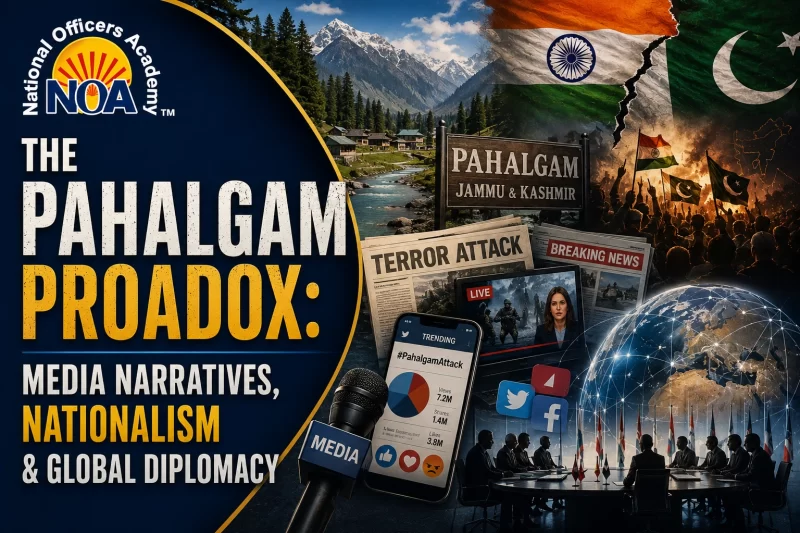
The Pahalgam Attack: A Disputed Tragedy
The attack in Pahalgam, a well-known tourist destination in Indian-administered Jammu and Kashmir, reignited tensions between India and Pakistan. It also triggered a wave of accusations, counterclaims, media narratives, and geopolitical manoeuvring.
The incident took place on the afternoon of 22 April 2025 and targeted a large group of tourists, creating widespread confusion and controversy.
Pahalgam is located approximately 300 kilometres from the Line of Control and is surrounded by difficult terrain, including high mountains and deep gorges. The region is also heavily militarised and monitored by a large number of Indian security personnel.
These circumstances have raised questions about the immediate allegations against Pakistan-based organisations, particularly Lashkar-e-Taiba. Critics argue that carrying out such a coordinated attack in a remote and heavily monitored area would involve serious logistical challenges.
Indian authorities have historically blamed Pakistan-based groups for attacks inside India, sometimes before presenting detailed evidence. The Pahalgam incident appeared to follow a similar pattern, as accusations against Pakistan emerged before a transparent investigation had been completed.
The Indian media quickly repeated these allegations and linked the attack to Pakistan. However, such narratives often overlook the operational challenges involved and the possibility of other internal, political, or security-related factors.
The article argues that the initial narrative may be too simplistic and that all possible motives and actors should be examined through an independent and evidence-based investigation.
India’s Media Narrative and Political Ideology
One of the most noticeable features of the Pahalgam incident was the speed with which sections of the Indian media shaped the public narrative.
Several media outlets closely aligned with the ideology of the ruling Bharatiya Janata Party and the broader Hindutva movement linked the attack to Pakistan and presented it as part of a wider terrorist conspiracy.
Some reports also claimed that the attackers specifically targeted Hindu tourists and verified their religious identities before carrying out the killings.
These allegations were highly serious, but critics argued that they were based more on speculation than publicly verified evidence. The absence of a transparent presentation of forensic findings created further doubts about the certainty of the claims.
The Indian government’s response also appeared closely linked with domestic politics. By presenting Pakistan as the main threat to India’s security, the government reinforced its broader nationalist message.
This approach supports the political image of India as a victim of terrorism while also presenting the government as strong, decisive, and militarily capable.
Portraying Pakistan as the central enemy can also help consolidate support among nationalist voters and divert attention from internal challenges such as economic pressure, social unrest, unemployment, and political criticism.
The absence of publicly available evidence and the speed of the accusations have led some observers to question whether the incident was being used for political purposes.
India has previously used incidents such as the 2001 Parliament attack and the 2016 Uri attack to mobilise domestic support and justify strong security responses.
In the Pahalgam case, premature accusations and limited public evidence have created concerns about the credibility of the official narrative.
Global Reactions and Calls for De-escalation
While India continued to accuse Pakistan of involvement in the Pahalgam attack, the international community largely called for restraint and de-escalation.
The United States expressed concern about the possibility of a broader conflict. Vice President J.D. Vance, who was visiting India at the time, urged New Delhi to avoid actions that could lead to further regional instability.
European Union foreign policy chief Kaja Kallas also emphasised that escalation would benefit no one and encouraged diplomatic efforts to manage the crisis.
These international calls for restraint reflect the serious risks associated with conflict between India and Pakistan, both of which possess nuclear weapons.
The global community is already dealing with major crises, including the war in Ukraine and the humanitarian situation in Gaza. There is little international support for another dangerous confrontation in South Asia.
Many countries therefore avoided fully endorsing India’s accusations and instead encouraged both sides to participate in dialogue and seek a peaceful resolution.
Pakistan denied any involvement in the attack and called for a joint or independent investigation to determine the facts.
Islamabad also communicated its position to international partners, including Gulf countries and other important diplomatic actors.
Pakistani media outlets generally responded with greater restraint, expressing sympathy for the victims while calling for calm, investigation, and a measured response.
The contrast between Pakistan’s restrained public messaging and the more aggressive tone of some Indian media outlets attracted international attention.
India’s Domestic and International Positioning
India’s strong response to the Pahalgam incident must also be understood within its domestic political environment.
With important state elections approaching, including elections in Bihar, the BJP government faced pressure to demonstrate strength against Pakistan and protect India’s national interests.
The party’s political base is strongly influenced by Hindu nationalist sentiment. This creates pressure on the government to respond firmly to any incident presented as an attack connected to Pakistan.
Such domestic pressure could encourage military or diplomatic escalation even without conclusive evidence.
A forceful response may satisfy nationalist supporters, but it also risks increasing tensions and creating instability across the region.
Internationally, India’s efforts to isolate Pakistan appeared to receive limited support.
This represented a shift from earlier periods when accusations against Pakistan were often accepted more readily by Western governments.
The lack of publicly available evidence weakened India’s diplomatic position and led many countries to encourage negotiation rather than confrontation.
The international response also reflected growing recognition of the dangers of escalation between two nuclear-armed states.
The Risk of Escalation and the Need for Diplomacy
The growing risk of escalation following the Pahalgam attack demonstrates the urgent need for diplomatic engagement.
A conflict between India and Pakistan would not remain limited to the two countries. It would threaten regional security, global stability, international trade, and millions of civilians.
One of the greatest obstacles to resolving the crisis is the deep mistrust between India and Pakistan.
This mistrust has been shaped by decades of territorial disputes, military confrontations, political hostility, and accusations of terrorism.
Breaking this cycle requires both countries to commit to dialogue, investigation, and negotiation.
The United States, European Union, Gulf countries, China, and other international actors can play an important role in encouraging both sides to reduce tensions.
These countries can support direct talks and help create an environment in which military confrontation becomes less likely.
The United Nations Security Council also has a role to play because aggressive rhetoric and military escalation in South Asia pose a threat to international peace and security.
The Council should encourage both countries to share evidence, support an impartial investigation, and avoid actions that could worsen the crisis.
Key Points to Consider
Questions Surrounding the Allegations
The immediate attribution of the attack to Pakistan-based organisations raised concerns because of the difficult terrain, distance from the Line of Control, and strong Indian security presence in the area.
These factors highlight the importance of a detailed investigation before assigning responsibility.
Need for Credible Evidence
Public accusations should be supported by verifiable evidence, including forensic findings, intelligence records, security footage, witness statements, and other material that can be independently examined.
Without such evidence, official claims remain open to question.
Political Use of the Incident
The timing of the attack and the rapid political response have led critics to argue that the incident could be used to support domestic and geopolitical objectives.
The BJP may use the crisis to reinforce its narrative of Pakistan as a permanent security threat.
Religious and Nationalist Media Coverage
Some Indian media outlets linked the incident with religious identity and claimed that Hindu tourists were specifically targeted.
Such claims should not be treated as established fact without verified evidence.
Inflammatory religious narratives can increase social tension and create hostility against minority communities.
International Support for De-escalation
The United States, European Union, and other international actors called for restraint and warned against military escalation.
Their response demonstrated a clear preference for dialogue and regional stability.
Global Priorities and Regional Stability
The international community is already focused on other major conflicts and humanitarian crises.
Major powers therefore have a strong interest in preventing another conflict in South Asia.
India’s Domestic Political Pressure
Upcoming elections and nationalist political pressure may influence the Indian government’s response.
This could encourage a forceful policy even before all evidence has been examined.
India’s Limited Success in Isolating Pakistan
India’s diplomatic efforts to isolate Pakistan appeared to gain limited international support.
Most major powers encouraged restraint rather than endorsing military action.
China’s Concern Over Regional Conflict
China has traditionally maintained close relations with Pakistan, but it also has strong economic and strategic interests in regional stability.
Chinese officials have therefore expressed concern about the possibility of conflict between India and Pakistan.
A Diplomatic Opportunity
The lack of publicly verified evidence creates an opportunity for both countries to support an independent investigation and direct dialogue.
The United Nations and other international platforms can help encourage transparency and prevent further escalation.
Conclusion: The Path Toward Peace and Diplomacy
The Pahalgam attack once again exposed the fragile nature of South Asian geopolitics and the volatile relationship between India and Pakistan.
The immediate rush to blame Pakistan without presenting publicly verified evidence increased mistrust and hostility.
However, international calls for restraint provide an opportunity for peaceful crisis management.
Both countries must recognise that further escalation would harm their own people, weaken their economies, and destabilise the wider region.
Diplomatic engagement, transparent investigation, and mutual restraint offer the only sustainable path forward.
The legacy of leaders such as Atal Bihari Vajpayee and Dr Manmohan Singh demonstrates that meaningful progress is possible when dialogue replaces confrontation.
In the end, lasting peace will come through diplomacy, not conflict.
The decisions taken by India and Pakistan in the aftermath of the Pahalgam attack will shape the future of South Asia for years to come.