Written By: Ms. Zoya Anwar
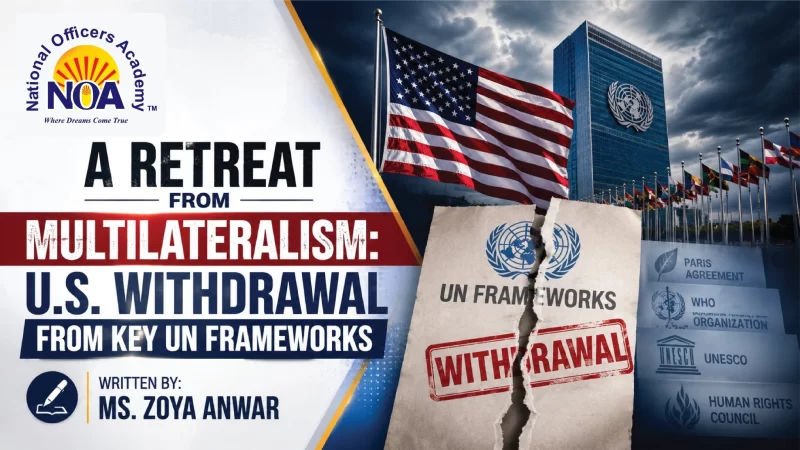
A Retreat from Multilateralism: U.S. Withdrawal from Key UN Frameworks
As of 2025, America appears to be undergoing a shift from its traditional role as the architect and guarantor of the liberal international order since 1945 toward a more unilateral and state-centric foreign policy approach. This transition marks a departure from the Wilsonian ideals of collective security, international cooperation, and the promotion of democratic norms through multilateral institutions that have long shaped American global leadership.
The current governance policy of America is based on President Donald Trump’s nationalist doctrine. The well-known “America First” policy prioritizes U.S. sovereignty, economic self-reliance, and strategic autonomy. However, this policy reflects a disproportionate tilt away from international cooperation. This is evident in Donald Trump’s approach toward multilateral treaties and international organizations. The President views them not as platforms for collective global governance but as constraints on America, whether in terms of monetary commitments to international financial institutions, military guarantees to strategic partners, or broader policymaking autonomy.
President Donald Trump’s strategic goals include restoring U.S. economic dominance through protectionist and nationalist economic policies and asserting national sovereignty over foreign policy decisions. More importantly, he has prioritized bilateral agreements over multilateral frameworks. America’s current policies appear to be moving toward reducing financial and political commitments to international institutions, all in an attempt to “Make America Great Again.”
From Episodic Withdrawal to Institutional Retrenchment
This separation from multilateral agreements is not new. During his first tenure, Trump demonstrated a clear pattern of disengagement from multilateral agreements and institutions, including the Paris Climate Agreement, World Health Organization (WHO), UN Human Rights Council, and the Joint Comprehensive Plan of Action (JCPOA).
As of 2025, Donald Trump’s return to the presidency marks not merely a continuation but an intensification of his earlier multilateral disengagement strategy. Unlike his first term, when withdrawals appeared episodic, his second presidency reflects a more coherent doctrine of institutional retrenchment targeting climate governance, global health institutions, development frameworks, and UN-linked cooperative regimes.
Withdrawal from the Paris Agreement and the Retreat from Global Climate Governance
The Paris Agreement, adopted in 2015 under the United Nations Framework Convention on Climate Change (UNFCCC), is one of the most significant multilateral efforts to combat global warming. Nearly every country in the world, accounting for more than 98 percent of global greenhouse-gas emissions, agreed to pursue ambitious climate goals, including limiting the increase in global average temperature to well below 2°C above pre-industrial levels while pursuing efforts to limit it to 1.5°C.
Signatories also agreed to establish national climate plans through Nationally Determined Contributions (NDCs) and undertake regular reporting to track progress.
However, as of January 2026, the United States officially withdrew from the Paris Agreement for the second time under Executive Order 14162, titled “Putting America First in International Environmental Agreements.” The executive action represented a renewed effort to dismantle what the administration viewed as costly and restrictive international environmental commitments.
It is important to note that the United States is one of the world’s largest historical contributors to climate pollution. Its withdrawal from the agreement therefore marks a major shift in U.S. climate policy.
Leadership and Climate-Finance Consequences
Under Article 28 of the Paris Agreement, withdrawal does not take effect immediately; a party must notify the United Nations and wait one year before its exit becomes legally effective. This process culminated on January 27, 2026, when the United States ceased to be a member of the agreement and no longer had obligations to submit climate plans or participate in formal review mechanisms.
The U.S. withdrawal from the Paris Agreement carries several practical and symbolic consequences. First, its departure creates a leadership gap. The United States has historically been one of the largest emitters and has played a major role in shaping global climate policy. With Washington absent, other powers, particularly the European Union and China, have greater space to influence international climate governance.
Another important consequence concerns climate financing. The United States had committed significant funding to international initiatives, including contributions to the Green Climate Fund. The cancellation of such commitments reduces support available to vulnerable nations attempting to adapt to climate change at a time when scientists continue to warn about critical climate tipping points.
Beyond the Paris Agreement, the Trump administration has also begun reducing U.S. participation in the Green Climate Fund, UN environmental programs, and other climate-adaptation financing initiatives. Washington argues that such programs transfer American taxpayer funds to foreign governments, benefit competitors more than the United States, and provide limited direct national benefit.
This reflects a broader shift from a global public goods model toward a national-interest cost-benefit model.
Critics warn that withdrawal undermines international cooperation at a critical moment. Climate advocates argue that American disengagement could encourage other countries to weaken their own commitments, thereby slowing collective progress toward shared climate goals.
Withdrawal from the World Health Organization and Global Health Governance
Building on concerns about weakening collective resolve, the United States’ withdrawal from the World Health Organization reflects a broader pattern of retreat from multilateral institutions. Just as critics argue that exiting the Paris Agreement risks encouraging other nations to dilute their climate commitments, stepping back from the WHO raises similar concerns in the realm of global public health.
Established in 1948, the WHO serves as the central coordinating authority on international health within the United Nations system. It leads international efforts involving disease surveillance, emergency response, vaccination campaigns, and pandemic preparedness.
The United States has historically been one of the largest financial contributors to the WHO, providing both assessed contributions and substantial voluntary funding for programs involving polio eradication, HIV/AIDS prevention, maternal health, and emergency response operations.
COVID-19 and the Renewal of U.S.–WHO Tensions
Tensions between the U.S. government and the WHO intensified during the COVID-19 pandemic, when concerns were raised about the organization’s early response and its relationship with member states. Although the Trump administration announced U.S. withdrawal in 2020, that decision was reversed in 2021 under President Joe Biden, restoring membership and financial commitments.
Following the political transition in 2025, the United States once again initiated withdrawal procedures from the WHO. Under U.S. law and international practice, withdrawal requires formal notification and the settlement of outstanding financial obligations. By the end of 2025, the process had effectively reduced U.S. participation in WHO decision-making bodies and suspended new funding commitments.
The United States has justified this move by citing concerns over the perceived lack of institutional reforms within the WHO, allegations of inefficiency and politicization, and a desire to prioritize domestic health sovereignty over multilateral coordination.
Financial and Pandemic-Preparedness Consequences
The consequences of withdrawal are wide-ranging. First and foremost is the financial impact. The United States has historically accounted for a significant share of the WHO’s budget. Reduced funding can affect programs in low-income countries, including vaccination campaigns, malaria control, tuberculosis treatment, and emergency health responses.
U.S. disengagement from the WHO may also influence global pandemic-preparedness frameworks. The organization plays a central role in coordinating international responses under the International Health Regulations (IHR). Disengagement may limit information-sharing mechanisms and reduce American influence in shaping global preparedness frameworks.
As with the Paris Agreement, withdrawal from the WHO potentially creates a leadership vacuum, allowing other major powers to exert greater influence in setting global health priorities and standards.
When viewed alongside the withdrawal from the Paris Agreement, the exit from the WHO reflects broader scepticism toward multilateral institutions. The interconnection between climate change and public health is undeniable: rising temperatures contribute to the spread of infectious diseases, food insecurity, and health displacement. In both domains, critics argue that global challenges require coordinated international responses.
Disengagement from the United Nations Population Fund
Extending this broader retreat from multilateral engagement, the United States’ withdrawal from the United Nations Population Fund (UNFPA) represents another significant shift in its international development and human-rights policy.
UNFPA was established in 1969 and serves as the United Nations’ reproductive health and population agency, with a major focus on maternal health, safe childbirth, and the prevention of gender-based violence, among other issues.
Although the United States has periodically suspended funding to UNFPA under previous administrations, the 2025–2026 policy shift involved broader and more formal disengagement from the agency as part of the administration’s review of international organizations.
The withdrawal has been justified on the grounds of policy differences related to reproductive health. However, it also reflects the administration’s broader scepticism toward UN-affiliated institutions.
Funding Shortfalls and Reduced U.S. Influence
Withdrawal from UNFPA is expected, first and foremost, to create funding shortfalls. This may affect reproductive health services provided in refugee camps and disaster-affected areas.
As with the WHO and Paris Agreement, U.S. disengagement also reduces Washington’s influence over policy priorities, governance standards, and reform discussions within the organization. Other donor states may consequently gain greater leverage in shaping UNFPA’s strategic direction.
A Broader Transformation of Multilateral Governance
Together, U.S. withdrawals from the United Nations Population Fund, the World Health Organization, and the Paris Agreement represent a larger shift in American involvement in multilateral governance rather than merely a series of discrete policy reversals.
These organizations deal with issues that inherently transcend national boundaries, including reproductive and humanitarian health, climate change, and global health security. American disengagement therefore changes not only U.S. foreign policy but also the structure of international collaboration.
The overall effect on the world is substantial. Financially, the removal of one of the world’s largest contributors creates funding shortfalls that can have an immediate impact on emergency humanitarian operations, immunization programs, maternal health services, and climate-mitigation projects.
Diplomatically, reduced U.S. involvement changes the balance of power within international organizations, potentially creating space for other significant actors to assume greater leadership roles. Normatively, it may weaken the shared expectation that major powers will collectively shoulder responsibility for global public goods, further feeding what can be described as the leviathan of global anarchy.
Could Fragmented Governance Replace Global Consensus?
The international system could evolve in several ways. Other nations may increase their efforts to fill the leadership vacuum, particularly the European Union and developing countries. Multilateral institutions may also undertake reform initiatives to diversify their donor bases and restore institutional legitimacy.
On the other hand, regional blocs and bilateral agreements could gradually replace broad frameworks of global consensus as the world moves toward increasingly fragmented governance systems.
Subnational actors, including states, cities, academic institutions, and civil-society organizations, are also likely to continue cooperating across national boundaries, helping mitigate some of the effects of federal disengagement. Global disease-surveillance systems, humanitarian collaborations, and climate innovation can continue to operate beyond formal treaty frameworks.
The Debate over Selective American Internationalism
Critics further argue that withdrawing funds from global climate and health bodies in the name of fiscal restraint appears inconsistent when the United States continues major military and financial support to Israel during its operations in Palestine. They characterize these actions as violations of human-rights norms and argue that this contrast has intensified accusations of hypocrisy in America’s human-rights rhetoric.
Conclusion
Ultimately, the direction the world takes will depend not only on U.S. policy but also on how the international community adapts. It remains unclear whether the current period represents a short-term realignment or a long-term transformation of global governance.
What is clear, however, is that in an era of interconnected environmental, epidemiological, and humanitarian challenges, the extent of multilateral cooperation will play a major role in determining the course of global stability in the coming decades.