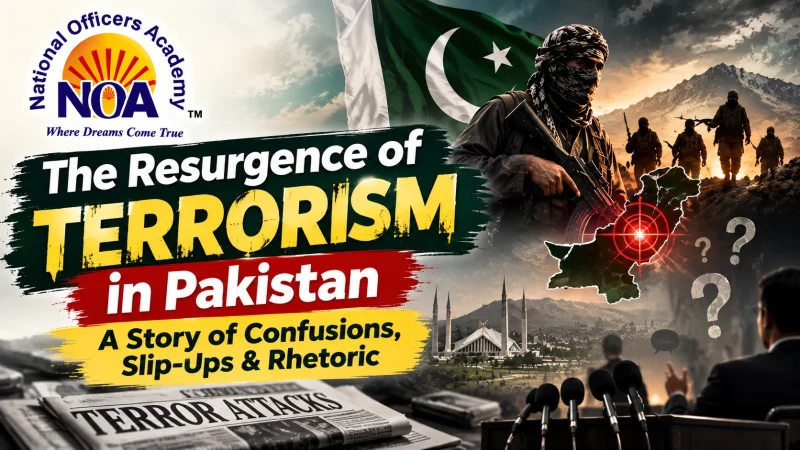
The Resurgence of Terrorism in Pakistan
A Story of Confusions, Slip-Ups & Rhetoric
Since the Tehreek-e-Taliban Pakistan (TTP) cancelled its ceasefire and ordered its fighters to resume attacks across the country, Pakistan has witnessed a significant resurgence of terrorism.
The renewed wave of militant violence brought the fragility of Pakistan’s earlier counter-terrorism gains into sharp focus. The political and security environment changed considerably after the Afghan Taliban returned to power in Kabul in August 2021.
A significant section of Pakistani society, including some mainstream political figures, initially viewed the Taliban takeover as a development that could potentially bring stability to neighbouring Afghanistan. The expectation was that stability across Pakistan’s western border could have positive implications for Pakistan’s own security.
Islamabad, however, did not formally recognise the Taliban’s provisional administration. Instead, Pakistan began reassessing its policy along the western frontier while attempting to address the presence of TTP militants and their sanctuaries in Afghanistan.
Pakistan sought cooperation from the Taliban authorities against the TTP. Kabul, instead of directly confronting the organisation, facilitated negotiations between the Pakistani government and the TTP.
The subsequent ceasefire arrangements failed to produce sustainable peace. The TTP eventually announced the resumption of attacks inside Pakistan, while Khyber Pakhtunkhwa once again became a major centre of militant violence.
Pakistan appeared to be caught in a security quagmire: facing renewed terrorism at home while simultaneously dealing with increasingly complicated relations with Afghanistan.
Factors Behind the Resurgence of Terrorism
1. Loopholes in Pakistan’s Afghan Policy
One of the major arguments surrounding the resurgence of terrorism concerns Pakistan’s previous Afghan policy.
The article argues that Pakistan’s approach towards the Afghan Taliban failed to sufficiently account for the possibility that their return to power could strengthen militant organisations sharing ideological, operational and historical links with them.
Consequently, developments in Afghanistan had direct repercussions for Pakistan’s internal security environment.
2. Taliban’s Return to Power — A Boost to the TTP
The return of the Afghan Taliban to power had a rejuvenating effect on the TTP.
The TTP viewed the Taliban victory as a source of ideological and strategic encouragement. The two organisations have longstanding battlefield, political, ethnic and ideological linkages.
Instead of directly taking action against the TTP, the Taliban authorities largely presented the organisation as an internal Pakistani matter and offered to facilitate negotiations between Islamabad and the militant group.
This environment provided the TTP with greater confidence and contributed to its organisational revival.
3. Policy of Appeasement
Another factor identified behind the resurgence of terrorism was Pakistan’s decision to engage in negotiations with the TTP.
Critics argued that the negotiations gave the organisation time and space to recuperate, reorganise and expand its network.
The first major attempt after the Taliban takeover came in 2021, but the one-month truce ended when the TTP resumed attacks.
A second attempt was made in 2022. It resulted in an indefinite ceasefire in June and the beginning of a formal peace process.
However, negotiations soon reached a deadlock because both sides maintained incompatible positions on several issues, particularly the status of the former FATA region and its merger with Khyber Pakhtunkhwa.
The TTP demanded reversal of the merger, while the Pakistani state refused to accept the demand.
The process ultimately collapsed on November 28, 2022, when the TTP ended the ceasefire and directed its fighters to resume attacks across Pakistan.
The article argues that Pakistan’s previous peace agreements with militant organisations similarly failed to produce sustainable peace and, in several cases, were followed by renewed violence.
4. Border Fencing Did Not Yield the Expected Results
The decline in militant violence between roughly 2015 and 2020 created a perception that Pakistan had largely overcome its terrorism challenge.
The fencing of the approximately 2,640-kilometre Pakistan-Afghanistan border was also expected to significantly reduce infiltration and the cross-border movement of militants.
However, subsequent developments demonstrated that physical fencing alone could not eliminate the threat.
The TTP continued to demonstrate an ability to conduct cross-border operations and maintain networks connected with Afghanistan.
The experience highlighted an important counter-terrorism lesson: the temporary absence of violence should not automatically be interpreted as the permanent restoration of peace.
5. Merger of Terrorist Factions
Inter-group alliances and mergers can significantly increase the resilience and operational capacity of militant organisations.
Under TTP chief Noor Wali Mehsud, the organisation focused on bringing various splinter groups back under its umbrella.
The article notes that more than 22 militant factions had merged with the TTP during the period under discussion.
These mergers strengthened the organisation by:
- Increasing its manpower
- Expanding its geographical reach
- Strengthening operational networks
- Improving organisational cohesion
- Increasing its ability to sustain militant violence
The reunification of splinter groups therefore became an important factor behind renewed militant activity.
6. Inadequate Counter-Terrorism Infrastructure
Institutional weaknesses also contributed to the security challenge.
The earlier decline in terrorist violence generated a degree of complacency, while counter-terrorism institutions in some of the most affected areas remained under-resourced.
Khyber Pakhtunkhwa’s police and Counter Terrorism Department faced particularly serious pressures as militant attacks intensified.
The article highlights several institutional shortcomings, including:
- Insufficient operational resources
- Limited specialised training
- Weak technological capacity
- Funding constraints
- Equipment shortages
- Heavy operational pressure on police personnel
A sustainable counter-terrorism strategy therefore requires not only military capability but also strong civilian law-enforcement institutions.
7. Deteriorating Pakistan-Afghan Taliban Relations
Pakistan’s relationship with the Taliban authorities in Afghanistan gradually deteriorated after their return to power.
Border disputes, cross-border militancy and mutual accusations increasingly complicated bilateral relations.
Pakistan’s growing counter-terrorism cooperation with the United States also added another dimension to the relationship.
The deterioration in Pakistan-Afghanistan relations made cooperation against transnational militant organisations increasingly difficult.
8. Domestic Political Environment
Pakistan’s domestic political environment also created conditions that complicated the counter-terrorism response.
Political polarisation, institutional tensions and uncertainty created governance distractions at a time when militant violence was increasing.
The TTP could exploit such political divisions by exerting pressure on a government already dealing with multiple domestic challenges.
An effective counter-terrorism strategy therefore requires political stability and broad institutional consensus.
9. Rising TTP Attacks
The article cites Pakistan Institute for Peace Studies estimates indicating that the TTP and affiliated organisations carried out more than 150 attacks during the first eleven months of 2022, causing more than 150 deaths, with law-enforcement personnel forming a significant proportion of the casualties.
The increase in violence reflected the deterioration of Pakistan’s security environment during that period.
10. Economic Crisis Coupled with a Security Crisis
The resurgence of terrorism occurred while Pakistan was simultaneously experiencing serious economic and political challenges.
The country was dealing with:
- Political instability
- Growing polarisation
- Foreign-exchange pressures
- High inflation
- Economic uncertainty
- The devastating effects of the 2022 floods
These overlapping crises placed Pakistan under pressure on several fronts.
A state facing an economic crisis has fewer resources available for policing, intelligence, border management, development and counter-terrorism operations.
Security deterioration can, in turn, further damage investment, economic confidence and political stability.
Suggestive Measures
1. Develop a Proactive Counter-Terrorism Strategy
Pakistan needs to move beyond a purely reactive approach towards terrorism.
A comprehensive strategy should identify militant networks, financing channels, recruitment structures and operational sanctuaries before attacks take place.
Counter-terrorism policy should therefore combine preventive intelligence with targeted enforcement.
2. Build National Political Consensus
Counter-terrorism cannot succeed when major state institutions and political parties pursue conflicting approaches.
A broad consensus should include:
- Federal government
- Provincial governments
- Political parties
- Military leadership
- Police
- Intelligence agencies
- Counter Terrorism Departments
A nationally owned policy would provide greater continuity and reduce uncertainty in Pakistan’s response to militant organisations.
3. Strengthen Intelligence-Based Operations
Pakistan should strengthen carefully targeted intelligence-based operations against militant networks.
Such operations can focus on specific terrorist cells, facilitators and commanders while avoiding some of the social and economic disruption associated with large-scale military campaigns.
Effective IBOs require:
- Accurate intelligence
- Real-time intelligence sharing
- Coordination between civilian and military institutions
- Modern surveillance technology
- Effective legal prosecution after arrests
4. Strengthen Civilian Counter-Terrorism Institutions
Police and provincial Counter Terrorism Departments should receive the manpower, equipment, training and financial resources necessary to confront increasingly sophisticated militant organisations.
A long-term strategy cannot rely exclusively on the armed forces.
Strong civilian law-enforcement institutions are essential for maintaining security after military or intelligence operations have disrupted militant networks.
5. Revisit Pakistan’s Afghanistan Policy
The resurgence of terrorism demonstrates the importance of developments in Afghanistan for Pakistan’s domestic security.
Pakistan therefore needs a realistic Afghanistan policy based on measurable security interests rather than expectations about ideological or political alignment.
Pakistan should clearly communicate that Afghan territory must not be used by militant organisations for attacks against Pakistan.
6. Improve Western Border Management
Border fencing alone cannot guarantee security.
Pakistan needs a broader border-management strategy involving:
- Modern surveillance systems
- Improved intelligence gathering
- Better-managed crossing points
- Biometric monitoring
- Coordination between border forces
- Action against smuggling and militant infiltration networks
7. Avoid Short-Term Agreements Without Enforcement Mechanisms
The article strongly questions the effectiveness of agreements with militant non-state actors when no credible enforcement mechanism exists.
Unlike states, militant groups may face fewer diplomatic, legal or economic consequences when abandoning agreements.
Any future dialogue process must therefore be approached with clear constitutional limits, enforceable conditions and realistic expectations.
8. Address the Political and Socioeconomic Dimensions of Terrorism
Terrorism cannot be eliminated through security operations alone.
Long-term stability also requires addressing conditions that allow extremist organisations to recruit supporters.
Priority areas include:
- Education
- Employment
- Economic development
- Local governance
- Police reform
- Access to justice
- Counter-extremism initiatives
- Development of former conflict-affected areas
9. Prepare for a Long-Term Counter-Terrorism Challenge
Pakistan should avoid viewing terrorism as a temporary security problem that can be permanently resolved through one operation or one agreement.
The threat changes according to regional politics, developments in Afghanistan, militant organisational structures and Pakistan’s domestic environment.
A sustained strategy therefore requires institutional preparedness rather than episodic responses after major terrorist incidents.
Conclusion
The resurgence of terrorism in Pakistan is the product of multiple interconnected factors rather than a single policy failure.
The Taliban’s return to power in Afghanistan, the revival and reunification of TTP factions, unsuccessful negotiations, limitations of border fencing, weaknesses in counter-terrorism institutions and Pakistan’s domestic political and economic instability collectively contributed to a more difficult security environment.
The experience also demonstrates that temporary reductions in violence should not be mistaken for permanent victory over militancy.
Pakistan requires a comprehensive counter-terrorism policy built around intelligence, effective civilian law enforcement, political consensus, border management, regional diplomacy and socioeconomic development.
Most importantly, counter-terrorism policy must be consistent and long-term.
Without addressing both the immediate security threat and the political, institutional and socioeconomic conditions that sustain militancy, Pakistan risks repeating a cycle in which temporary calm is followed by another resurgence of terrorist violence.